Home
Class 11
PHYSICS
A body cools in a surrounding of constan...

A body cools in a surrounding of constant temperature `30^@C` Its heat capacity is `2 J//^@C`. Initial temeprature of cooling is valid. The body cools to `38^@C` in 10 min
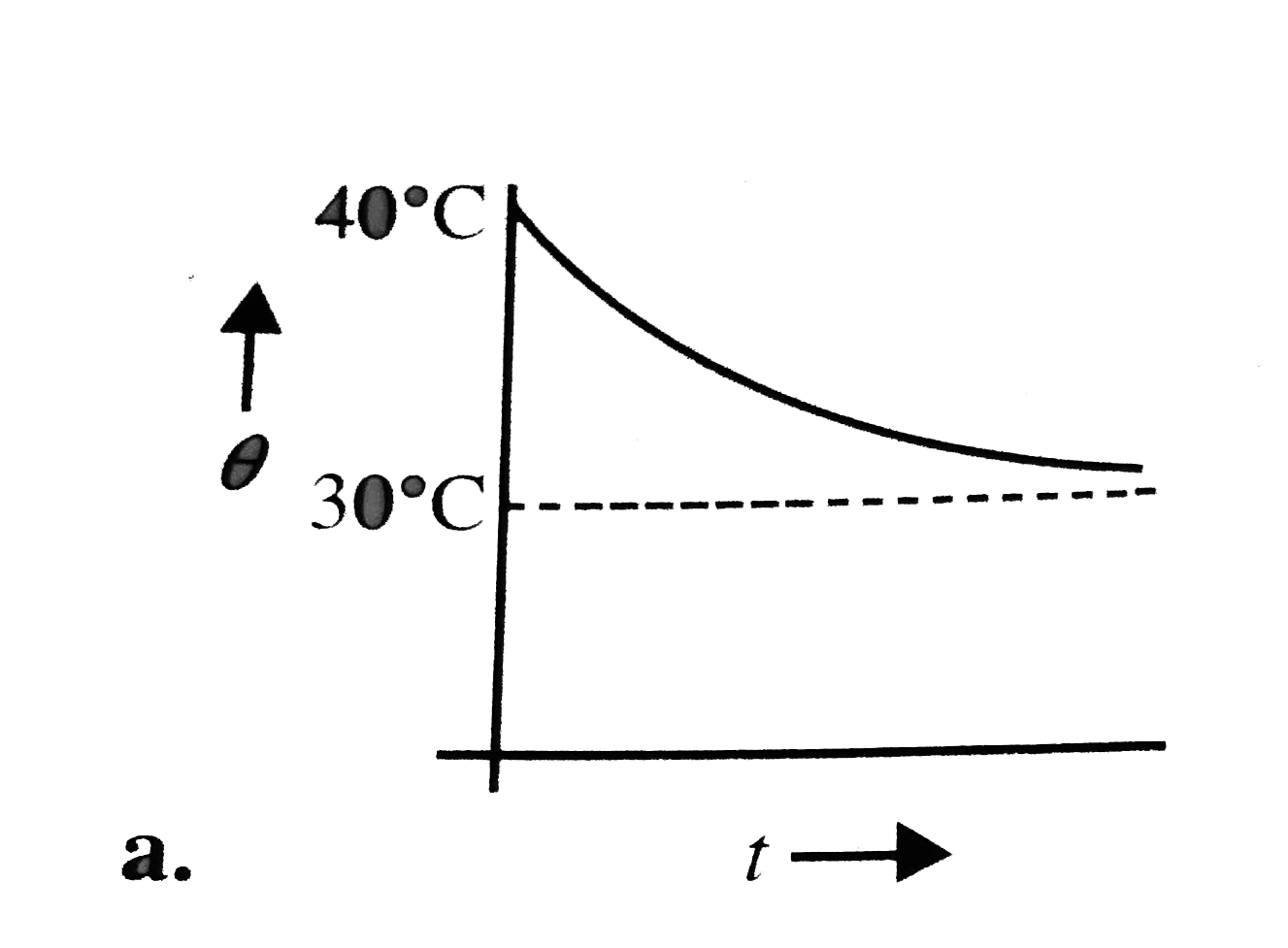
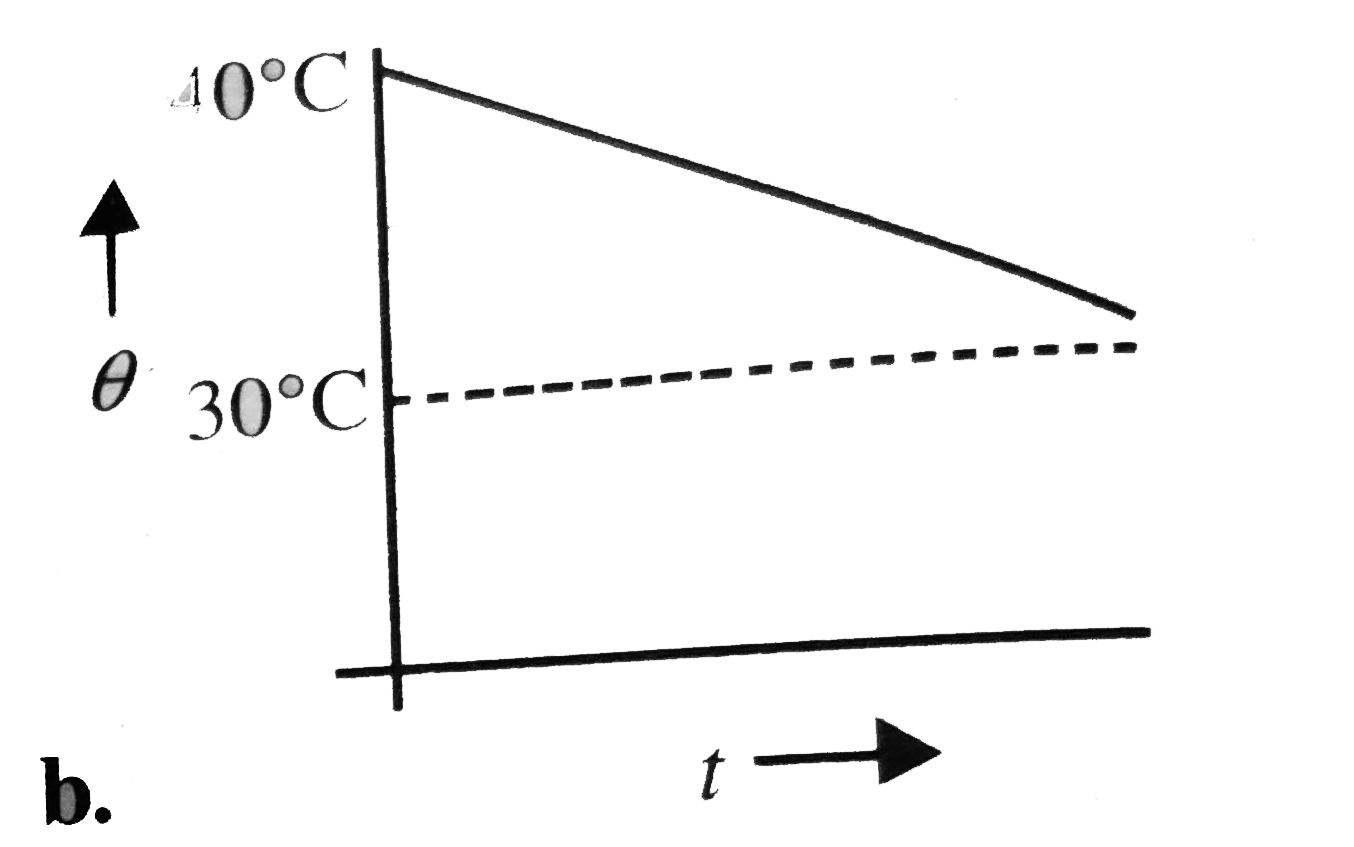
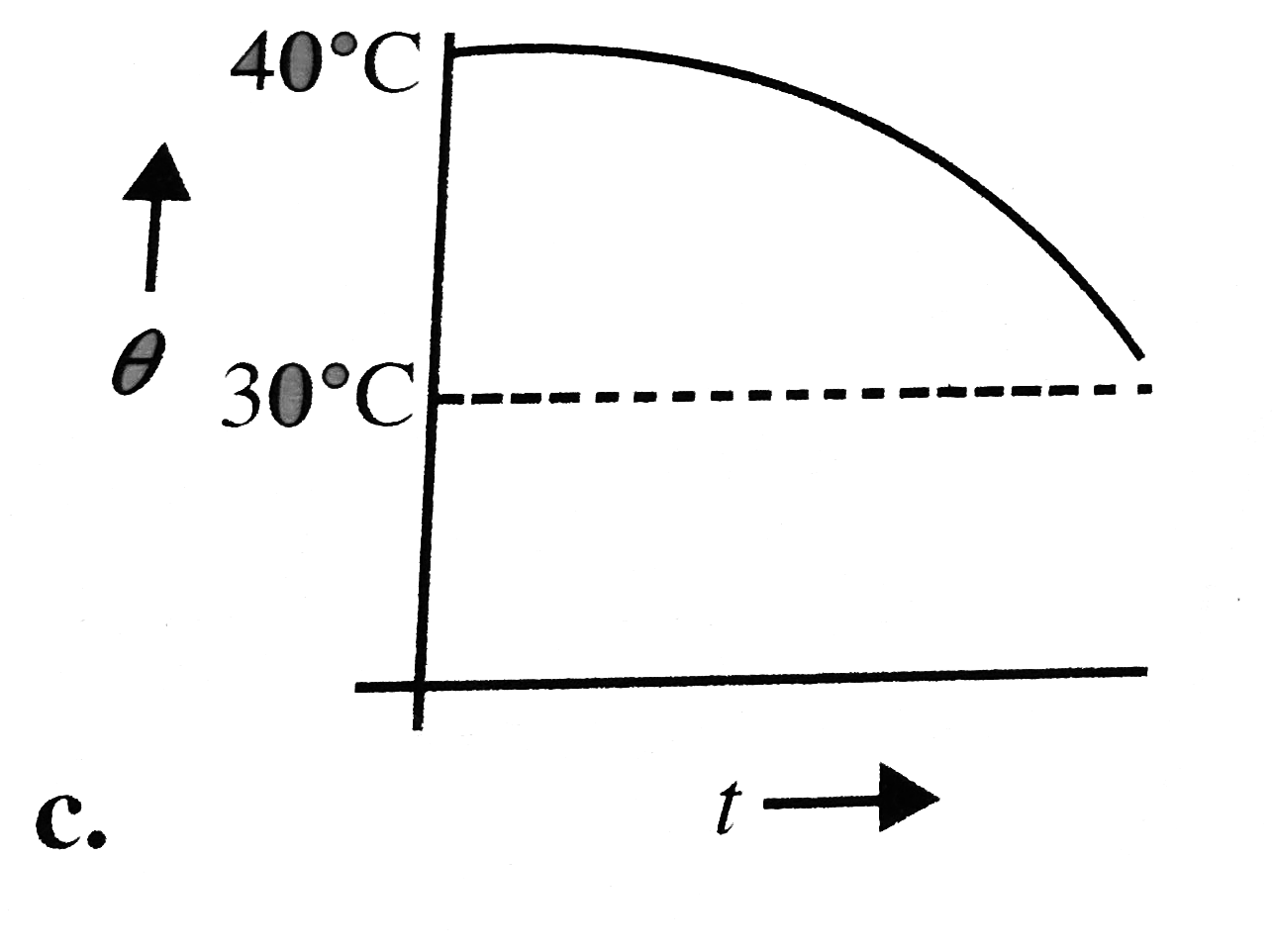
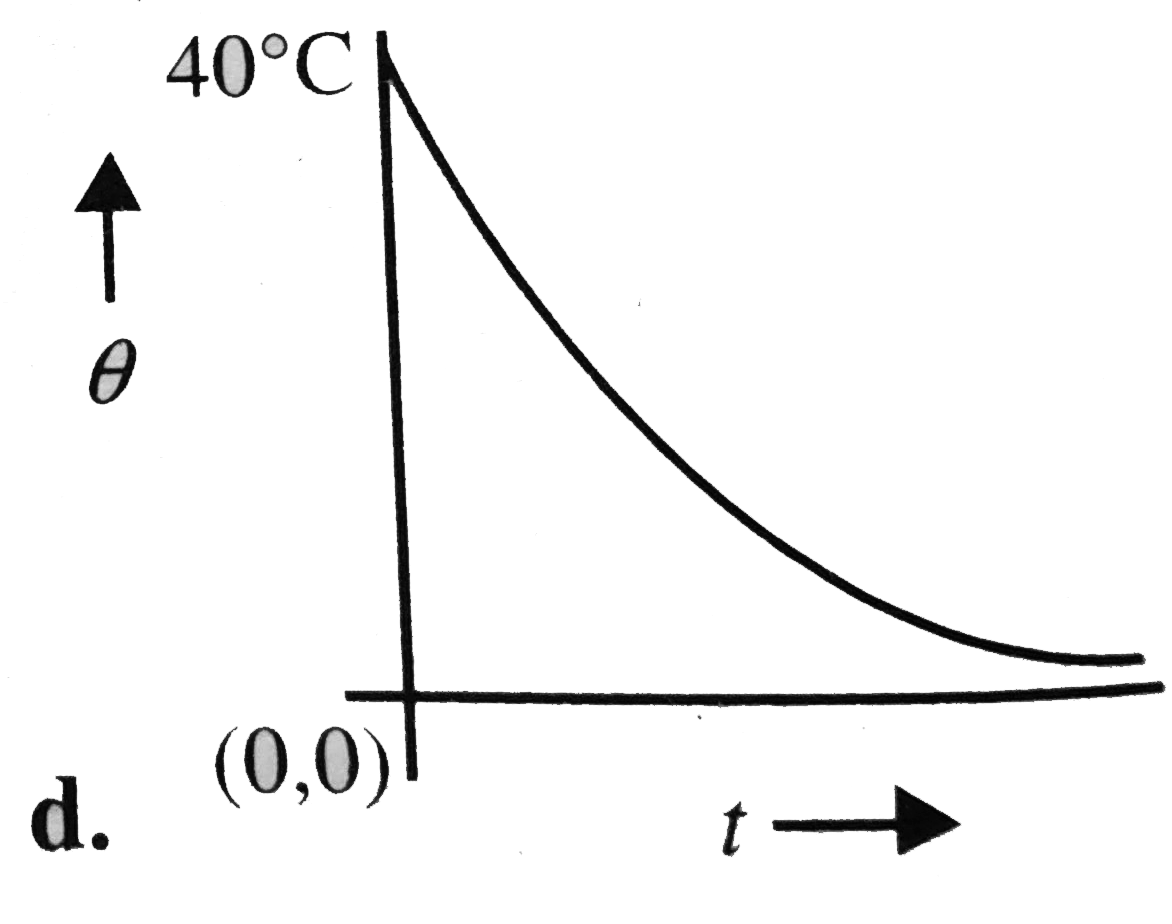
The temperature of the body In `.^@C` denoted by `theta`. The veriation of `theta` versus time t is best denoted as

A

B

C

D

Text Solution

AI Generated Solution

The correct Answer is:

To solve the problem, we will use Newton's Law of Cooling, which states that the rate of change of temperature of an object is proportional to the difference between its own temperature and the ambient temperature surrounding it. ### Step-by-Step Solution: 1. **Identify Given Data:** - Surrounding temperature, \( T_s = 30^\circ C \) - Heat capacity of the body, \( C = 2 \, J/^\circ C \) - Initial temperature of the body, \( \theta_1 \) (unknown) - Final temperature of the body after 10 minutes, \( \theta_2 = 38^\circ C \) - Time, \( t = 10 \, minutes = 600 \, seconds \) 2. **Apply Newton's Law of Cooling:** According to Newton's Law of Cooling, we can express the change in temperature over time as: \[ \frac{d\theta}{dt} = -k(\theta - T_s) \] where \( k \) is the cooling constant. 3. **Integrate the Equation:** Rearranging gives: \[ \frac{d\theta}{\theta - T_s} = -k \, dt \] Integrating both sides, we get: \[ \ln|\theta - T_s| = -kt + C \] where \( C \) is the integration constant. 4. **Solve for the Constant:** At \( t = 0 \), let \( \theta = \theta_1 \): \[ \ln|\theta_1 - T_s| = C \] So, we have: \[ \ln|\theta - T_s| = -kt + \ln|\theta_1 - T_s| \] 5. **Find the Cooling Constant \( k \):** At \( t = 600 \, seconds \), \( \theta = 38^\circ C \): \[ \ln|38 - 30| = -600k + \ln|\theta_1 - 30| \] Simplifying gives: \[ \ln(8) = -600k + \ln|\theta_1 - 30| \] 6. **Relate Initial and Final Temperatures:** Rearranging gives: \[ \ln|\theta_1 - 30| = \ln(8) + 600k \] Thus, we can express \( \theta_1 \) in terms of \( k \): \[ \theta_1 = 30 + 8e^{600k} \] 7. **Determine the Nature of the Graph:** The temperature \( \theta \) decreases over time and approaches the surrounding temperature \( T_s \). The graph of \( \theta \) versus \( t \) will be a curve that starts at \( \theta_1 \) and approaches \( T_s \) asymptotically. 8. **Conclusion:** The variation of \( \theta \) versus \( t \) is best represented as a decreasing curve that flattens out as it approaches \( 30^\circ C \). ### Final Answer: The variation of \( \theta \) versus time \( t \) is best denoted by a decreasing curve that approaches \( 30^\circ C \).

To solve the problem, we will use Newton's Law of Cooling, which states that the rate of change of temperature of an object is proportional to the difference between its own temperature and the ambient temperature surrounding it. ### Step-by-Step Solution: 1. **Identify Given Data:** - Surrounding temperature, \( T_s = 30^\circ C \) - Heat capacity of the body, \( C = 2 \, J/^\circ C \) - Initial temperature of the body, \( \theta_1 \) (unknown) ...
Promotional Banner

Topper's Solved these Questions

  • CALORIMETRY

    CENGAGE PHYSICS ENGLISH|Exercise Integer|8 Videos
  • CALORIMETRY

    CENGAGE PHYSICS ENGLISH|Exercise Solved Example|13 Videos
  • CALORIMETRY

    CENGAGE PHYSICS ENGLISH|Exercise Multiple Correct|25 Videos
  • BASIC MATHEMATICS

    CENGAGE PHYSICS ENGLISH|Exercise Exercise 2.6|20 Videos
  • CENTRE OF MASS

    CENGAGE PHYSICS ENGLISH|Exercise INTEGER_TYPE|1 Videos

Similar Questions

Explore conceptually related problems

A body cools in a surrounding of constant temperature 30^@C Its heat capacity is 2 J//^(@)C . Initial temperature of cooling is valid. The body of mass 1 kg cools to 38^@C in 10 min When the body temperature has reached 38^@C , it is heated again so that it reaches 40^@C in 10 min. The heat required from a heater by the body is

A body cools in a surrounding of constant temperature 30^@C Its heat capacity is 2 J//^(@)C . Initial temeprature of cooling is 40^@C and assuming newtons law of cooling is valid. The body cools to 38^@C in 10 min In further 10 min it will cools from 38^@C to _____

A body cools in a surrounding of constant temperature 30^(@)C . Its heat capacity is 2J//^(@)C . Initial temperature of the body is 40^(@)C . Assume Newton's law of cooling is valid. The body cools to 36^(@)C in 10 minutes. In further 10 minutes it will cool from 36^(@)C to :

A body having mass 2 Kg cools in a surrounding of constant temperature 30^(@)C . Its heat capacity is 2J//^(@)C . Initial temperature of the body is 40^(@)C . Assume Newton's law of cooling is valid. The body cools to 36^(@)C in 10 minutes. When the body temperature has reached 36^(@)C . it is heated again so that it reaches to 40^(@)C in 10 minutes. Assume that the rate of loss of heat at 38^(@)C is the average rate of loss for the given time . The total heat required from a heater by the body is :

A body cools from 50^@C " to " 40^@C in 5 min. If the temperature of the surrounding is 20^@C , the temperature of the body after the next 5 min would be

A body at temperature 40^(@)C is kept in a surrounding of constant temperature 20^(@)C . It is observed that its temperature falls to 35^(@)C in 10 minutes. Find how much more time will it taken for the body to attain a temperature of 30^(@)C .

A body takes 10 min to cool douwn from 62^@C to 50^@C . If the temperature of surrounding is 26^@C then in the next 10 minutes temperature of the body will be

A body cools from 50^@C to 40^@C in 5 mintues in surrounding temperature 20^@C . Find temperature of body in next 5 mintues.

A body is heated to a temperature 40^(@)C and kept in a chamber maintained at 20^@C . If the temperature of the body decreases to 36^@C in 2 minutues, then the time after which the temperature will further decrease by 4^@C , is

A body cools in 7 min from 60^@C to 40^@C What will be its temperature after the next 7 min? The temperature of surroundings is 10^@C .

CENGAGE PHYSICS ENGLISH-CALORIMETRY-Comprehension
  1. A body cools in a surrounding of constant temperature 30^@C Its heat c...

    Text Solution

    |

  2. A body cools in a surrounding of constant temperature 30^@C Its heat c...

    Text Solution

    |

  3. A body cools in a surrounding of constant temperature 30^@C Its heat c...

    Text Solution

    |

  4. The internal energy of a solid also increases when heat is transferred...

    Text Solution

    |

  5. The internal energy of a solid also increases when heat is transferred...

    Text Solution

    |

  6. The internal energy of a solid also increases when heat is transferred...

    Text Solution

    |

  7. A wire of length 1 m and radius 10^-3m is carrying a heavy current and...

    Text Solution

    |

  8. A wire of length 1 m and radius 10^-3m is carrying a heavy current and...

    Text Solution

    |

  9. A wire of length 1 m and radius 10^-3m is carrying a heavy current and...

    Text Solution

    |

  10. Assume that the thermal conductivity of copper is twice that of alumin...

    Text Solution

    |

  11. Assume that the thermal conductivity of copper is twice that of alumin...

    Text Solution

    |

  12. Assume that the thermal conductivity of copper is twice that of alumin...

    Text Solution

    |

  13. A thin copper rod of uniform cross section A square metres and of leng...

    Text Solution

    |

  14. A thin copper rod of uniform cross section A square metres and of leng...

    Text Solution

    |

  15. A thin copper rod of uniform cross section A square metres and of leng...

    Text Solution

    |

  16. An immersion heater, in an insulated vessel of negligible heat capacit...

    Text Solution

    |

  17. An immersion heater, in an insulated vessel of negligible heat capacit...

    Text Solution

    |

  18. An immersion heater, in an insulated vessel of negligible heat capacit...

    Text Solution

    |

  19. A body of area 0.8xx10^-2m^2 and mass 5xx10^-4kg directly faces the su...

    Text Solution

    |

  20. A body of area 0.8xx10^(-2) m^(2) and mass 5xx10^(-4) kg directly face...

    Text Solution

    |
