Home
Class 11
PHYSICS
A quantity of gas occupies an initial vo...

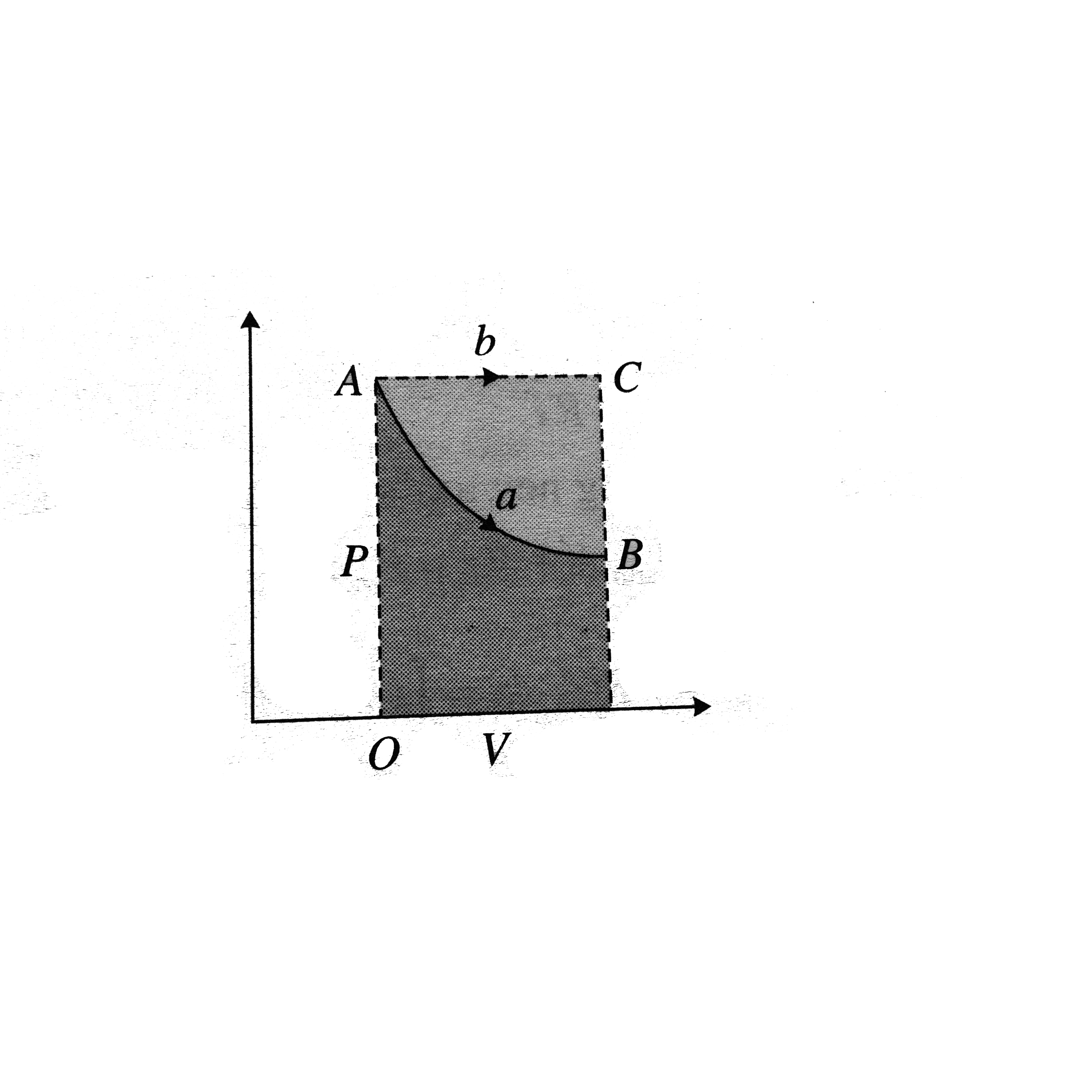
A quantity of gas occupies an initial volume `V_(0)` at pressure `p_(0)` and temperature `T_(0)`. It expands to a volume V (a) constant temperature and (b) constant pressure. In which case does the gas do more work ?

Text Solution

Verified by Experts

The work done is givne by the area between the P-V plot and the V-axis. Here, the area between the P-V plot and the V-axis is less in the case (a) than in the case (b). Hence, the work done at constant pressure is greater than the work done at constant temperature.
Promotional Banner

Topper's Solved these Questions

  • KINETIC THEORY OF GASES AND FIRST LAW OF THERMODYNAMICS

    CENGAGE PHYSICS ENGLISH|Exercise Solved Examples|14 Videos
  • KINETIC THEORY OF GASES AND FIRST LAW OF THERMODYNAMICS

    CENGAGE PHYSICS ENGLISH|Exercise Exercise 2.1|20 Videos
  • KINETIC THEORY OF GASES

    CENGAGE PHYSICS ENGLISH|Exercise Compression|2 Videos
  • LINEAR AND ANGULAR SIMPLE HARMONIC MOTION

    CENGAGE PHYSICS ENGLISH|Exercise Single correct anwer type|14 Videos

Similar Questions

Explore conceptually related problems

A sample of an ideal gas occupies a volume V at pressure P and absolute temperature T. The masss of each molecule is m, then the density of the gas is

Two moles of an ideal monoatomic gas occupy a volume 2V at temperature 300K, it expands to a volume 4V adiabatically, then the final temperature of gas is

At constant volume , pressure and temperature are related (T_0 = " STP temp.")

One mole of an ideal gas at pressure P_(0) and temperature T_(0) is expanded isothermally to twice its volume and then compressed at constant pressure to (V_(0) // 2) and the gas is brought bac to original state by a process in which P alpha V (pressure is directly proportional to volume). The correct temperature of the process is

Three moles of an ideal gas (C_p=7/2R) at pressure p_0 and temperature T_0 is isothermally expanded to twice its initial volume. It is then compressed at a constant pressure to its original volume. (a) Sketch p-V and p-T diagram for complete process. (b) Calculate net work done by the gas. (c) Calculate net heat supplied to the gas during complete process. (Write your answer in terms of gas constant =R)

Three moles of an ideal gas at a pressure P_(A) and temperature T_(A) is isothermally expanded to twice its initial volume. It is then compressed at constant pressure to its original , volume. Finally the gas is compressed at constant volume to its original pressure P_(A) (a) Sketch the P-V and P-T diagrams for the complete process. (b) Calculate the net work done by the gas, and net heat supplied to the gas during the complete process.

A sample of an ideal gas has pressure p_(0) , volume V_(0) and tempreture T_(0) . It is isothermally expanded to twice its oringinal volume.it is then compressed at constant pressure to have the original volume V_(0) . Finally, the gas is heated at constant volume to get the original tempreture.(a) show the process in a V-T diagram (b) calculate the heat absorbed in the process.

A vessel of volume V_(0) contains an ideal gas at pressure p_(0) and temperature T. Gas is continuously pumped out of this vessel at a constant volume-rate dV/dt=r keeping the temperature constant, The pressure inside the vessel. Find (a) the pressure of the gas as a function of time,(b) the time taken before half the original gas is pumped out.

A gas is found to obey the law P^(2)V = constant . The initial temperature and volume are T_(0) and V_(0) . If the gas expands to a volume 3 V_(0) , its final temperature becomes

Three moles of an ideal gas (C_p=7/2R) at pressure, P_A and temperature T_A is isothermally expanded to twice its initial volume. It is then compressed at constant pressure to its original volume. Finally gas is compressed at constant volume to its original pressure P_A . (a) Sketch P-V and P-T diagrams for the complete process. (b) Calculate the net work done by the gas, and net heat supplied to the gas during the complete process.
