Home
Class 11
PHYSICS
A sample of ideal gas is expanded to twi...

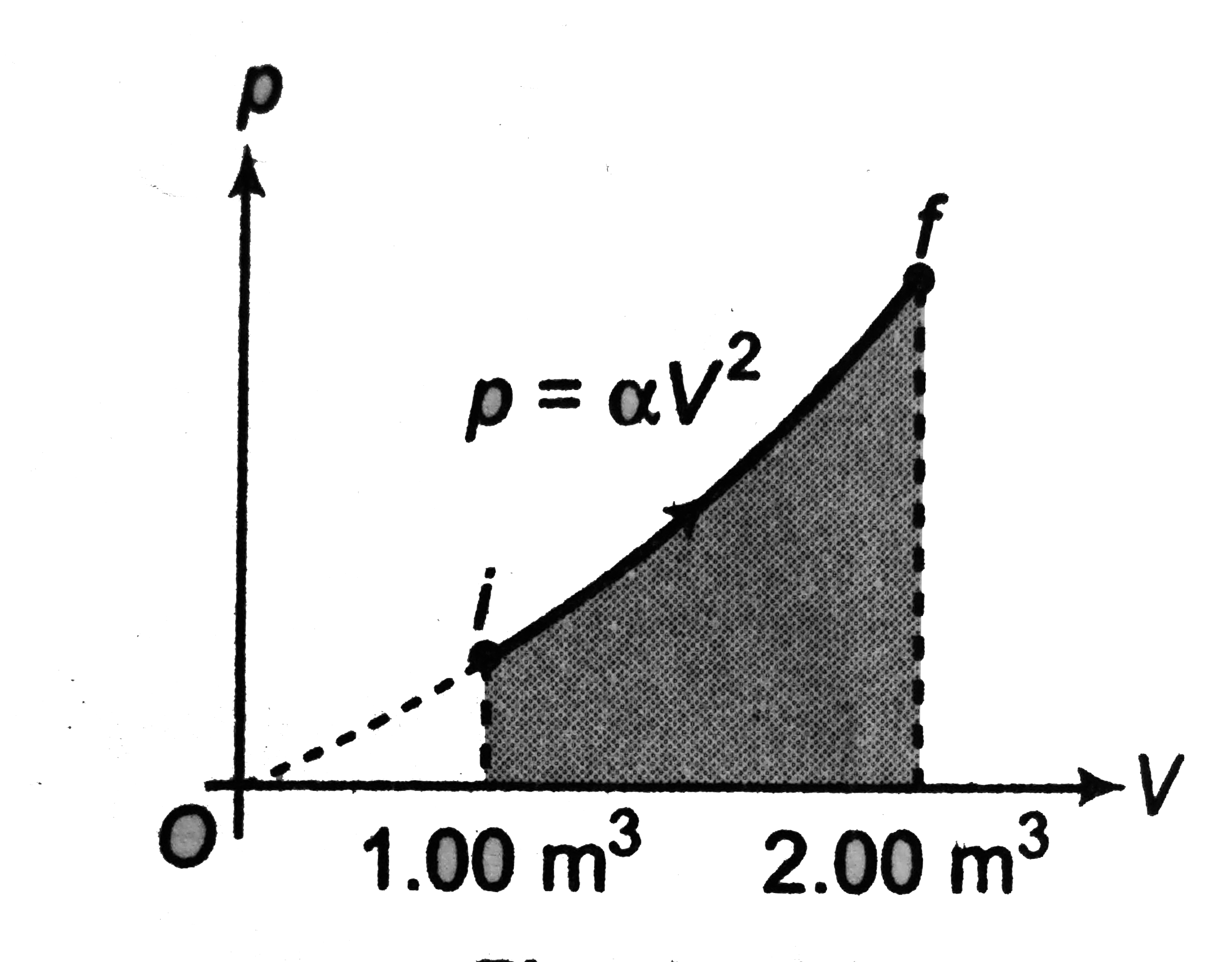
A sample of ideal gas is expanded to twice its original volume of `1.00m^3` in a quasi-static process for which `p=alphaV^2`, with `alpha=5.00 atm//m^6`, as shown in Fig. How much work is done by the expanding gas?

Text Solution

Verified by Experts

The final pressure is `5 xx 4 = 20 atm = 2 MP a`.
The work done on the gas is the negative of the area under the curve `P = alpha V^(2)` From `V_(i)` to `V_(f)`. The work on the gas is negative, which means that the expanding gas does positive work. We find its value as
`W = - int_(i)^(f) PdV` with `V_(f) = 2V_(i) = 2(1.00 m^(3)) = 2.00 m^(3)`
`W = int_(v_(i))^(v^(f)) alpha V^(2) dV = - (1)/(3) alpha (V_(f)^(3) - V_(i)^(3))`
`W = - (1)/(5) (5.00 atm//m^(6)) (1.013 xx 10^(5) Pa//atm)`
`xx [(2.00 m^(3))^(3) - (1.00 m^(3))^(3)]`
`= 1.18 xx 10^(6) J`
One estimate was good. To do the integal of PdV, we start by indenifying how P depends on V, just as to do the integal of ydx in mathematics you start by identifying how y depends on x.
Promotional Banner

Topper's Solved these Questions

  • KINETIC THEORY OF GASES AND FIRST LAW OF THERMODYNAMICS

    CENGAGE PHYSICS ENGLISH|Exercise Solved Examples|14 Videos
  • KINETIC THEORY OF GASES AND FIRST LAW OF THERMODYNAMICS

    CENGAGE PHYSICS ENGLISH|Exercise Exercise 2.1|20 Videos
  • KINETIC THEORY OF GASES

    CENGAGE PHYSICS ENGLISH|Exercise Compression|2 Videos
  • LINEAR AND ANGULAR SIMPLE HARMONIC MOTION

    CENGAGE PHYSICS ENGLISH|Exercise Single correct anwer type|14 Videos

Similar Questions

Explore conceptually related problems

A sample of an ideal gas is expanded to twice its original volume of 1m^(3) in a reversible process for which P = alphaV^(2) , where alpha = 5 atm m^(-6) . If C_(V,m) = 20 J mol^(-1)K^(-1) , determine moalr change in entropy (DeltaS_(m)) for the process.

An ideal gas is taken through a quasi-static process described by P = alphaV^(2) , with alpha = 5.00 atm//m^(6) . The gas is expanded to twice its original volume of 1.00 m^(3) . How much work is done by the gas in expanding gas in this process?

A sample of an ideal gas is expanded 1 m^(3) to 3 m^(3) in a reversible process for which P=KV^(2) , with K=6 "bar"//m^(6). What is work done by the gas (in kJ) ?

A sample of an ideal gas is expanded from 1 dm^(3) to 3 in a reversible process for which P=KV^(3) , with K=1//5 (atm//dm^(3)) , what is work done by gas (L atm)

One mole of an ideal gas is expanded from a volume of 3L to 5L under a constant pressure of 1 atm. Calculate the work done by the gas.

Two litres of an ideal gas at a pressure of 10 atm expands isothermally at 25^(@)C into a vacuum until its total volume is 10 litres. How much heat is absorbed and how much work is done in the expansion ?

Two litres of an ideal gas at a pressure of 10 atm expands isothermally at 25^(@)C into a vacuum until its total volume is 10 litres. How much heat is absorbed and how much work is done in the expansion ?

In a flexible balloon 2, moles of SO_2 having an initial volume of 1 kL at a temperature of 27.^@C is filled . The gas is first expanded to thrice its initial volume isobarically and then further expanded adiabatically so as to attain its initial temperature . Assuming the gas to be ideal , the work done by the gas in the whole process is [gammaSO_2=4/3,R=25/3J mol ^(-1) K^(-1)]

Three moles of an ideal gas are expanded isothermally and reversibly at 27^(@)C to twice its original volume. Calculate q, w, and DeltaU .

5 mole of an ideal gas of volume is expanded against vaccum to make its volume 2 times, then work done by the gas is:
