Home
Class 11
PHYSICS
A cylindrical container having non-condu...

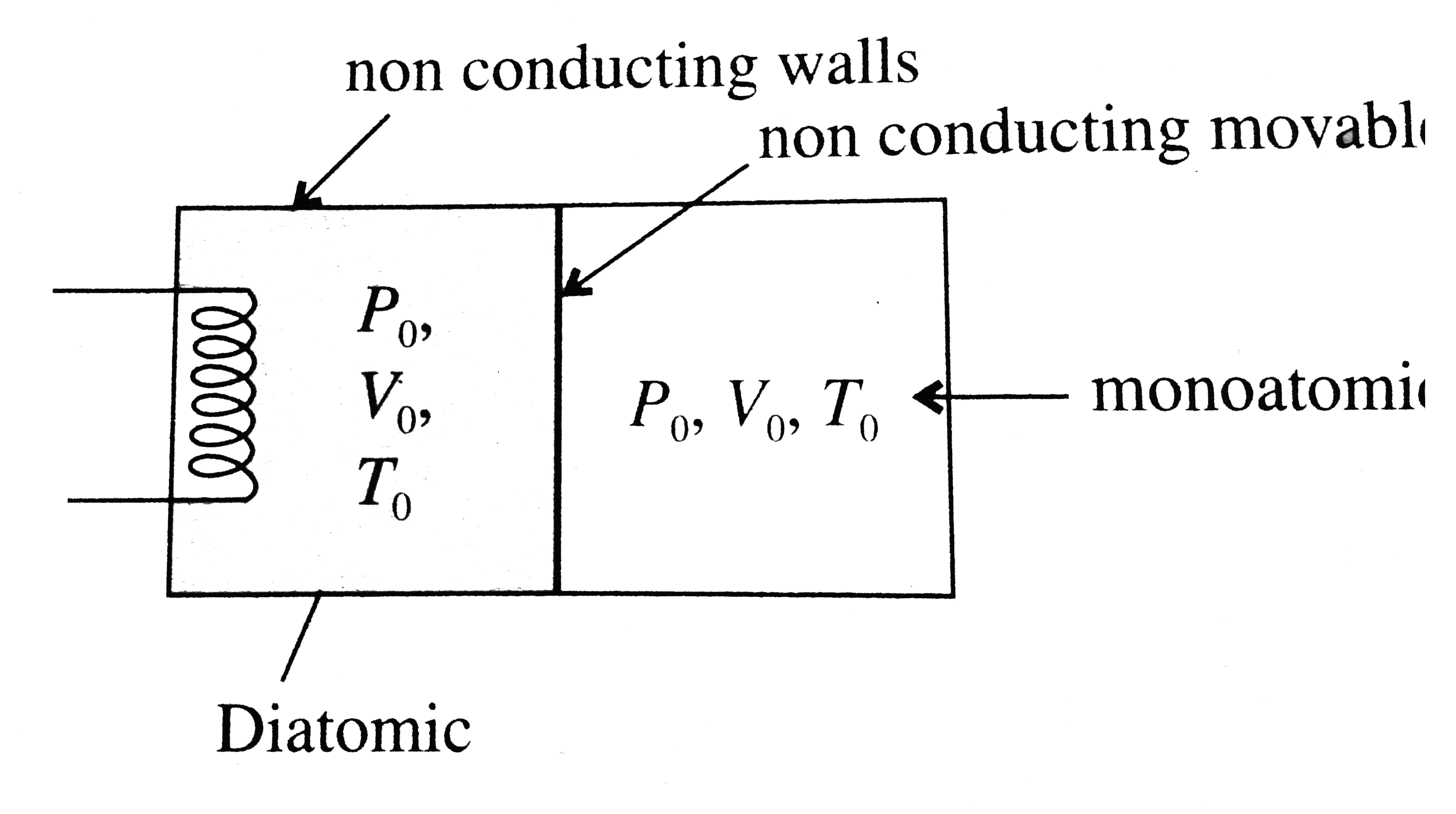
A cylindrical container having non-conducting walls is partitioned in two equal parts such that the volume of the each parts is eqaul to `V_(0)` A movable non-conducting piston is kept between the two parts. Gas on left is slowly heated so that the gas on right is compressed upto volume `V_(0)//8`. Find pressure and temperature on both sides if initial pressure and temperature, were `P_(0)` and `T_(0)` respectively. Also find heat given by the heater to the gas (number of moles in each parts is n)

Text Solution

Verified by Experts

Since the process on the right is adiabatic therefore
`PV^(gamma)` = constant
`implies P_(0) V_(0)^(gamma) = P_("final ") ((V_(0))/(8))^(gamma) implies P_("final") = 32 P_(0)`
`T_(0) V_(0)^(gamma - 1) = T_("final") ((V_(0))/(8))^(gamma -1) implies T_("final" = 4 T_(0)`
Let volume of the left part is `V_(1)`
`implies 2V_(0) = V_(1) + (V_(0))/(8) implies V_(1) = (15 V_(0))/(8)`
Since number of moles on the left parts remains constant therefore the left part `(PV)/(T)` = constant.
Final pressure on both sides will be same
`implies (P_(0) V_(0))/(T_(0)) = (P_("final") V_(1))/(T_("final")) implies T_("final") = 60 T_(0)`
`Delta Q = Delta u + Delta W`
`Delta Q = (5 R)/(2) (60 t_(0) - T_(0)) + n (3R)/(2) (4T_(0) - T_(0))`
`Delta Q = (5 nR)/(2) xx 59 T_(0) + (3 nR)/(2) xx 3T_(0)`
Promotional Banner

Topper's Solved these Questions

  • KINETIC THEORY OF GASES AND FIRST LAW OF THERMODYNAMICS

    CENGAGE PHYSICS ENGLISH|Exercise Solved Examples|14 Videos
  • KINETIC THEORY OF GASES AND FIRST LAW OF THERMODYNAMICS

    CENGAGE PHYSICS ENGLISH|Exercise Exercise 2.1|20 Videos
  • KINETIC THEORY OF GASES

    CENGAGE PHYSICS ENGLISH|Exercise Compression|2 Videos
  • LINEAR AND ANGULAR SIMPLE HARMONIC MOTION

    CENGAGE PHYSICS ENGLISH|Exercise Single correct anwer type|14 Videos

Similar Questions

Explore conceptually related problems

A monoatomic gas is enclosed in a non-conducting cylinder having a piston which can move freely. Suddenly gas is compressed to 1//8 of its initial volume. Find the final pressure and temperature if initial pressure and temperature are P_(0) and T_(0) respectively.

A monoatomic gas is enclosed in a nonconducting cylinder having a piston which can move freely. Suddenly gas is compressed to 1//8 of its initial volume. Find the final pressure and temperature if initial pressure and temperature are P_(0) and T_(0) respectively.

Ten moles of a diatomic perfect gas are allowed to expand at constant pressure. The initial volume and temperature are V_0 and T_0 respectively. If 7/2RT_0 heat is transferred to the gas, then the final volume and temperature are

A non-conducting cylinder having volume 2 V_(0) is partitioned by a fixed non conducting wall in two equal part. Partition is attached with a valve. Right side of the partition is a vacuum and left part is filled with a gas having pressure and temperature P_(0) and T_(0) respectively. If valve is opened find the final pressure and temperature of the two parts.

A nonconducting cylinder having volume 2 V_(0) is partitioned by a fixed non conducting wall in two equal part. Partition is attached with a valve. Right side of the partition is a vacuum and left part is filled with a gas having pressure and temperature P_(0) and T_(0) respectively. If valve is opened find the final pressure and temperature of the two parts.

An ideal gas is found to obey the law V^2T = constant . The initial pressure and temperature are P_0 and T_0 . If gas expands such that its pressure becomes (P_0)/4 , then the final temperature of the gas will be

If a gas of a volume V_(1) at pressure p_(1) is compressed adiabatically to volume V_(2) and pressure p_(2) , calculate the work done by the gas.

The pressure P, Volume V and temperature T of a gas in the jar A and the other gas in the jar B at pressure 2P , volume V//4 and temperature 2 T , then the ratio of the number of molecules in the jar A and B will be

A cylindrical vessel made of thermally insulating material is divided into two equal parts by an insulating and. Movable piston. Both parts contain ideal monoatomic gas . The gas in the left part is supplied heat such that the volume of right part becomes one-eight of its initial volume . Work done by the gas in the right part is

A quantity of gas occupies an initial volume V_(0) at pressure p_(0) and temperature T_(0) . It expands to a volume V (a) constant temperature and (b) constant pressure. In which case does the gas do more work ?
