Home
Class 11
PHYSICS
A reversible heat engine carries 1 mole ...

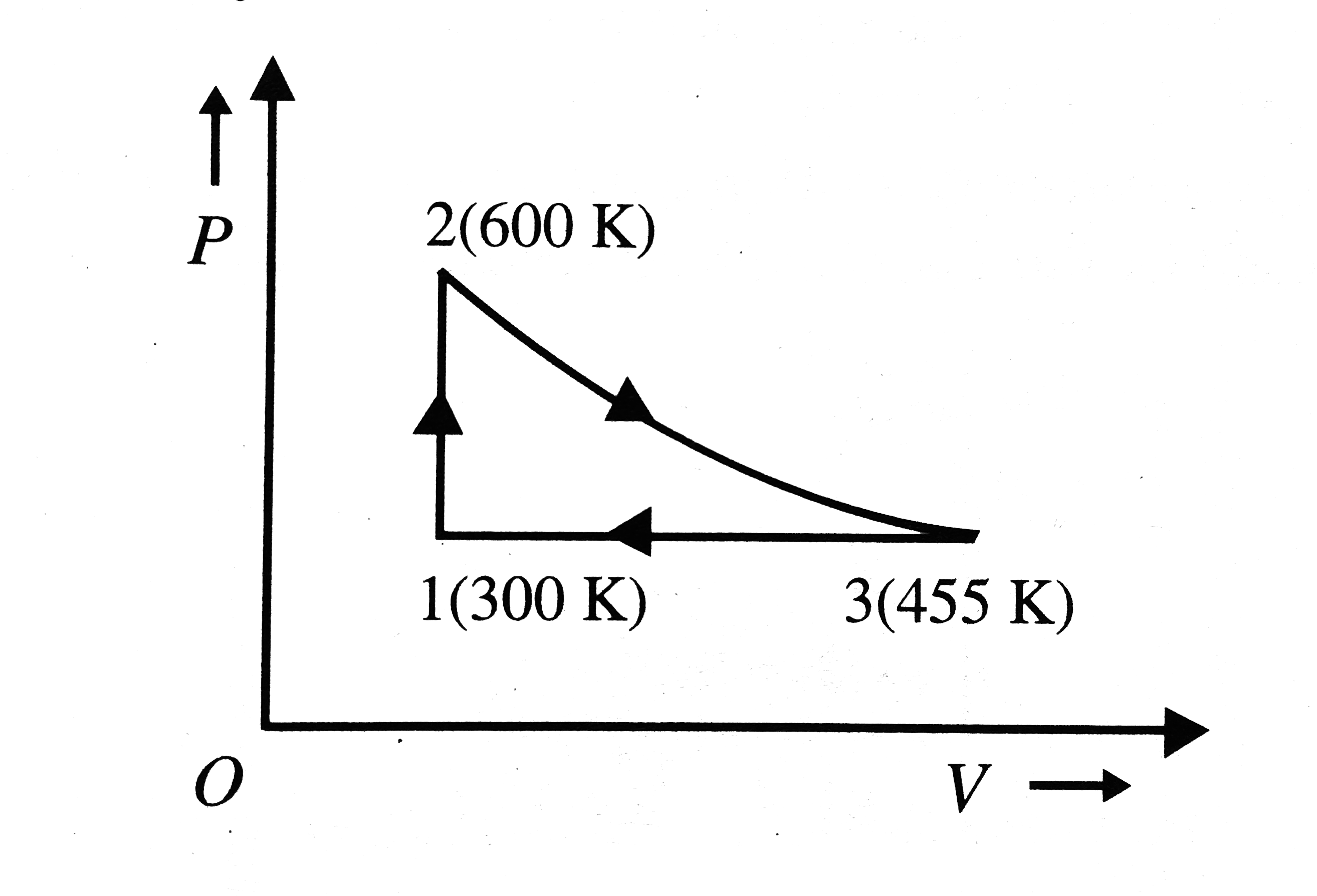
A reversible heat engine carries 1 mole of an ideal monatomic gas around the cycle 1-2-3-1. Process 1-2 takes place at constant volume, process 2-3 is adiabatic, and process 3-1 takes place at constant pressure. Complete the values for the heat `Delta Q`, the change in internal energy `Delta U`, and the work done `Delta `, for each of the three processes and for the cycle as a whole.

Text Solution

Verified by Experts

For the process 1-2, we have `Delta W = 0` (since volume ramains constant)
`Delta U = C, Delta T = (R )/(gamma - 1) Delta T = (8.3)/(((3)/(3))-1) xx (600 - 300) = 3735 J`
For the process 2-3 we have `Delta Q = 0` (since the process is adiabatic)
`Delta W = (p_(1) V_(1) - p_(2) V_(2))/(gamma - 1) = (R (T_(1) - T_(2)))/((gamma - 1)) = (8.3 (600 - 455))/(((5)/(3))- 1) = 1895 J`
`Delta U = Delta Q - Delta W = 0 - 1805 = - 1805 J`
For the process 3-1, we have `Delta Q = C_(P) Delta T = (gamma R)/((gamma - 1)) xx Delta T`
or `Delta Q = (((5)/(3)) xx 8.3)/(((5)/(3))) xx (300 - 455) = - 3216 J`
`Delta U = C_(V) Delta T = (R )/((gamma - 1)) Delta T = (8.3)/(((5)/(3)) -1) (300 - 455) = - 1286 J`
`Delta W = Delta Q - Delta U = - 3116 - (- 1930) = - 1286 J`
Promotional Banner

Topper's Solved these Questions

  • KINETIC THEORY OF GASES AND FIRST LAW OF THERMODYNAMICS

    CENGAGE PHYSICS ENGLISH|Exercise Solved Examples|14 Videos
  • KINETIC THEORY OF GASES AND FIRST LAW OF THERMODYNAMICS

    CENGAGE PHYSICS ENGLISH|Exercise Exercise 2.1|20 Videos
  • KINETIC THEORY OF GASES

    CENGAGE PHYSICS ENGLISH|Exercise Compression|2 Videos
  • LINEAR AND ANGULAR SIMPLE HARMONIC MOTION

    CENGAGE PHYSICS ENGLISH|Exercise Single correct anwer type|14 Videos

Similar Questions

Explore conceptually related problems

A heat engine carries one mole of an ideal mono-atomic gas around the cycle as shown in the figure below. Process 1 rarr 2 takes place at constant volume, process 2 rarr 3 is adiabatic and process 3 rarr 1 takes place at constant pressure. Then the amount of heat added in the process 1 rarr2 is

A reversible heat engine carries 1 mol of an ideal monatomic gas around the cycle ABCA , as shown in the diagram. The process BC is adiabatic. Call the processes AB, BC and CA as 1,2 and 3 and the heat ( DeltaQ)_(r) , change in internal energy (DeltaU) , and work done ( DeltaW)_(r), r=1,2,3 respectively. The temperature at A,B,C are T_(1)=300K,T_(2)=600K and T_(3)=455K . Indicate the pressure and volume at A,B and C by P_(r) and V_(r), r=1,2,3, respectively. Assume that intially pressure P_(1)=1.00atm. Which of the following represents the correct values of the quantities indicated ?

A reversible heat engine carries 1 mol of an ideal monatomic gas around the cycle ABCA , as shown in the diagram. The process BC is adiabatic. Call the processes AB, BC and CA as 1,2 and 3 and the heat ( DeltaQ)_(r) , change in internal energy (DeltaU) , and work done ( DeltaW)_(r), r=1,2,3 respectively. The temperature at A,B,C are T_(1)=300K,T_(2)=600K and T_(3)=455K . Indicate the pressure and volume at A,B and C by P_(r) and V_(r), r=1,2,3, respectively. Assume that intially pressure P_(1)=1.00atm. Which of the following represents the correct values for the quantities indicated ?

One mole of an ideal monatomic gas undergoes a process described by the equation PV^(3) = constant. The heat capacity of the gas during this process is

Two moles of an ideal gas are undergone a cyclic process 1-2-3-1. If net heat exchange in the process is 300J, the work done by the gas in the process 2-3 is

One mole of an ideal monatomic gas undergoes the process P=alphaT^(1//2) , where alpha is constant . If molar heat capacity of the gas is betaR1 when R = gas constant then find the value of beta .

One mole of an ideal monoatomic gas undergoes a cyclic process as shown in figure . Temperature at point 1 = 300K and process 2-3 is isothermal . . Net work done by gas in complete cycle is

Three processes compose a thermodynamic cycle shown in the accompanying P-V , diagram of an ideal gas. Process 1 rarr 2 take place at constant temperature, during this process 60 J of heat enters the system. Process 2 rarr 3 takes place at constant volume. During this process 40 J of heat leaves the system. Process 3 rarr 1 is adiabatic. What is the change in internal energy of the during process 3 rarr 1 ?

Find the molar heat capacity (in terms of R ) of a monoatomic ideal gas undergoing the process: PV^(1//2) = constant ?

Find the molar heat capacity (in terms of R ) of a monoatomic ideal gas undergoing the process: PV^(1//2) = constant ?
