Home
Class 11
PHYSICS
Helium gas goes through a cycle ABCDA (c...

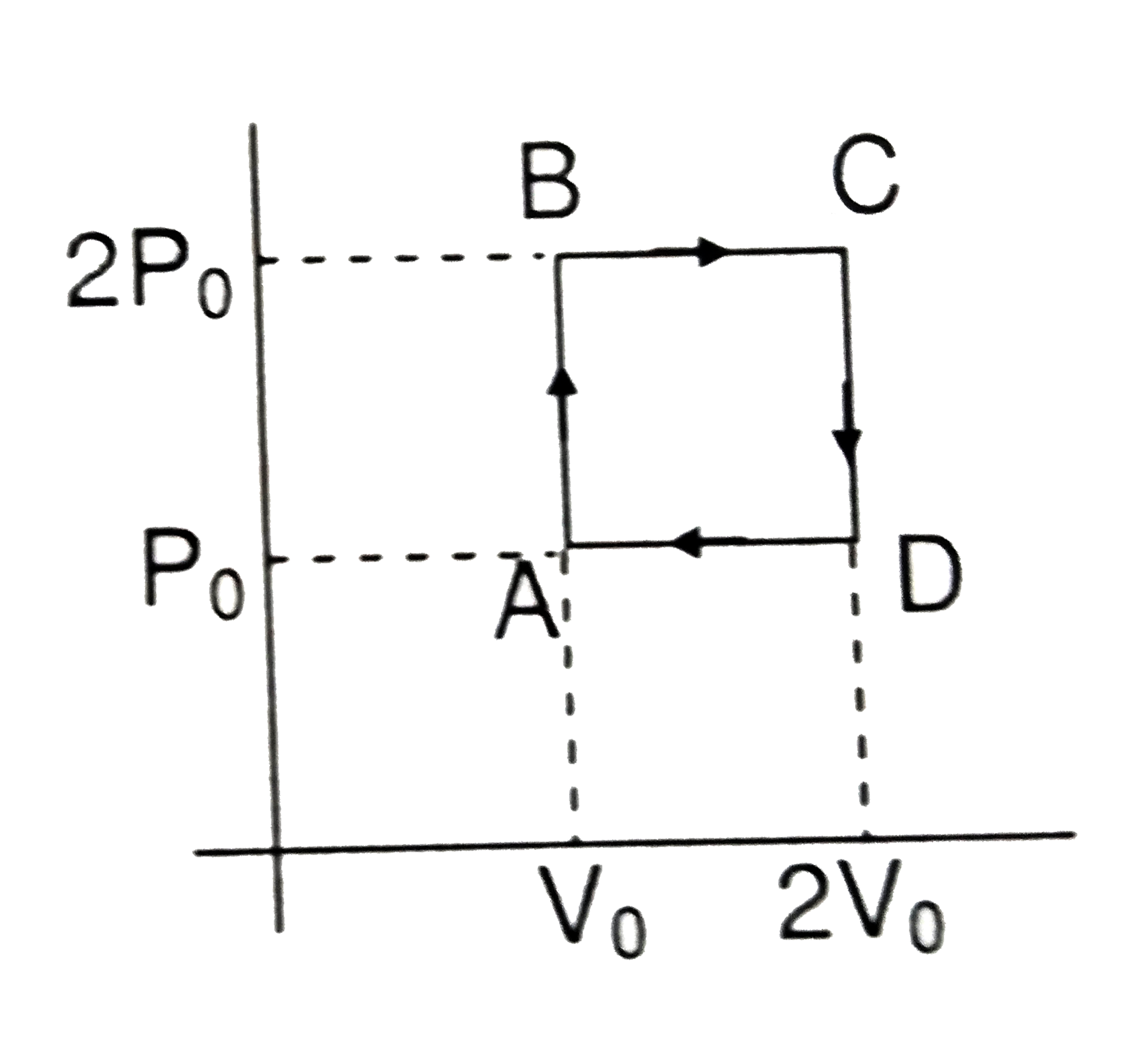
Helium gas goes through a cycle ABCDA (consisting of two isochoric and two isobaric lines) as shown in figure. Efficiency of this cycle is nearly :

Text Solution

Verified by Experts

Evidently, work done by the gas during the cyclic process is
`W = (2P_(0) - P_(0)) (2V_(0) - V_(0))` unit `= P_(0) V_(0)` unit For the process A to B which is iscohoric, the heat supplied will be given by
`Delta Q_(1) = Delta U + Delta W = nC_(V) Delta T + 0`
`= n ((3 R)/(2)) [(V_(0) (2 P_(0) - P_(0)))/(nR)] ( :. nR Delta T = V Delta P)`
`= (3)/(2) P_(0) V_(0)` unit
And for the process B to C which is isobaric, the heat abosrbed will be given by
`Delta Q_(2) = n C_(P) Delta T`
`= n ((5 R)/(2)) [(2 P_(0) (2V_(0) - V_(0)))/(nR)] ( :. nR Delta T = P (Delta V))`
`= 5P_(0) V_(0)` unit
For the processes C to D to A, the heat given will be obviously negative, which implies that heat is abstracted from the system. Therefore, efficiency `(eta)` of the cycle
`= ("Work done per cycle")/("Total heat given per cycle") %`
`= (P_(0) V_(0))/(((3 P_(0) V_(0))/(2)) + 5 P_(0) V_(0)) = (2)/(3) xx 100 = (200)/(13) % = 15.38%`
Promotional Banner

Topper's Solved these Questions

  • KINETIC THEORY OF GASES AND FIRST LAW OF THERMODYNAMICS

    CENGAGE PHYSICS ENGLISH|Exercise Solved Examples|14 Videos
  • KINETIC THEORY OF GASES AND FIRST LAW OF THERMODYNAMICS

    CENGAGE PHYSICS ENGLISH|Exercise Exercise 2.1|20 Videos
  • KINETIC THEORY OF GASES

    CENGAGE PHYSICS ENGLISH|Exercise Compression|2 Videos
  • LINEAR AND ANGULAR SIMPLE HARMONIC MOTION

    CENGAGE PHYSICS ENGLISH|Exercise Single correct anwer type|14 Videos

Similar Questions

Explore conceptually related problems

Helium gas goes through a cycle ABCDA (consisting of two isochoric and isobaric lines) as shown in figure Efficiency of this cycle is nearly: (Assume the gas to be close to ideal gas)

Helium gas goes through a cycle ABCDA (consisting of two isochoric and isobaric lines) as shown in figure Efficiency of this cycle is nearly: (Assume the gas to be close to ideal gas)

An ideal gas is carried through a thermodynamic cycle consisting of two isobaric and two isothermal processes as shown in figure. Show that the net work done in the entire cycle is given by the equation. W_(n et)=p_1(V_2-V_1) In(p_2)/(p_1)

An ideal monoatomic gas is carried around the cycle ABCDA as shown in the figure. The efficiency of the gas cycle is

An ideal monoatomic gas is carried around the cycle ABCDA as shown in the figure. The efficiency of the cycle is ltBrgt

A monoatomic gas undergoes a cycle consisting of two isothermals and two isobarics. The minimum and maximum temperatures of gas during the cycle are T_(1)= 400 K and T_(2)=800 K , respectively, and the ratio of maximum to minimum volume is 4. The efficiency of the cycle is

A monatomic gas undergoes a cycle consisting of two isothermals and two isobarics. The minimum and maximum temperatures of gas during the cycle are T_(1)= 400 K and T_(2)=800 K , respectively, and the ratio of maximum to minimum volume is 4. The heat is extracted from the system in process

A monatomic gas undergoes a cycle consisting of two isothermals and two isobarics. The minimum and maximum temperatures of gas during the cycle are T_(1)= 400 K and T_(2)=800 K , respectively, and the ratio of maximum to minimum volume is 4. The volume at B is

A monatomic gas undergoes a cycle consisting of two isothermals and two isobarics. The minimum and maximum temperatures of gas during the cycle are T_(1)= 400 K and T_(2)=800 K , respectively, and the ratio of maximum to minimum volume is 4. The volume is D is

A sample of 1.0 mol of a monoatomic ideal gas is taken through a cyclic process of expansion and compression as shown in figure. What will be the value of Delta H for the cycle as a whole ?
