Home
Class 11
PHYSICS
One mole of an ideal monatomic gas is ta...

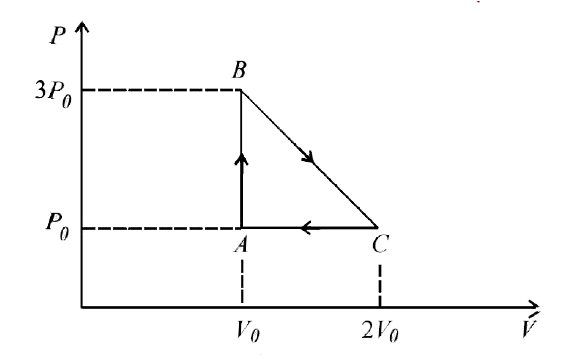
One mole of an ideal monatomic gas is taken round the cyclic process ABCA as shown in figure. Calculate

(a) the work done by the gas.
(b) the heat rejected by the gas in the path CA and the heat absorbed by the gas in the path AB,
(c) the net heat absorbed by the gas in the path BC,
(d) the maximum temperature attained by the gas during the cycle.

Text Solution

Verified by Experts

a. The work done by the gas is equal to the area under the closed curve. Thus, work done in cycle is
`W = (1)/(2) (2 V_(0) - V_(0)) (3 P_(0) - P_(0))`
`= (1)/(2) V_(0) xx 2 P_(0) = P_(0) V_(0)`
b. Heat rejected in path CA is given as
`Q_(CA) = nC_(P) Delta T = nC_(P) (T_(C ) - T_(A))`
`= 1 xx (5//2) R [(P_(0) 2 V_(0))/(R ) - (P_(0) V_(0))/(R )] = (5)/(2) P_(0) V_(0)`
(as n = 1 mole)
Heat absorbed in path AC is
`Q_(AC) = nC_(P) (T_(B) - T_(A))`
`= 1 xx (3)/(2) R xx [(3 P_(0) V_(0))/(R ) - (P_(0) V_(0))/(R )]= 3 P_(0) V_(0)`
For cycle ABC, we have
heat supplied = work done by the gas
or `- ((5)/(2)) P_(0) V_(0) + 3 P_(0) V_(0) + Q_(BC) = P_(0) V_(0)`
Heat supplied to path BC is given by
`Q_(BC) = P_(0) V_(0) + ((5)/(2)) P_(0) V_(0) - 3 P_(0) V_(0) = P_(0) V_(0) //2`
d. We know that `PV//T` = constant. So, when PV is maximum, T is also maximum. PV is maximum for part BC. Hence, temperature will be maximum between B and C.
Let equation of BC be
`P = kV + k'`
satisfying both the point B and C
Fro point C,
`3 P_(0) = V_(0) + k'`
For point C,
`P_(0) = k (2 V_(0)) + k'`
Solving these equations, we get
`k = - 2 (P_(0)//V_(0))` and `k' = 5 P_(0)`
So the equation for time BC is
`P = - 2 ((P_(0))/(V_(0))) xx V + 5 P_(0)`
or `((RT)/(V)) = - ((2 P_(0) V)/(V_(0))) + 5 P_(0)`
or `T = (P_(0))/(R ) [5 V - 2 ((v_(2))/(V_(0)))] = 0`
For maximum, `dT//dV = 0`
So `((dT)/(dV)) = ((P_(0))/(R )) [5 - ((4 V)/(V_(0)))] = 0`
Hence, `5 - ((4 V)/(V_(0))) = 0` or `5 V_(0) - 4 V = 0`
or `V = ((5)/(4)) V_(0)`
Substituting the value fo V from Eq. (ii) in Eq. (i) we get
`Tan_(max) = (P_(0))/(R) [5 xx ((5)/(4) V_(0)) - 2 ((5 V_(0))/(4))^(2) (1)/(V_(0))] = (P_(0))/(R ) [(25 V_(0))/(4) - (25 V_(0))/(8)]`
`= (P_(0))/(R ) xx (25 V_(0))/(8) = (25 P_(0) V_(0))/(8 R)`
Promotional Banner

Topper's Solved these Questions

  • KINETIC THEORY OF GASES AND FIRST LAW OF THERMODYNAMICS

    CENGAGE PHYSICS ENGLISH|Exercise Exercise 2.1|20 Videos
  • KINETIC THEORY OF GASES AND FIRST LAW OF THERMODYNAMICS

    CENGAGE PHYSICS ENGLISH|Exercise Exercise 2.2|28 Videos
  • KINETIC THEORY OF GASES AND FIRST LAW OF THERMODYNAMICS

    CENGAGE PHYSICS ENGLISH|Exercise Interger|11 Videos
  • KINETIC THEORY OF GASES

    CENGAGE PHYSICS ENGLISH|Exercise Compression|2 Videos
  • LINEAR AND ANGULAR SIMPLE HARMONIC MOTION

    CENGAGE PHYSICS ENGLISH|Exercise Single correct anwer type|14 Videos

Similar Questions

Explore conceptually related problems

One mole of an ideal mono-atomic gas is taken round cyclic process ABCD as shown in figure below. Calculate work done by the gas.

One mole of an ideal mono-atomic gas is taken round cyclic process ABC as shown in figure below. Calculate work done

One mole of an ideal mono-atomic gas is taken round cyclic process ABC as shown in figure below. Calculate work done

One mole of ideal monoatmic gas is carried throught the reversible cyclic process as shown in figure. Calculate net heat absorbed by the gas in the path BC

One mole of monoatomic gas is taken round the cyclic process. Heat absorbed by gas in process AB is

One mole of ideal monoatomic gas is taken round the cyclic process as shown in figure. The heat rejected by the gas in the path CA is ………...and the heat absorbed by the gas in the path AB is ………...........

One mole of ideal monatomic gas is carried through the reversible cyclic process as shown in figure. Calculate the max temperature attained by the gas during the cycle.

One mole of a monatomic ideal gas is taken along the cycle ABCA as shown in the diagram. The net heat absorbed by the gas in the given cycle is

One mole of an ideal monoatomic gas is taken along the path ABCA as shown in the PV diagram. The maximum temperature attained by the gas along the path BC is given by :

An ideal monoatomic gas undergoes a cyclic process ABCA as shown in the figure. The ratio of heat absorbed during AB to the work done on the gas during BC id
