Home
Class 11
PHYSICS
Figure shows an ideal gas changing its s...

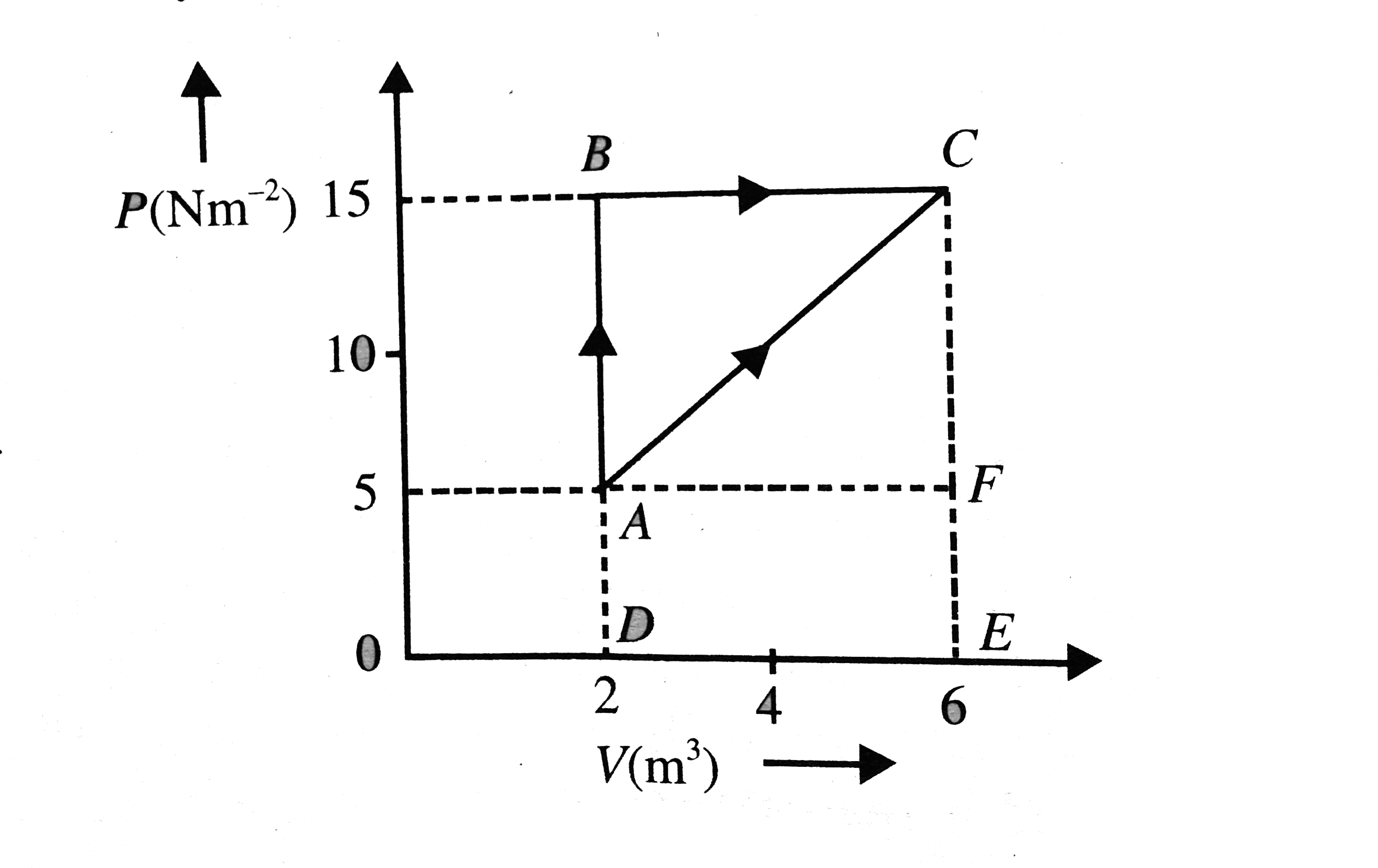
Figure shows an ideal gas changing its state `A` to state `C` by two different path `ABC` and `AC`. The internal energy of the gas at `A` is `10 J` and the amount of heat supplied to change its state to `C` through the path `AC` is `200 J`. Find the internal energy at `C`.

Text Solution

Verified by Experts

Work done in path `AC` by the gas is
`W_(AC) =` area of `ACFEDA`
= area of `ACF +` area of `AFED`
`= (1)/(2) xx (15 - 5) xx (6 - 2) xx 5`
`= 20 + 20 = 40 J`
It is given that heat supplied in process `AC` is
`Q_(AC) = 200 T`
Thus change in intenal energy of gas in path `AC` is, from the first law of thermodynamics, given as
`Q_(AC) = W_(AC) + Delta U_(AC)`
or `Delta U_(AC) = Q_(AC) - W_(AC) = 200 - 40 = 160 J`
As it is given that at state `A`, internal energy of gas is `10 J` thus at state `C`, internal energy is
`Delta U_(AC) = U_(C ) - U_(A)`
or `U_(C ) = Delta U_(AC) + U_(A) = 16 + 10 = 170 J`
Promotional Banner

Topper's Solved these Questions

  • KINETIC THEORY OF GASES AND FIRST LAW OF THERMODYNAMICS

    CENGAGE PHYSICS ENGLISH|Exercise Single Correct|140 Videos
  • KINETIC THEORY OF GASES AND FIRST LAW OF THERMODYNAMICS

    CENGAGE PHYSICS ENGLISH|Exercise Multiple Corrects|29 Videos
  • KINETIC THEORY OF GASES AND FIRST LAW OF THERMODYNAMICS

    CENGAGE PHYSICS ENGLISH|Exercise Exercise 2.2|28 Videos
  • KINETIC THEORY OF GASES

    CENGAGE PHYSICS ENGLISH|Exercise Compression|2 Videos
  • LINEAR AND ANGULAR SIMPLE HARMONIC MOTION

    CENGAGE PHYSICS ENGLISH|Exercise Single correct anwer type|14 Videos

Similar Questions

Explore conceptually related problems

In the given figure, an ideal gas changes its state from state state C by two paths ABC and AC. The internal energy of gas at A is 10 J and the amount of heat supplied to change its state to C through path AC is 200 J.Calculate the internal energy of gas at C

In the given figure, an ideal gas changes it state from A to state C by two paths ABC and AC . (i) Find the path along which work done is the least. (ii) The internal energy of the gas at A to 10J and the amount of heat supplied to change its state to C through the path AC is 200J . Calculate the internal energy at C . (iii) The internal energy of the gas at state B is 30J . Find the amount of heat supplied to the gas to go from A to B .

In the given figure an ideal gas changes its state from A to state C by two paths ABC and AC . (i) Find the path along which work done is the least. (ii) The internal energy of gas at A and B is 10J and 20 J respectively amount of heat supplied to change its state to C through the path AC is 200J . Calculate the internal energy at C . (iii) How much is the heat involved in the process ABC and ADC ?

The given figure shows a change of state A to state C by two paths ABC and AC for an ideal gas. Calculate. a. The path along which work done is least. b. The internal energy at C if the internal energy of gas at A is 10J and amount of heat supplied to change its state to C through the path AC is 200J . c. The amount of heat supplied to the gas to go from A to B , if internal energy of gas at state B is 10J .

The given figure shown a change of state A to state C by two paths ABC and AC for an ideal gas. Calculate the : (a) Path along which work done is least. (b) Internal energy at C if the internal energy of gas at A is 10 J and amount of heat supplied to change its state to C through the path AC is 200 J . (c) Amount of heat supplied ot the gas to go from A to B, if internal energy of gas at state B is 10 J .

In the given graph, an ideal gas changes its state from A to C by two paths ABC and AC. (a) Find the path along which work done is less. (b) The internal energy of gas at A is 10J and the amount of heat supplied in path AC is 200J. Calculate the internal energy of gas at C. (c) The internal energy of gas at state B is 20J. Find the amount of heat supplied to the gas to go from A to B.

In the given an ideal gas can change its state from A to C by two paths ABC or AC . Then

In the given figure, an ideal gas changes its state from A to state C by two paths ABC and AC. Along which path the work done by the gas is least.

calculate the change in internal energy of a gas kept in a rigid container when 100 J of heat is supplied to it.

Internal energy of an ideal gas change s with change in its

CENGAGE PHYSICS ENGLISH-KINETIC THEORY OF GASES AND FIRST LAW OF THERMODYNAMICS-Subjective
  1. Fig shows the variation in the internal energy U with the volume V of ...

    Text Solution

    |

  2. Two moles a monatomic gas in state A having critical pressure P(0) and...

    Text Solution

    |

  3. A gaseous mixture enclosed in a vessel consists of one gram mole of a ...

    Text Solution

    |

  4. A gas expands in a piston-cylinder device from volume V(1) to V(2), th...

    Text Solution

    |

  5. find the minimum attainable pressure of an ideal gs in the process T =...

    Text Solution

    |

  6. Air is contained in a piston-cylinder arrangement as shown in Fig. wit...

    Text Solution

    |

  7. Consider the cyclic process ABCA, shown in fig, performed on a sample ...

    Text Solution

    |

  8. Fig shows the variation in the internal energy U with the volume V of ...

    Text Solution

    |

  9. One mole of a gas is carried through the cycle shown in Fig. The gas e...

    Text Solution

    |

  10. One mole of a monatomic gas is taken from a point A to another point B...

    Text Solution

    |

  11. Figure shows an adiabatic cylindrical tube of volume (V0) divided in t...

    Text Solution

    |

  12. Fig. shows a horzontal cylindrical container of length 30 cm, which is...

    Text Solution

    |

  13. As adiabatic vessel contains n(1) = 3 mole of diatomic gas. Moment of ...

    Text Solution

    |

  14. Figure shows an ideal gas changing its state A to state C by two diffe...

    Text Solution

    |

  15. Fig. shows a process ABCA performed on 1 mole of an ideal gas. Find th...

    Text Solution

    |

  16. Calculate the heat abosrbed by a system in going through the cyclic pr...

    Text Solution

    |

  17. An ideal gas has a volume 0.3 m^(3) at 150 k Pa. It is confined by a s...

    Text Solution

    |

  18. One mole of an ideal monatomic gas undergoes the process p=alphaT^(1//...

    Text Solution

    |

  19. Two moles of monatomic ideal gas is taken through a cyclic process sho...

    Text Solution

    |

  20. One mole of a gas is enclosed in a cylinde in a cyclinder and occupies...

    Text Solution

    |
