Home
Class 11
PHYSICS
Carbon monoxide is carried around a clos...

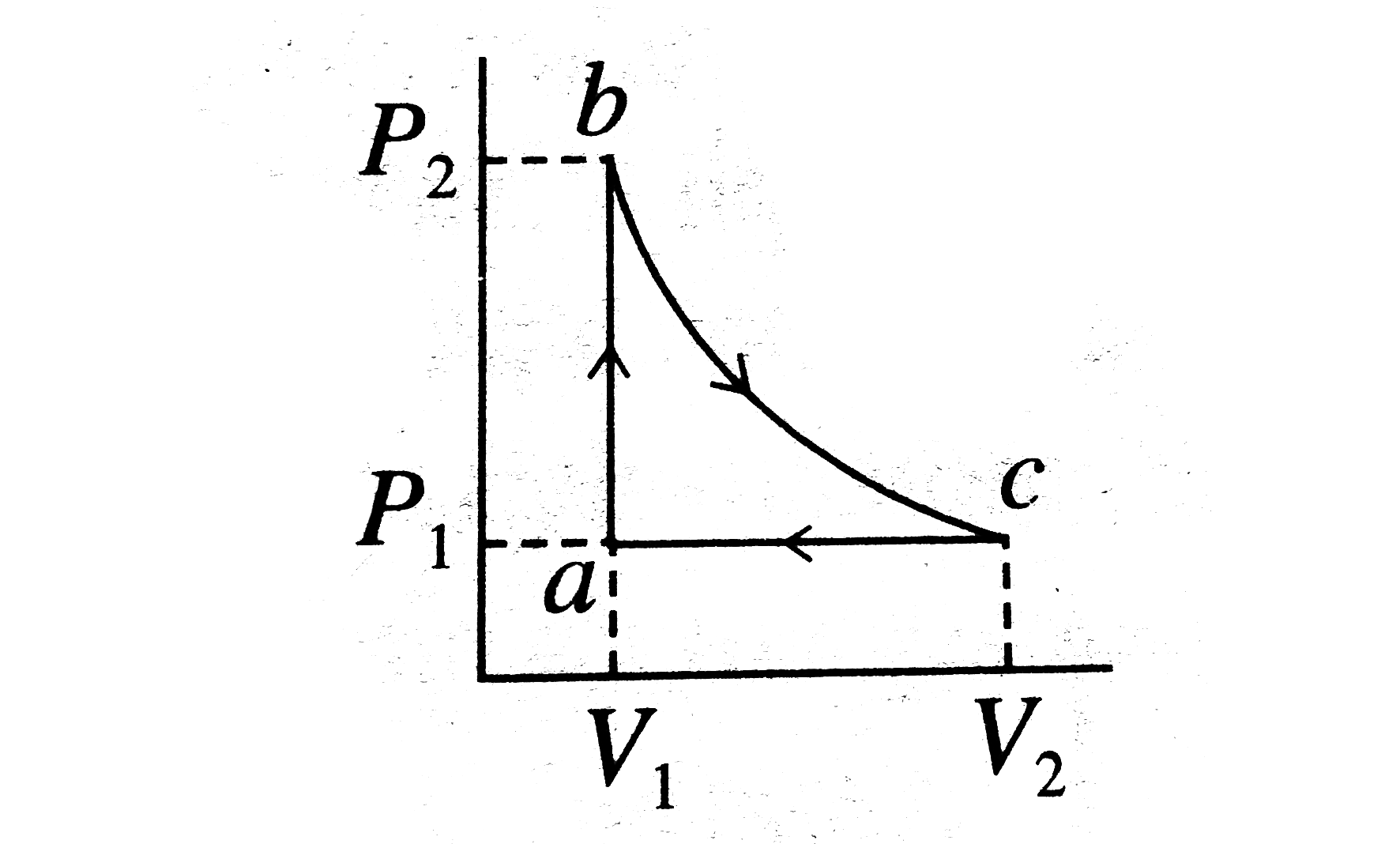
Carbon monoxide is carried around a closed cyclic processes `abc`, in which `bc` is an isothermal process, as shown in Fig. The gas absorbs `7000 J` of heat as its temperature is increased from `300 K` to `1000 K` in going from `a` to `b`. The quantity of heat ejected by the gas during the process `ca` is

A

`4200 J`

B

`500 J`

C

`9000 J`

D

`9800 J`

Text Solution

Verified by Experts

The correct Answer is:

D

`(Delta Q)_(ab) = + 7000 = mu C_(v) (1000 - 300)`
For the process ca:
`T_(a) = 300 K, T_(c ) = T_(b) = 1000 K`
`(Delta Q)_(ca) = mu C_(P) (300 - 1000) = - mu C_(P) xx 700`
`= - mu (C_(V) + R) 700`
For carbon monoxide :
`T_(a) = 300 K, T_(c) = T_(v) = 1000 K`
`(Delta Q)_(ca) = mu C_(P) (300 - 1000) = - mu C_(P) xx 700`
`= - mu (C_(V) + R) 700`
For carbon monoxide :
`gamma = (7)/(5)`
`C_(V) = (R )/(gamma - 1) = (R )/((7)/(5) - 1) = (5 R)/(2)`
Hence, form Eq. (i)
`7000 = mu (5 R)/(2) xx 700` or `mu R = (20)/(5) = 4`
`(Delta Q)_(ca) = - (700 + 4 xx 700) = - 9800 J`
Negative sign shows that heat is ejected.
Promotional Banner

Topper's Solved these Questions

  • KINETIC THEORY OF GASES AND FIRST LAW OF THERMODYNAMICS

    CENGAGE PHYSICS ENGLISH|Exercise Multiple Corrects|29 Videos
  • KINETIC THEORY OF GASES AND FIRST LAW OF THERMODYNAMICS

    CENGAGE PHYSICS ENGLISH|Exercise Assertion-Reasoning|6 Videos
  • KINETIC THEORY OF GASES AND FIRST LAW OF THERMODYNAMICS

    CENGAGE PHYSICS ENGLISH|Exercise Subjective|22 Videos
  • KINETIC THEORY OF GASES

    CENGAGE PHYSICS ENGLISH|Exercise Compression|2 Videos
  • LINEAR AND ANGULAR SIMPLE HARMONIC MOTION

    CENGAGE PHYSICS ENGLISH|Exercise Single correct anwer type|14 Videos

Similar Questions

Explore conceptually related problems

One mole of a gas absorbs 200 J of heat at constant volume. Its temperature rises from 298 K to 308 K. The change in internal energy is :-

In a thermodynamic process two moles of a monatomic ideal gas obeys PV^(–2)=constant . If temperature of the gas increases from 300 K to 400 K, then find work done by the gas (Where R = universal gas constant)

A sample of an ideal gas is taken through the cyclic process abca and shown in the figure. The change in the internal energy of the gas along the path ca is -180J . The gas absorbs 250J of heat along the path ab and 60 J along the path bc. the work done by the gas along the path abc is:

A sample of ideal gas is taken through the cyclic process shown in the figure. The temerauture of the gas in state A is T_(A) =200 K. In states B and C the temperature of the gas is the same. Net work done by the gas in the process is

Two moles of an ideal diatomic gas is taken through a process VT^(2)= constant so that its temperature increases by DeltaT=300K . The ratio ((DeltaU)/(DeltaQ)) of increase in internal energy and heat supplied to the gas during the process is

In an isothermal expansion of one mole of an ideal gas against vacuum from 5 litre to 50 litre at 300 K, the quantity of heat absorbed by the gas is

An ideal gas undergoes a cyclic process, in which one process is isochoric, one process is isothermal and one process is adiabatic. During the isothermal process, 40 J heat is released by the gas, and during the isochoric process, 80 J heat is absorbed by the gas. if work done by the gas during adiabatic process is W_(1) and during isothermal process is W_(2) then the magnitude of (W_(1))/(W_(2)) will be equal to:

One mole of ideal monoatmic gas is carried throught the reversible cyclic process as shown in figure. Calculate net heat absorbed by the gas in the path BC

A sample of helium is undergoing a cyclic process ABCA as shown. In which of the following processes heat is a absorbed by the gas?

when a system is taken through the process abc shown in the fig. 80 J of heat is absorbed by the system and 30 J of work is done by it. If the system does 10 J work during the process adc, how much heat flows into it during the process ?

CENGAGE PHYSICS ENGLISH-KINETIC THEORY OF GASES AND FIRST LAW OF THERMODYNAMICS-Single Correct
  1. One mole of air (C(V) = 5R//2) is confined at atmospheric pressure in ...

    Text Solution

    |

  2. A thermodynamic process is shown in the figure. The pressures and volu...

    Text Solution

    |

  3. Carbon monoxide is carried around a closed cyclic processes abc, in wh...

    Text Solution

    |

  4. An ideal gas is taken through a cyclic thermodynamic process through f...

    Text Solution

    |

  5. Pressure versus temperature graph of an ideal gas as shown in Fig. C...

    Text Solution

    |

  6. An ideal gas is taken through cycle A to B to C-A, as shown in Fig. IF...

    Text Solution

    |

  7. Two identical cylinders A and B with frictionless pistons contain the ...

    Text Solution

    |

  8. Argon gas is adiabatically compressed to half its volume. If P, V and ...

    Text Solution

    |

  9. A fixed mass of helium gas is made to undergo a process in which its p...

    Text Solution

    |

  10. Oxygen gas is made to undergo a process in which its molar heat capaci...

    Text Solution

    |

  11. If the ratio of specific heat of a gas at constant pressure to that at...

    Text Solution

    |

  12. A gas is at 1 atm pressure with a volume 800 cm^(3). When 100 J of hea...

    Text Solution

    |

  13. A fixed mass of a gas is first heated isobarically to double the volum...

    Text Solution

    |

  14. An ideal heat engine has an efficiency eta. The cofficient of performa...

    Text Solution

    |

  15. Two moles of helium gas are taken along the path ABCD (as shown in Fig...

    Text Solution

    |

  16. Figure shows the adiabatic curve for n moles of an ideal gas, the bulk...

    Text Solution

    |

  17. Two moles of an ideal gas is contained in a cylinder fitted with a fri...

    Text Solution

    |

  18. The equation of state for a gas is given by PV = eta RT + alpha V, whe...

    Text Solution

    |

  19. A sound wave passing volume 1 m^(3) is divided into two equal compartm...

    Text Solution

    |

  20. A container of volume 1m^3 is divided into two equal parts by a partit...

    Text Solution

    |
