Home
Class 11
PHYSICS
One mole of an ideal gas at pressure P(0...

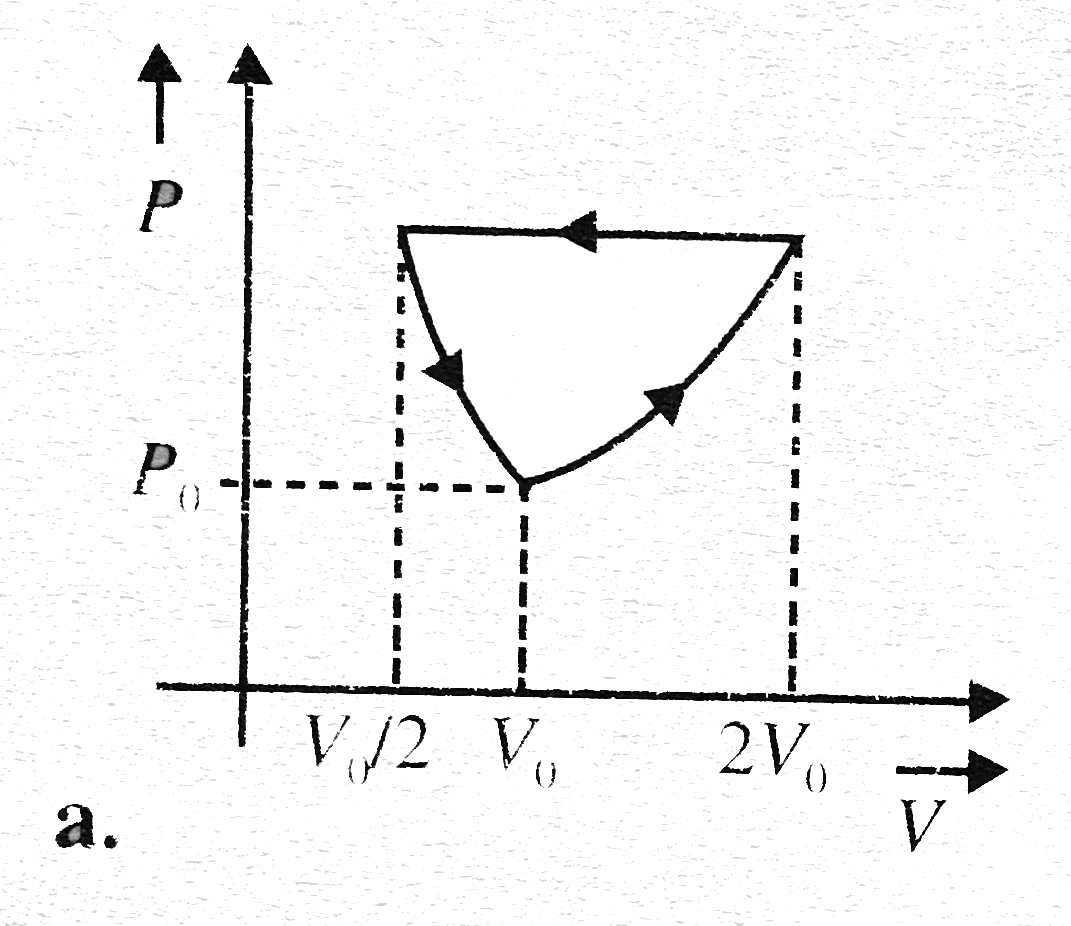
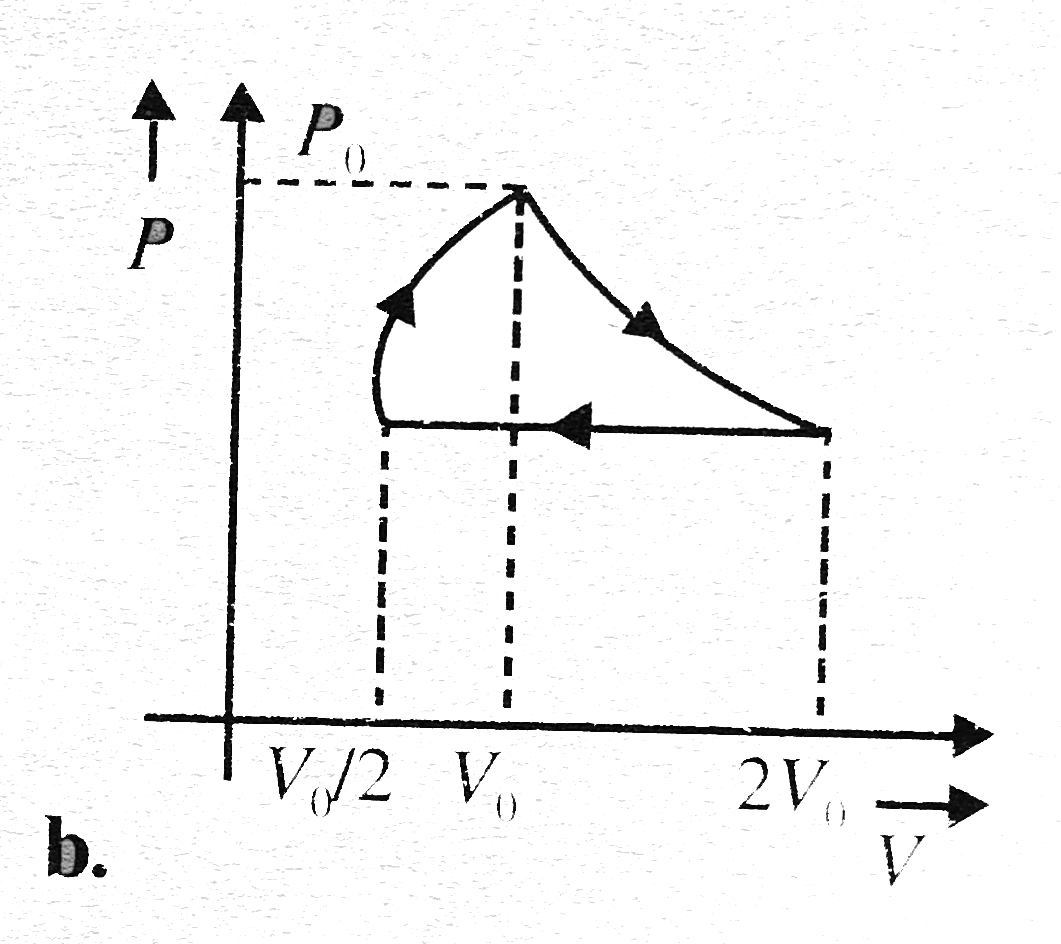
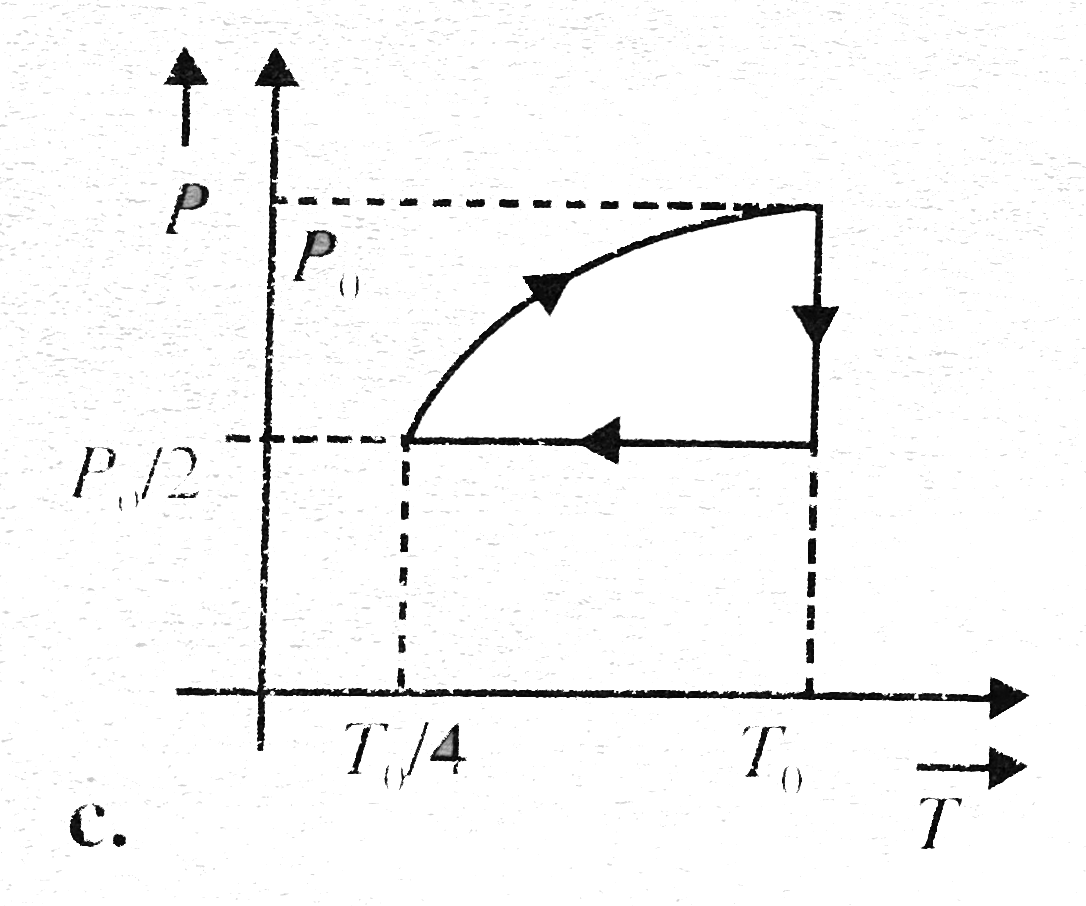
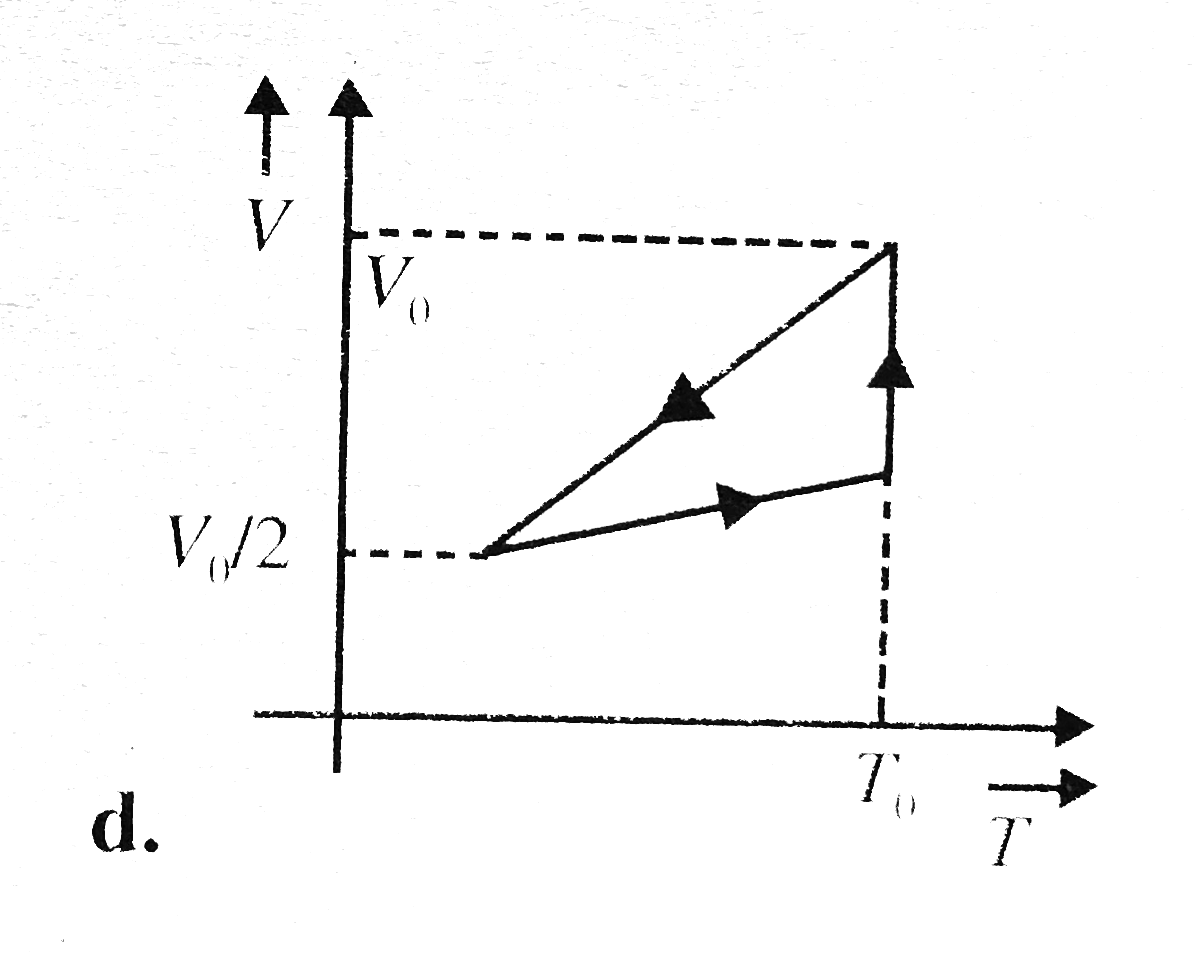
One mole of an ideal gas at pressure `P_(0)` and temperature `T_(0)` is expanded isothermally to twice its volume and then compressed at constant pressure to `(V_(0) // 2)` and the gas is brought bac to original state by a process in which `P alpha V` (pressure is directly proportional to volume). The correct temperature of the process is

A

B

C

D

Text Solution

AI Generated Solution

The correct Answer is:

To solve the problem step by step, we will analyze the three processes that the gas undergoes and determine the final temperature of the gas after it has returned to its original state. ### Step 1: Understand the Initial Conditions We have 1 mole of an ideal gas at: - Initial Pressure: \( P_0 \) - Initial Temperature: \( T_0 \) - Initial Volume: \( V_0 \) ### Step 2: Process 1 - Isothermal Expansion The gas is expanded isothermally to twice its volume: - Final Volume after expansion: \( V = 2V_0 \) Since the process is isothermal, the temperature remains constant at \( T_0 \). According to Boyle's Law for isothermal processes: \[ P_0 V_0 = P_1 (2V_0) \] From this, we can find the new pressure \( P_1 \): \[ P_1 = \frac{P_0 V_0}{2V_0} = \frac{P_0}{2} \] ### Step 3: Process 2 - Isobaric Compression Next, the gas is compressed at constant pressure to \( V_0/2 \): - Final Volume after compression: \( V = \frac{V_0}{2} \) - Pressure remains constant: \( P_1 = P_0/2 \) Using the ideal gas law \( PV = nRT \): \[ \frac{P_0}{2} \cdot \frac{V_0}{2} = nRT_1 \] Where \( T_1 \) is the temperature after this process. Substituting \( n = 1 \) (1 mole): \[ \frac{P_0 V_0}{4} = RT_1 \] Thus, \[ T_1 = \frac{P_0 V_0}{4R} \] ### Step 4: Process 3 - P is Proportional to V In the final process, the gas is brought back to the original state with \( P \propto V \). This means: \[ P = kV \] Using the ideal gas law again, we can express this as: \[ PV = nRT \] Substituting \( P = kV \): \[ kV^2 = nRT \] This implies: \[ T = \frac{kV^2}{nR} \] ### Step 5: Returning to Original State To find the temperature at the end of the third process, we need to know the values of \( k \) and \( V \). Since the process returns to the original state, we know: - Final Volume: \( V = V_0 \) - Final Pressure: \( P = P_0 \) Substituting back into the equation: \[ T = \frac{kV_0^2}{nR} \] ### Step 6: Relate \( k \) to Original Conditions From the previous processes, we can relate \( k \) to the original conditions. Since we know the gas returns to its original state, we can set \( T \) equal to \( T_0 \): \[ T_0 = \frac{kV_0^2}{R} \] ### Final Calculation To find the correct temperature of the process, we need to relate it back to the initial temperature: - After the first process, the temperature remains \( T_0 \). - After the second process, the temperature is \( T_1 = \frac{P_0 V_0}{4R} \). - The final temperature after the third process must also relate back to the original state. Thus, the correct temperature of the process is: \[ T = T_0 \] ### Conclusion The correct temperature of the process is \( T_0 \).

To solve the problem step by step, we will analyze the three processes that the gas undergoes and determine the final temperature of the gas after it has returned to its original state. ### Step 1: Understand the Initial Conditions We have 1 mole of an ideal gas at: - Initial Pressure: \( P_0 \) - Initial Temperature: \( T_0 \) - Initial Volume: \( V_0 \) ...
Promotional Banner

Topper's Solved these Questions

  • KINETIC THEORY OF GASES AND FIRST LAW OF THERMODYNAMICS

    CENGAGE PHYSICS ENGLISH|Exercise Multiple Corrects|29 Videos
  • KINETIC THEORY OF GASES AND FIRST LAW OF THERMODYNAMICS

    CENGAGE PHYSICS ENGLISH|Exercise Assertion-Reasoning|6 Videos
  • KINETIC THEORY OF GASES AND FIRST LAW OF THERMODYNAMICS

    CENGAGE PHYSICS ENGLISH|Exercise Subjective|22 Videos
  • KINETIC THEORY OF GASES

    CENGAGE PHYSICS ENGLISH|Exercise Compression|2 Videos
  • LINEAR AND ANGULAR SIMPLE HARMONIC MOTION

    CENGAGE PHYSICS ENGLISH|Exercise Single correct anwer type|14 Videos

Similar Questions

Explore conceptually related problems

Three moles of an ideal gas at a pressure P_(A) and temperature T_(A) is isothermally expanded to twice its initial volume. It is then compressed at constant pressure to its original , volume. Finally the gas is compressed at constant volume to its original pressure P_(A) (a) Sketch the P-V and P-T diagrams for the complete process. (b) Calculate the net work done by the gas, and net heat supplied to the gas during the complete process.

An ideal gas has pressure P, volume V and temperature T. Select the correct option.

A sample of an ideal gas has pressure p_(0) , volume V_(0) and tempreture T_(0) . It is isothermally expanded to twice its oringinal volume.it is then compressed at constant pressure to have the original volume V_(0) . Finally, the gas is heated at constant volume to get the original tempreture.(a) show the process in a V-T diagram (b) calculate the heat absorbed in the process.

Three moles of an ideal gas (C_p=7/2R) at pressure, P_A and temperature T_A is isothermally expanded to twice its initial volume. It is then compressed at constant pressure to its original volume. Finally gas is compressed at constant volume to its original pressure P_A . (a) Sketch P-V and P-T diagrams for the complete process. (b) Calculate the net work done by the gas, and net heat supplied to the gas during the complete process.

An ideal gas of volume V and pressure P expands isothermally to volume 16 V and then compressed adiabatically to volume V . The final pressure of gas is [ gamma = 1.5]

Three moles of an ideal gas (C_p=7/2R) at pressure p_0 and temperature T_0 is isothermally expanded to twice its initial volume. It is then compressed at a constant pressure to its original volume. (a) Sketch p-V and p-T diagram for complete process. (b) Calculate net work done by the gas. (c) Calculate net heat supplied to the gas during complete process. (Write your answer in terms of gas constant =R)

A monoatomic gas at pressure P_(1) and volume V_(1) is compressed adiabatically to 1/8th of its original volume. What is the final pressure of gas.

A quantity of gas occupies an initial volume V_(0) at pressure p_(0) and temperature T_(0) . It expands to a volume V (a) constant temperature and (b) constant pressure. In which case does the gas do more work ?

A mass of ideal gas at pressure P is expanded isothermally to four times the originl volume and then slowly compressed adiabatically to its original volume. Assuming gamma to be 1.5 , the new pressure of the gas is

A monatomic gas at a pressure P, having a volume V expands isothermally to a volume 2 V and then adiabatically to a volume 16 V. The final pressure of the gas is ( take gamma=5/3 )

CENGAGE PHYSICS ENGLISH-KINETIC THEORY OF GASES AND FIRST LAW OF THERMODYNAMICS-Single Correct
  1. A diatomic ideal gas is heated at constant volume until the pressure ...

    Text Solution

    |

  2. One mole of an ideal gas is taken from state A to state B by three dif...

    Text Solution

    |

  3. One mole of an ideal gas at pressure P(0) and temperature T(0) is expa...

    Text Solution

    |

  4. P-T diagram is shown below. Then choose the corresponding V-T diagram

    Text Solution

    |

  5. P-V curve of a diatomic gas is shown in the Fig. Find the total heat g...

    Text Solution

    |

  6. A gas expands with temperature according to the relation V = kT^(2//3)...

    Text Solution

    |

  7. A gas is expanded from volume V(0) to 2V(0) under three different proc...

    Text Solution

    |

  8. Logarithms of readings of pressure and volume for an ideal gas were pl...

    Text Solution

    |

  9. Two moles of an ideal mono-atomic gas undergo a cyclic process as show...

    Text Solution

    |

  10. ‘n’ moles of an ideal gas undergoes a process A to B as shown in the f...

    Text Solution

    |

  11. A vessel contains a mixture consisting of m1=7 g of nitrogen (M1=28) a...

    Text Solution

    |

  12. The mass of a gas molecule can be computed form the specific heat at c...

    Text Solution

    |

  13. A certain balloon maintains an internal gas pressure of P(0) = 100 k P...

    Text Solution

    |

  14. A spherical balloon contains air at temperature T(0) and pressure P(0)...

    Text Solution

    |

  15. Find work done by the gas in the process shown in figure.

    Text Solution

    |

  16. Two different ideal diatomic gases A and B are initially in the same s...

    Text Solution

    |

  17. Three moles of an ideal monoatomic gas performs a cyclic process as sh...

    Text Solution

    |

  18. For process 1, Delta U is positive, for process 2, Delta U is zero and...

    Text Solution

    |

  19. In the diagram as shown, find parameters representing x and y axes and...

    Text Solution

    |

  20. The ratio of heat absorbed and work done by the gas in the process, as...

    Text Solution

    |
