Home
Class 11
PHYSICS
A gas is expanded from volume V(0) to 2V...

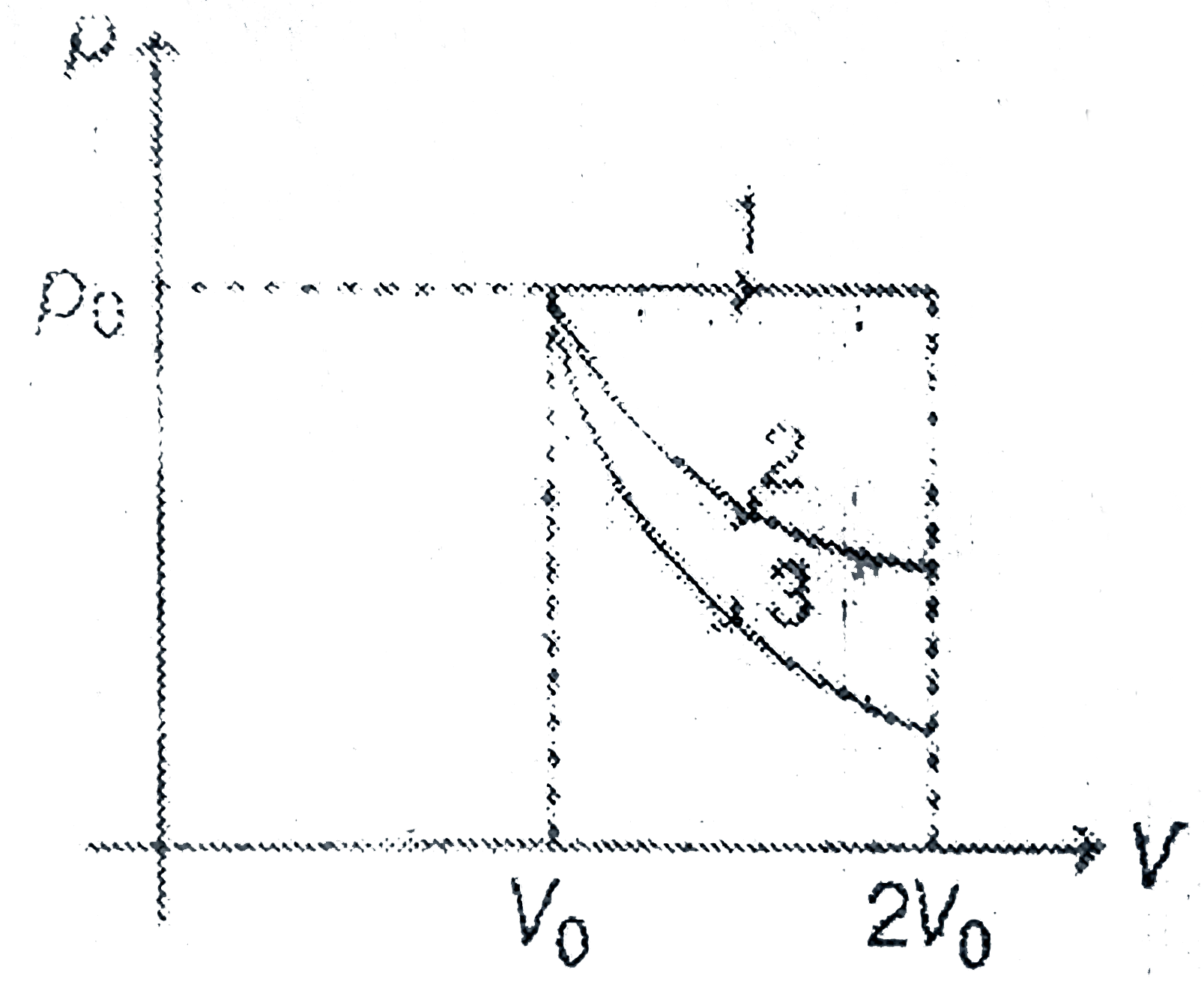
A gas is expanded from volume `V_(0)` to `2V_(0)` under three different processes. Process 1 is isobaric process 2 is isothermal and process 3 is adiabatic. Let `DeltaU_(1), DeltaU_(2)` and `DeltaU_(3)` be the change in internal energy of the gas in these three processes. Then

A

`Delta U_(1) gt Delta U_(2) gt Delta U_(3)`

B

`Delta U_(1) lt Delta U_(2) lt Delta U_(3)`

C

`Delta U_(2) lt Delta U_(1) lt Delta U_(3)`

D

`Delta U_(2) lt Delta U_(3) lt Delta U_(1)`

Text Solution

Verified by Experts

The correct Answer is:

A

a. Change in temperature in process 1 will be greater and in process 3 will be least.
Promotional Banner

Topper's Solved these Questions

  • KINETIC THEORY OF GASES AND FIRST LAW OF THERMODYNAMICS

    CENGAGE PHYSICS ENGLISH|Exercise Multiple Corrects|29 Videos
  • KINETIC THEORY OF GASES AND FIRST LAW OF THERMODYNAMICS

    CENGAGE PHYSICS ENGLISH|Exercise Assertion-Reasoning|6 Videos
  • KINETIC THEORY OF GASES AND FIRST LAW OF THERMODYNAMICS

    CENGAGE PHYSICS ENGLISH|Exercise Subjective|22 Videos
  • KINETIC THEORY OF GASES

    CENGAGE PHYSICS ENGLISH|Exercise Compression|2 Videos
  • LINEAR AND ANGULAR SIMPLE HARMONIC MOTION

    CENGAGE PHYSICS ENGLISH|Exercise Single correct anwer type|14 Videos

Similar Questions

Explore conceptually related problems

A gas is expanded from volume V_(0) = 2V_(0) under three different processes. Process 1 is isobaric process, process 2 is isothermal and process 3 is adiabatic. Let DeltaU_(1), DeltaU_(2) and DeltaU_(3) be the change in internal energy of the gas in these three processes. then

A gas is expanded form volume V_(0) to 2V_(0) under three different processes as shown in the figure . Process 1 is isobaric process process 2 is isothermal and and process 3 is adiabatic . Let DeltaU_(1),DeltaU_(2) and DeltaU_(3) be the change in internal energy of the gas in these three processes then

Refer to figure. Let DeltaU_(1) and DeltaU_(2) be the changes in internal energy of the system in the processes A and B. then

Change in internal energy in an isothermal process for ideal gas is

An ideal gas expands from V to 2V in 4 separate processes. Where process 1 is isothermal process 2 is adiabatic, process 3 is free expansion and process 4 is isobaric. If E_(1),E_(2),E_(3) and E_(4) are the changes in average kinetic energy of the molecules in the isothermal, adiabatic free expansion and isobaric process respectively then choose the correct options.

A gas is expanded from volume V_(1) to V_(2 through three different process: a. Reversible adiabatic b. Reversible isothermal c. Irreversible adiabatic (against a constant external pressure P_(ex)) The correct option is

An ideal gas goes from state A to state B via three different processes as indicated in the P-V diagram - If Q_(1),Q_(2),Q_(3) indicate the heat absorbed by the gas along the three process and DeltaU_(1),DeltaU_(2),DeltaU_(3) , indicate the change in internal energy along the three processes respectively, then -

Refer to figure. Let DeltaU_(1) and DeltaU_(2) be the changes in internal energy in the system in process A+B and DeltaW be the net work done by the system in the process A+B ,

A system goes from A and B via two processes. I and II as shown in figure. If DeltaU_1 and DeltaU_2 are the changes in internal energies in the processes I and II respectively, then

A system goes from A and B via two processes. I and II as shown in figure. If DeltaU_1 and DeltaU_2 are the changes in internal energies in the processes I and II respectively, then

CENGAGE PHYSICS ENGLISH-KINETIC THEORY OF GASES AND FIRST LAW OF THERMODYNAMICS-Single Correct
  1. P-V curve of a diatomic gas is shown in the Fig. Find the total heat g...

    Text Solution

    |

  2. A gas expands with temperature according to the relation V = kT^(2//3)...

    Text Solution

    |

  3. A gas is expanded from volume V(0) to 2V(0) under three different proc...

    Text Solution

    |

  4. Logarithms of readings of pressure and volume for an ideal gas were pl...

    Text Solution

    |

  5. Two moles of an ideal mono-atomic gas undergo a cyclic process as show...

    Text Solution

    |

  6. ‘n’ moles of an ideal gas undergoes a process A to B as shown in the f...

    Text Solution

    |

  7. A vessel contains a mixture consisting of m1=7 g of nitrogen (M1=28) a...

    Text Solution

    |

  8. The mass of a gas molecule can be computed form the specific heat at c...

    Text Solution

    |

  9. A certain balloon maintains an internal gas pressure of P(0) = 100 k P...

    Text Solution

    |

  10. A spherical balloon contains air at temperature T(0) and pressure P(0)...

    Text Solution

    |

  11. Find work done by the gas in the process shown in figure.

    Text Solution

    |

  12. Two different ideal diatomic gases A and B are initially in the same s...

    Text Solution

    |

  13. Three moles of an ideal monoatomic gas performs a cyclic process as sh...

    Text Solution

    |

  14. For process 1, Delta U is positive, for process 2, Delta U is zero and...

    Text Solution

    |

  15. In the diagram as shown, find parameters representing x and y axes and...

    Text Solution

    |

  16. The ratio of heat absorbed and work done by the gas in the process, as...

    Text Solution

    |

  17. In previous, Find the value of gamma = C(P) // C(v) :

    Text Solution

    |

  18. In an adiabatic process, R = (2)/(3) C(v). The pressure of the gas wil...

    Text Solution

    |

  19. The ratio of pressure of the same gas in two containers is (n(1) T(1))...

    Text Solution

    |

  20. In an isobaric process, Delta Q = (K gamma)/(gamma - 1) where gamma = ...

    Text Solution

    |
