Home
Class 11
PHYSICS
Three moles of an ideal gas (Cp=7/2R) at...

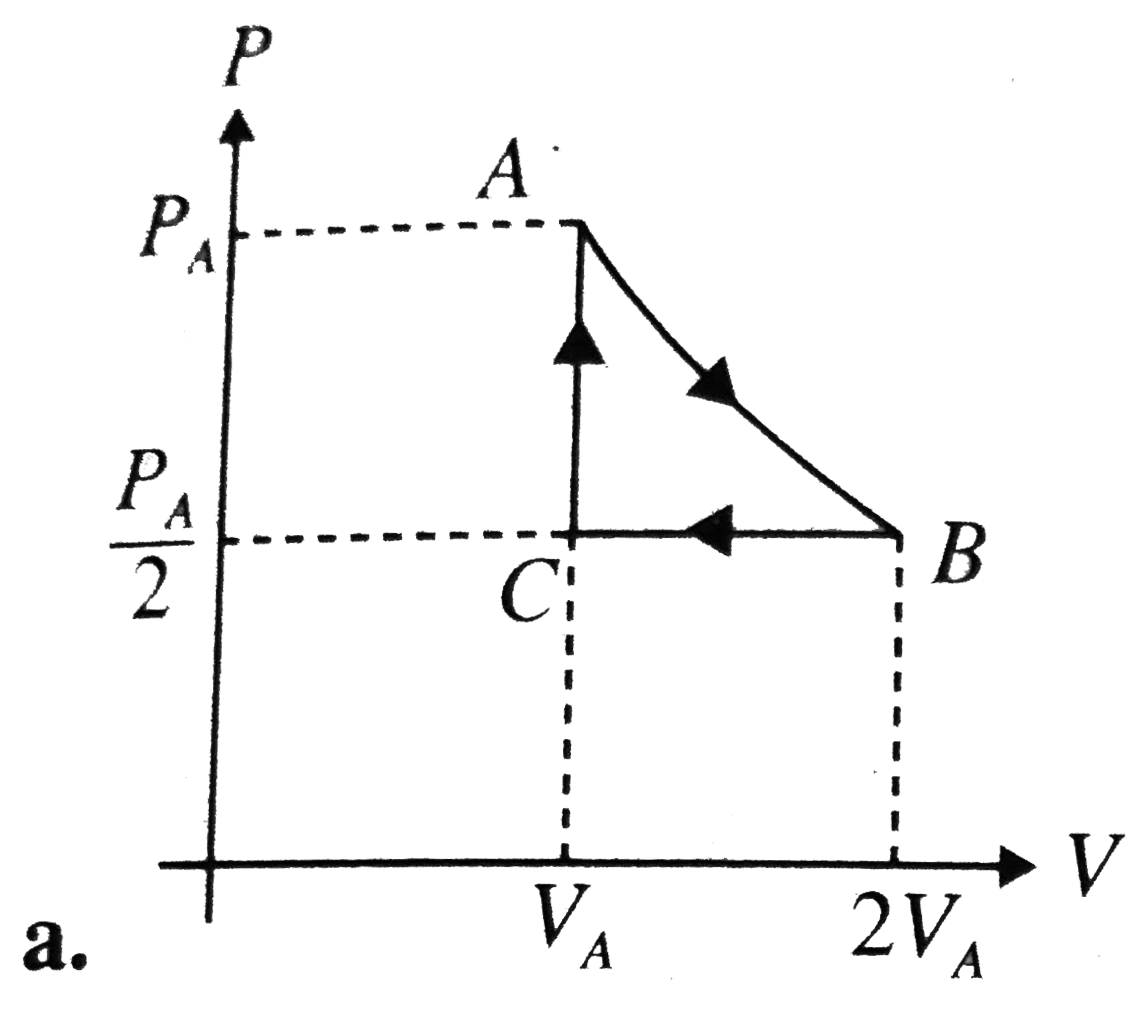
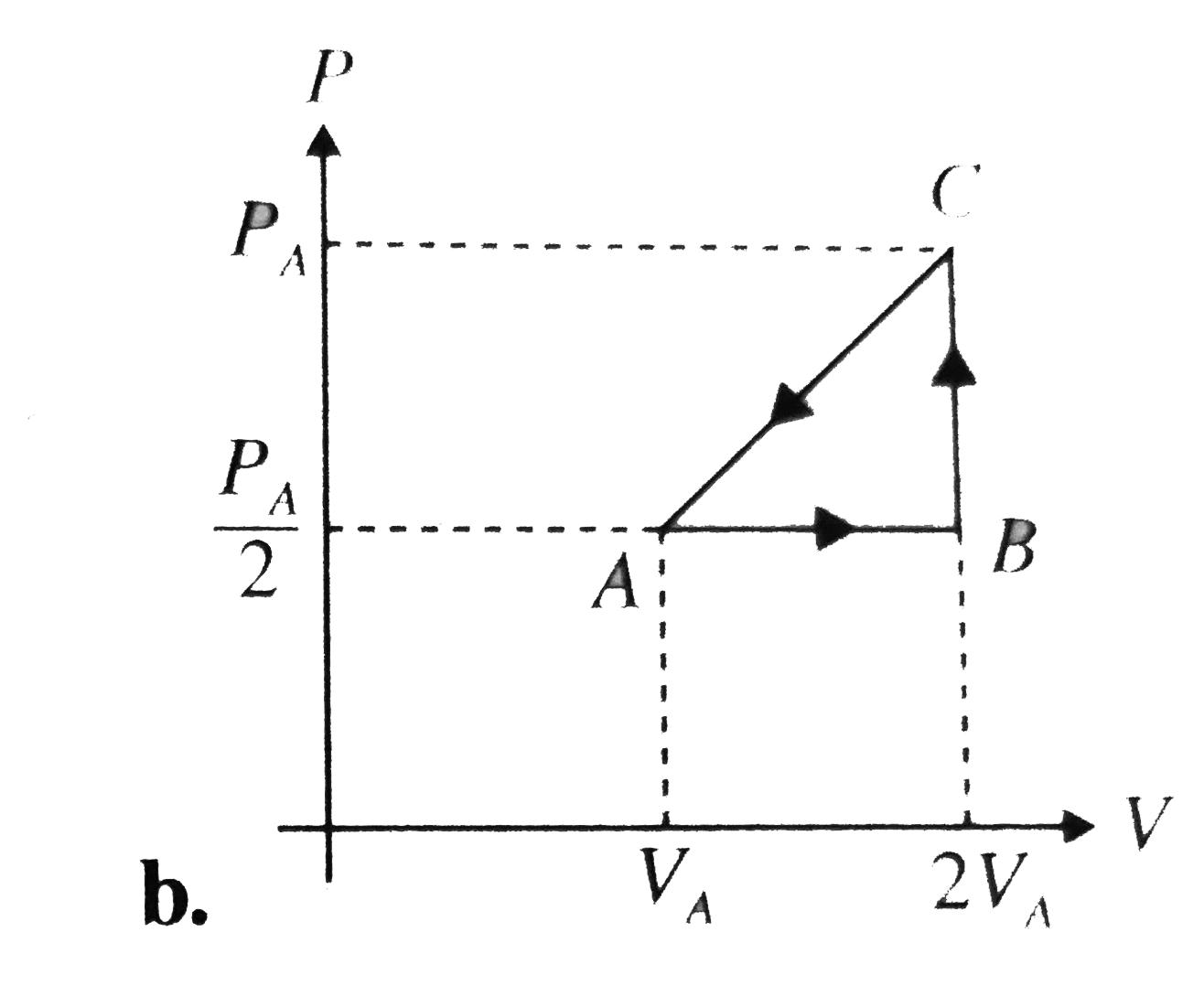
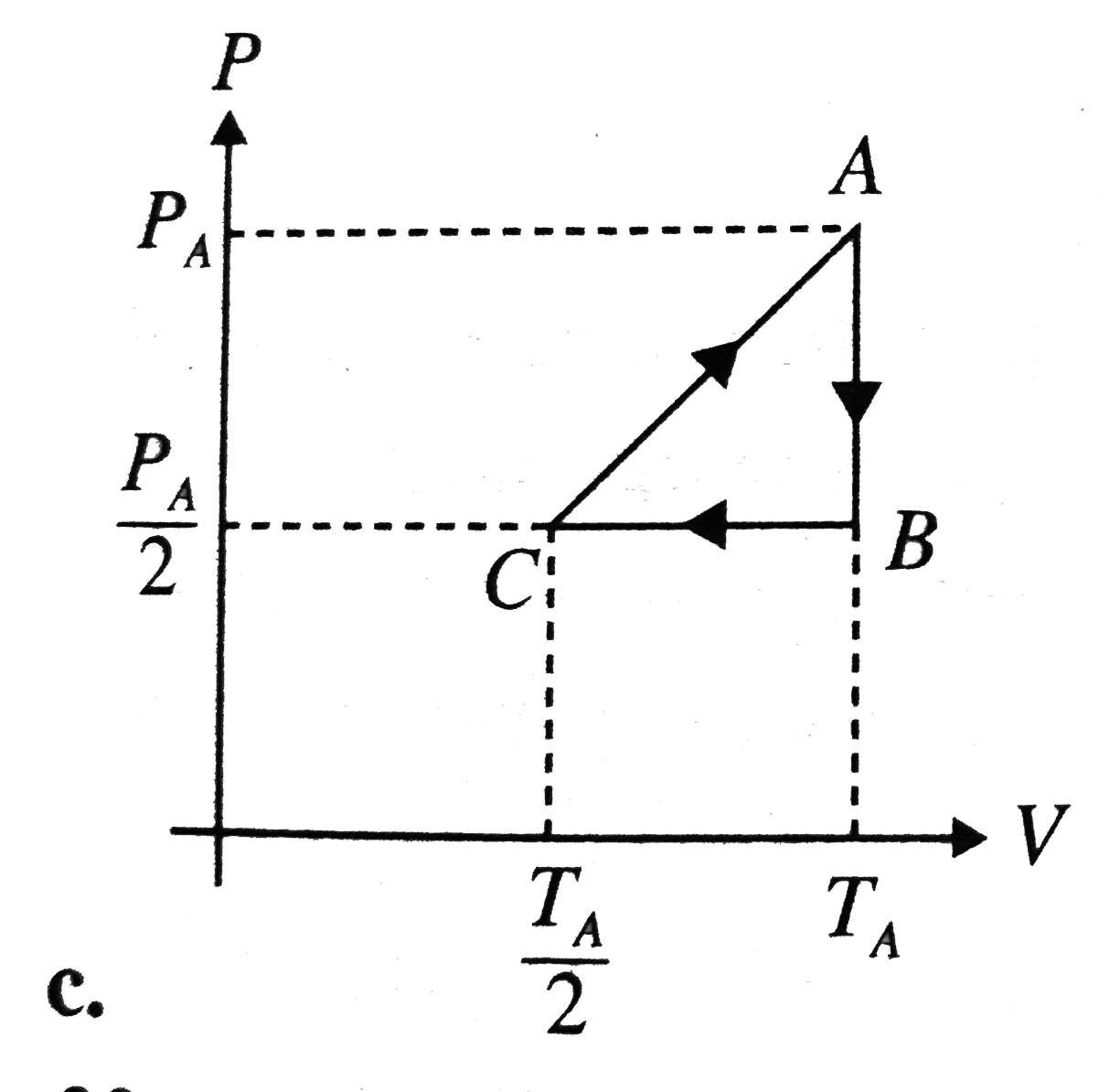
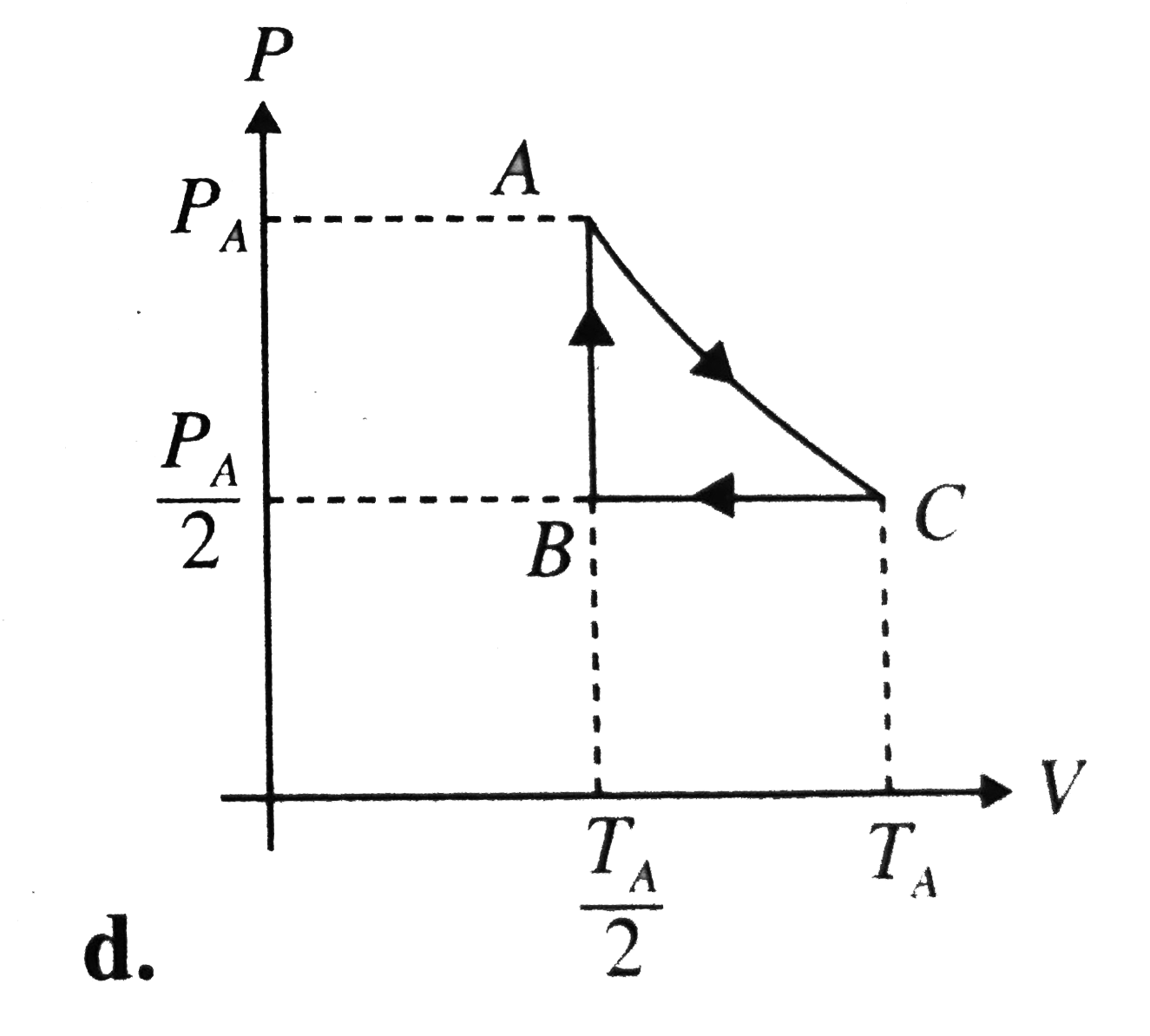
Three moles of an ideal gas `(C_p=7/2R)` at pressure, `P_A` and temperature `T_A` is isothermally expanded to twice its initial volume. It is then compressed at constant pressure to its original volume. Finally gas is compressed at constant volume to its original pressure `P_A`.
(a) Sketch P-V and P-T diagrams for the complete process.
(b) Calculate the net work done by the gas, and net heat supplied to the gas during the complete process.

A

B

C

D

Text Solution

AI Generated Solution

The correct Answer is:

To solve the problem step by step, we will analyze the processes involved, sketch the required diagrams, and calculate the net work done and net heat supplied during the complete process. ### Step 1: Understanding the Processes 1. **Isothermal Expansion (A to B)**: The gas expands isothermally from volume \( V_A \) to \( V_B = 2V_A \) at constant temperature \( T_A \). 2. **Isobaric Compression (B to C)**: The gas is compressed at constant pressure from volume \( V_B \) back to \( V_C = V_A \). 3. **Isochoric Compression (C to A)**: The gas is compressed at constant volume back to its original pressure \( P_A \). ### Step 2: Sketching the P-V Diagram - **Point A**: \( (P_A, V_A) \) - **Point B**: \( (P_B, V_B) \) where \( P_B = \frac{P_A}{2} \) and \( V_B = 2V_A \) - **Point C**: \( (P_C, V_C) \) where \( P_C = \frac{P_A}{2} \) and \( V_C = V_A \) The P-V diagram will show: - A hyperbolic curve from A to B (isothermal). - A straight line from B to C (isobaric). - A vertical line from C to A (isochoric). ### Step 3: Sketching the P-T Diagram - **Point A**: \( (P_A, T_A) \) - **Point B**: \( (P_B, T_A) \) where \( P_B = \frac{P_A}{2} \) - **Point C**: \( (P_C, T_C) \) where \( T_C = \frac{T_A}{2} \) The P-T diagram will show: - A horizontal line from A to B (isothermal). - A straight line from B to C (isobaric). - A straight line from C to A (isochoric). ### Step 4: Calculating the Work Done 1. **Work Done in Isothermal Process (A to B)**: \[ W_{AB} = nRT_A \ln\left(\frac{V_B}{V_A}\right) = 3R T_A \ln(2) \] 2. **Work Done in Isobaric Process (B to C)**: \[ W_{BC} = P_B (V_C - V_B) = \frac{P_A}{2} (V_A - 2V_A) = -\frac{P_A V_A}{2} = -\frac{3R T_A}{2} \] 3. **Work Done in Isochoric Process (C to A)**: \[ W_{CA} = 0 \] 4. **Net Work Done**: \[ W_{net} = W_{AB} + W_{BC} + W_{CA} = 3R T_A \ln(2) - \frac{3R T_A}{2} + 0 \] ### Step 5: Calculating the Heat Supplied 1. **Heat Supplied in Isothermal Process (A to B)**: \[ Q_{AB} = W_{AB} = 3R T_A \ln(2) \] 2. **Heat Supplied in Isobaric Process (B to C)**: - Change in Internal Energy: \[ \Delta U_{BC} = n C_V \Delta T = 3 \cdot \frac{5R}{2} \left(\frac{T_A}{2} - T_A\right) = -\frac{15R T_A}{4} \] - Heat Supplied: \[ Q_{BC} = W_{BC} + \Delta U_{BC} = -\frac{3R T_A}{2} - \frac{15R T_A}{4} = -\frac{21R T_A}{4} \] 3. **Heat Supplied in Isochoric Process (C to A)**: \[ Q_{CA} = \Delta U_{CA} = n C_V \Delta T = 3 \cdot \frac{5R}{2} \left(T_A - \frac{T_A}{2}\right) = \frac{15R T_A}{4} \] 4. **Net Heat Supplied**: \[ Q_{net} = Q_{AB} + Q_{BC} + Q_{CA} = 3R T_A \ln(2) - \frac{21R T_A}{4} + \frac{15R T_A}{4} \] \[ Q_{net} = 3R T_A \ln(2) - \frac{6R T_A}{4} = 3R T_A \ln(2) - \frac{3R T_A}{2} \] ### Final Answers - **Net Work Done**: \[ W_{net} = 3R T_A \ln(2) - \frac{3R T_A}{2} \] - **Net Heat Supplied**: \[ Q_{net} = 3R T_A \ln(2) - \frac{3R T_A}{2} \]

To solve the problem step by step, we will analyze the processes involved, sketch the required diagrams, and calculate the net work done and net heat supplied during the complete process. ### Step 1: Understanding the Processes 1. **Isothermal Expansion (A to B)**: The gas expands isothermally from volume \( V_A \) to \( V_B = 2V_A \) at constant temperature \( T_A \). 2. **Isobaric Compression (B to C)**: The gas is compressed at constant pressure from volume \( V_B \) back to \( V_C = V_A \). 3. **Isochoric Compression (C to A)**: The gas is compressed at constant volume back to its original pressure \( P_A \). ### Step 2: Sketching the P-V Diagram ...
Promotional Banner

Topper's Solved these Questions

  • KINETIC THEORY OF GASES AND FIRST LAW OF THERMODYNAMICS

    CENGAGE PHYSICS ENGLISH|Exercise Assertion-Reasoning|6 Videos
  • KINETIC THEORY OF GASES AND FIRST LAW OF THERMODYNAMICS

    CENGAGE PHYSICS ENGLISH|Exercise Comprehension|56 Videos
  • KINETIC THEORY OF GASES AND FIRST LAW OF THERMODYNAMICS

    CENGAGE PHYSICS ENGLISH|Exercise Single Correct|140 Videos
  • KINETIC THEORY OF GASES

    CENGAGE PHYSICS ENGLISH|Exercise Compression|2 Videos
  • LINEAR AND ANGULAR SIMPLE HARMONIC MOTION

    CENGAGE PHYSICS ENGLISH|Exercise Single correct anwer type|14 Videos

Similar Questions

Explore conceptually related problems

Three moles of an ideal gas at a pressure P_(A) and temperature T_(A) is isothermally expanded to twice its initial volume. It is then compressed at constant pressure to its original , volume. Finally the gas is compressed at constant volume to its original pressure P_(A) (a) Sketch the P-V and P-T diagrams for the complete process. (b) Calculate the net work done by the gas, and net heat supplied to the gas during the complete process.

Three moles of an ideal gas (C_p=7/2R) at pressure p_0 and temperature T_0 is isothermally expanded to twice its initial volume. It is then compressed at a constant pressure to its original volume. (a) Sketch p-V and p-T diagram for complete process. (b) Calculate net work done by the gas. (c) Calculate net heat supplied to the gas during complete process. (Write your answer in terms of gas constant =R)

A sample of an ideal gas has pressure p_(0) , volume V_(0) and tempreture T_(0) . It is isothermally expanded to twice its oringinal volume.it is then compressed at constant pressure to have the original volume V_(0) . Finally, the gas is heated at constant volume to get the original tempreture.(a) show the process in a V-T diagram (b) calculate the heat absorbed in the process.

An ideal gas intially has pressure P volume V and temperature T . Its is isothermally expanded to four times of its original volume, then it is compressed at constant pressure to attain its original volume V . Finally, the gas is heated at constant volume to get the original temperature T . (a) Draw V-T curve (b) Calculate the total work done by the gas in the process.(given ln2 = 0.693)

If a gas is heated at constant pressure, its isothermal compressibility

One mole of an ideal gas at pressure P_(0) and temperature T_(0) is expanded isothermally to twice its volume and then compressed at constant pressure to (V_(0) // 2) and the gas is brought bac to original state by a process in which P alpha V (pressure is directly proportional to volume). The correct temperature of the process is

A mass of ideal gas at pressure P is expanded isothermally to four times the originl volume and then slowly compressed adiabatically to its original volume. Assuming gamma to be 1.5 , the new pressure of the gas is

n moles of a gas are filled in a container at temperature T. If the gas is slowly and isothermally compressed to half its initial volume, the work done by the atmosphere on the gas is

A monoatomic gas at pressure P_(1) and volume V_(1) is compressed adiabatically to 1/8th of its original volume. What is the final pressure of gas.

If a gas of a volume V_(1) at pressure p_(1) is compressed adiabatically to volume V_(2) and pressure p_(2) , calculate the work done by the gas.

CENGAGE PHYSICS ENGLISH-KINETIC THEORY OF GASES AND FIRST LAW OF THERMODYNAMICS-Multiple Corrects
  1. A closed vessel contains a mixture of two diatomic gases A and B. Mola...

    Text Solution

    |

  2. An ideal gas undergoes a thermodynamic cycle as shown in figure: ...

    Text Solution

    |

  3. Which the following statements are correct ?

    Text Solution

    |

  4. Figure. Shows the P-V diagram for a Carnot cycle. In this diagram

    Text Solution

    |

  5. Figure shows an indicator diagram. During path 1-2-3, 100 cal is given...

    Text Solution

    |

  6. One mole of an ideal monatomic gas has initial temperature T(0), is ma...

    Text Solution

    |

  7. P - V diagram of a cyclic process ABCA is as shown in Fig. Choose the ...

    Text Solution

    |

  8. During the process AB of an ideal gas

    Text Solution

    |

  9. Temperature versus pressure graph of an ideal gas is shown in figure. ...

    Text Solution

    |

  10. An ideal gas undergoes the cyclic process shown in a graph below :

    Text Solution

    |

  11. The indicator diagram for two processes 1(isothermal) and 2(adiabatic)...

    Text Solution

    |

  12. Three moles of an ideal gas (Cp=7/2R) at pressure, PA and temperature ...

    Text Solution

    |

  13. An ideal gas is taken from the state A (pressure p, volume V) to the s...

    Text Solution

    |

  14. A partition divides a container having insulated walls into two compar...

    Text Solution

    |

  15. During an experiment, an ideal gas is found to obey a condition (p^2)/...

    Text Solution

    |

  16. Pick the correct statement (s) :

    Text Solution

    |

  17. An ideal gas undergoes an expansion from a state with temperature T(1)...

    Text Solution

    |

  18. A system undergoes three quasi-static process sequentially as indicate...

    Text Solution

    |

  19. An insulated 0.2 m^(3) tank contains helium at 1200 kPa and 47^(@)C. A...

    Text Solution

    |

  20. A gas in container A is in thermal equilibrium with another gas in con...

    Text Solution

    |
