Home
Class 11
PHYSICS
Statement I: A person is standing near a...

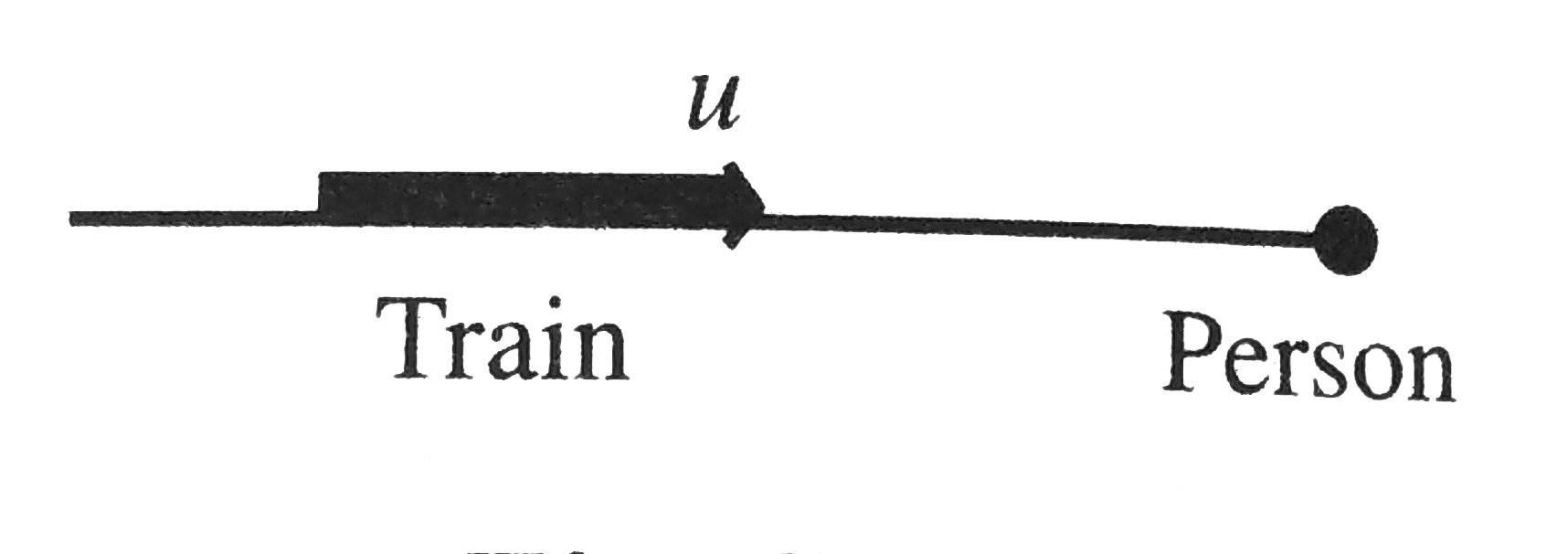
Statement I: A person is standing near a railway track. A train is moving on the track. As the train is approaching the person, apparent frequency keeps on increasing and when the train has passed the person, then apparent frequency keeps on decreasing.
Statement II: When train is approaching the person then,
`f=f_0[(c )/(c-u)]`
and when train is moving away from person
`f=f_0[(c )/(c+u)]`
Here, c is velocity of sound u is velocity of train and `f_0` is original frequency of whistle.

A

Statement I is true, Statement II is true: Statement II is a correct explanation for statement I.

B

Statement I is true, Statement II is true, Statement II is NOT a correct explanation for Statement I.

C

Statement I is true, Statement II is false

D

Statement I is falce: Statement II is true

Text Solution

Verified by Experts

The correct Answer is:
D


`f=f_0[(c+o)/(c-u)]`
`f=f_0[(c )/(c+u)]`
So, when the train is approaching, frequency has constant value given by
`f_0[(c )/(c-u)]`
Promotional Banner

Topper's Solved these Questions

  • SOUND WAVES AND DOPPLER EFFECT

    CENGAGE PHYSICS ENGLISH|Exercise Comprehension|144 Videos
  • SOUND WAVES AND DOPPLER EFFECT

    CENGAGE PHYSICS ENGLISH|Exercise Integer|16 Videos
  • SOUND WAVES AND DOPPLER EFFECT

    CENGAGE PHYSICS ENGLISH|Exercise Multiple Correct|44 Videos
  • RIGID BODY DYNAMICS 2

    CENGAGE PHYSICS ENGLISH|Exercise Interger|2 Videos
  • SUPERPOSITION AND STANDING WAVES

    CENGAGE PHYSICS ENGLISH|Exercise Comprehension Type|5 Videos

Similar Questions

Explore conceptually related problems

Statement I: A person is standing near a railway trach. A train is moving on the track. As the train is approaching the person, apparent freqeuncy keeps on increasing and when the train has passed the person, then apparent freqeuncy keeps on decreasing. Statement II: When train is approaching the person then, f=f_0[(c )/(c-u)] and when train is moving away from person f=f_0[(c )/(c+u)] Here, c is velocity of sound u is velocity of train and f_0 is original frequency of whistle.

When a train is approaching the observer, the frequency of the whistle is 100 cps. When it has passed observer, it is 50 cps. Calculate the frequncy when the observer moves with the train.

When a train is approaching the observer, the frequency of the whistle is 100 cps. When it has passed observer, it is 50 cps. Calculate the frequncy when the observer moves with the train.

When a train approaches a stationary observer, the apparent frequency of the whistle is n' and when the same train recedes away from the observer, the apparent frequency is n'' . Then the apperent frquency n when the observer sitting in the train is :

A train is moving with acceleration along a straight line with respect to ground. A person in the train finds that

A toy train moving around a circular track has rotatory motion.

The surfaces of the train wheels and railway tracks are made smooth ". Why ?

A stone is just released from the window of a train moving along a horizontal straight track. The stone will hit the ground in

A person standing on a platform finds that a train moving with velocity, 0.6c takes one second to pass by him. Find (a) the length of the train as seen by the person and (b) the rest length of the train .

A railway engine moving with a speed of 60 m/s passes in front of a stationary listener. The real frequency of the whistle is 400 Hz. Calculate the apparent frequency heard by the listener (a) When the engine is approaching the listener (b) When the engine is moving away from listener (V=340 m/s)

CENGAGE PHYSICS ENGLISH-SOUND WAVES AND DOPPLER EFFECT-Assertion-Reasoning
  1. Statement I: A 80 dB sound has twice the intensity of a 40 dB sound. ...

    Text Solution

    |

  2. Statement I: A person is standing near a railway trach. A train is mov...

    Text Solution

    |

  3. Statement I: A tuning fork is considered as a source of an acoustic wa...

    Text Solution

    |

  4. <b>Statement I:</b> The apparent freqeuncy which is the frequency as n...

    Text Solution

    |

  5. <b>Statement I:</b> If two people talk simulaneously and each creates ...

    Text Solution

    |

  6. Assertion: Intensity of sound wave does not change when the listener m...

    Text Solution

    |

  7. Statement I: A 80 dB sound has twice the intensity of a 40 dB sound. ...

    Text Solution

    |

  8. Statement I: A person is standing near a railway track. A train is mov...

    Text Solution

    |

  9. Statement I: A tuning fork is considered as a source of an acoustic wa...

    Text Solution

    |

  10. <b>Statement I:</b> The apparent freqeuncy which is the frequency as n...

    Text Solution

    |

  11. <b>Statement I:</b> If two people talk simulaneously and each creates ...

    Text Solution

    |

  12. Assertion: Intensity of sound wave does not change when the listener m...

    Text Solution

    |

  13. Statement I: A 80 dB sound has twice the intensity of a 40 dB sound. ...

    Text Solution

    |

  14. Statement I: A person is standing near a railway track. A train is mov...

    Text Solution

    |

  15. Statement I: A tuning fork is considered as a source of an acoustic wa...

    Text Solution

    |

  16. <b>Statement I:</b> The apparent freqeuncy which is the frequency as n...

    Text Solution

    |

  17. <b>Statement I:</b> If two people talk simulaneously and each creates ...

    Text Solution

    |

  18. Statement I: Intensity of sound wave changes when the listener moves t...

    Text Solution

    |

  19. Statement I: A 80 dB sound has twice the intensity of a 40 dB sound. ...

    Text Solution

    |

  20. Statement I: A person is standing near a railway track. A train is mov...

    Text Solution

    |