Home
Class 11
PHYSICS
A longitudinal standing wave y = a cos ...

A longitudinal standing wave ` y = a cos kx cos omega t` is maintained in a homogeneious medium of density `rho`. Here `omega` is the angular speed and `k` , the wave number and `a` is the amplitude of the standing wave . This standing wave exists all over a given region of space.
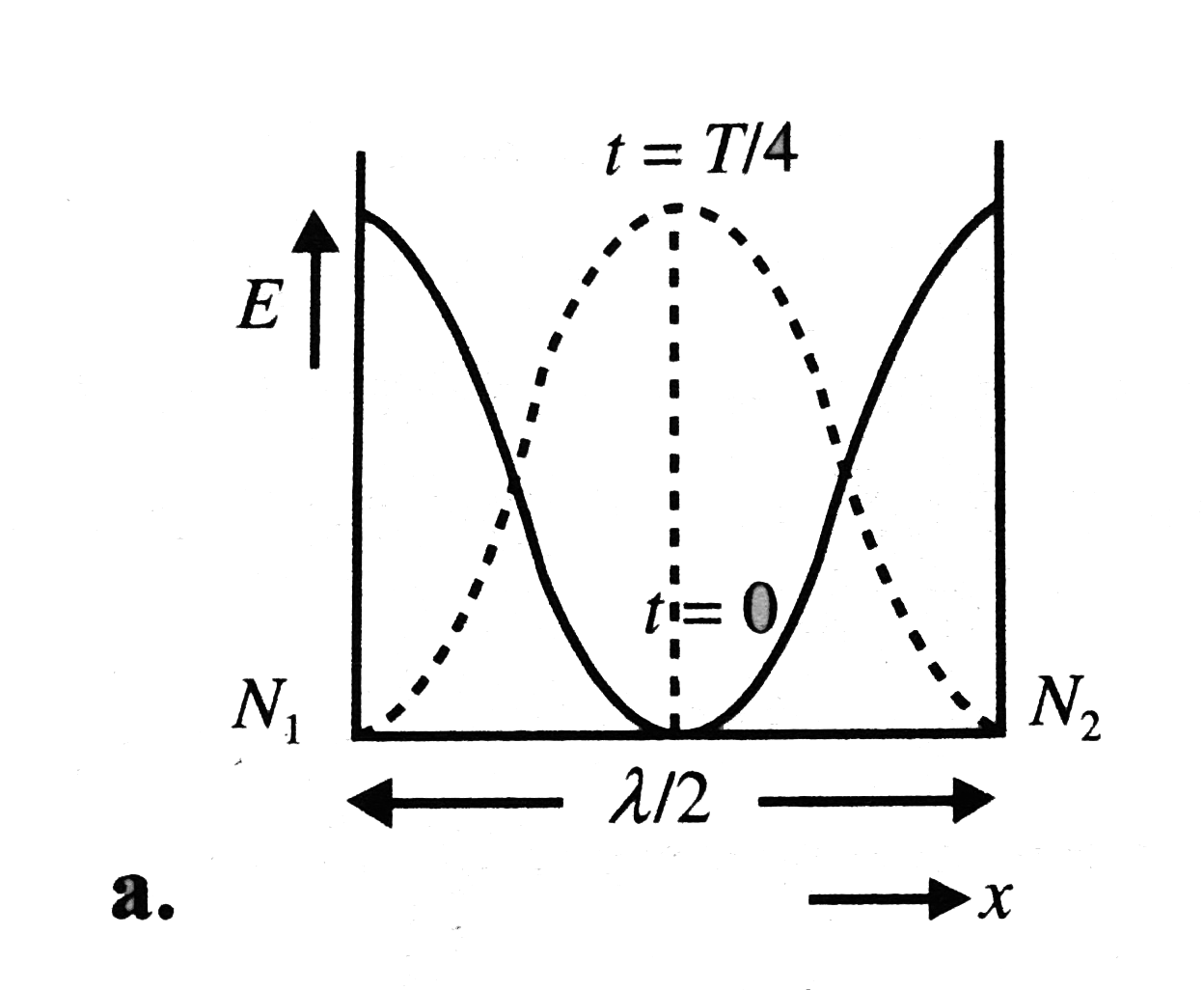
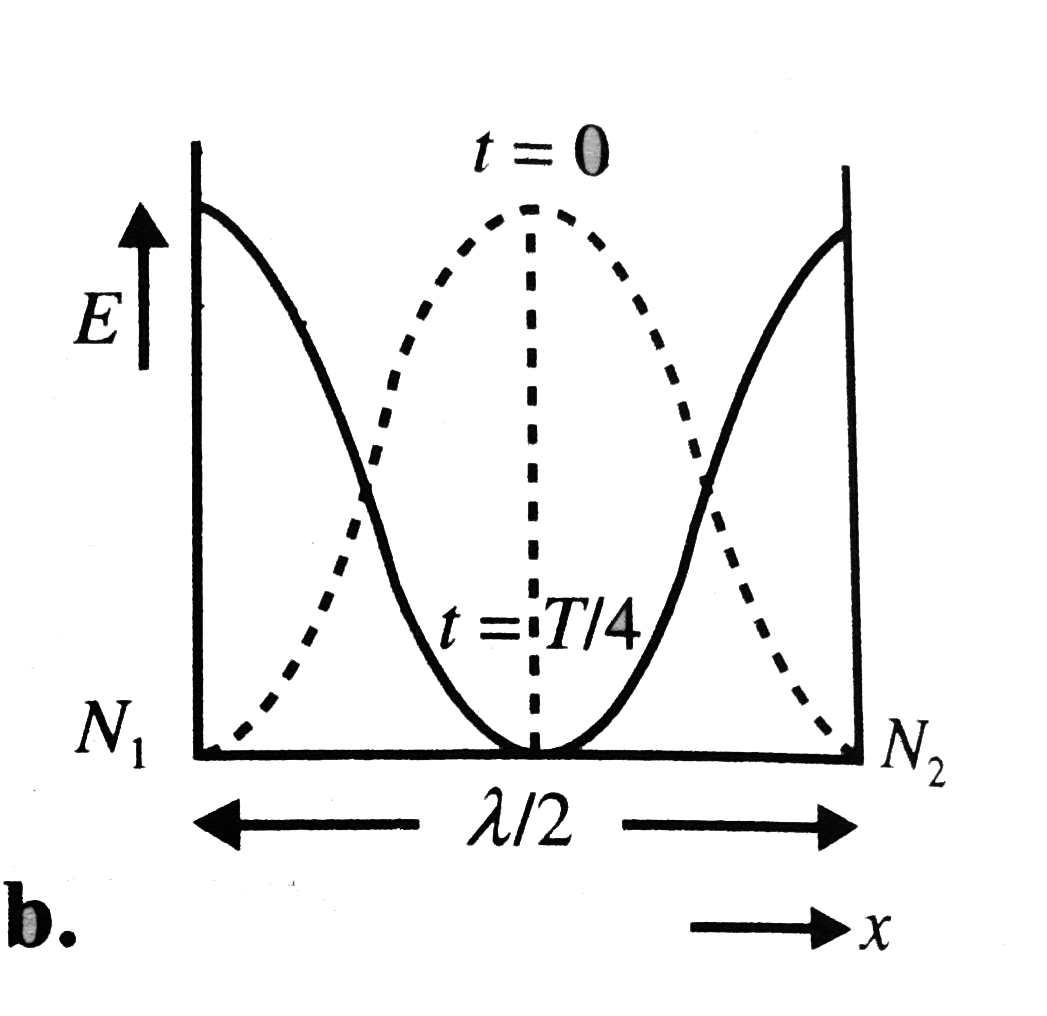
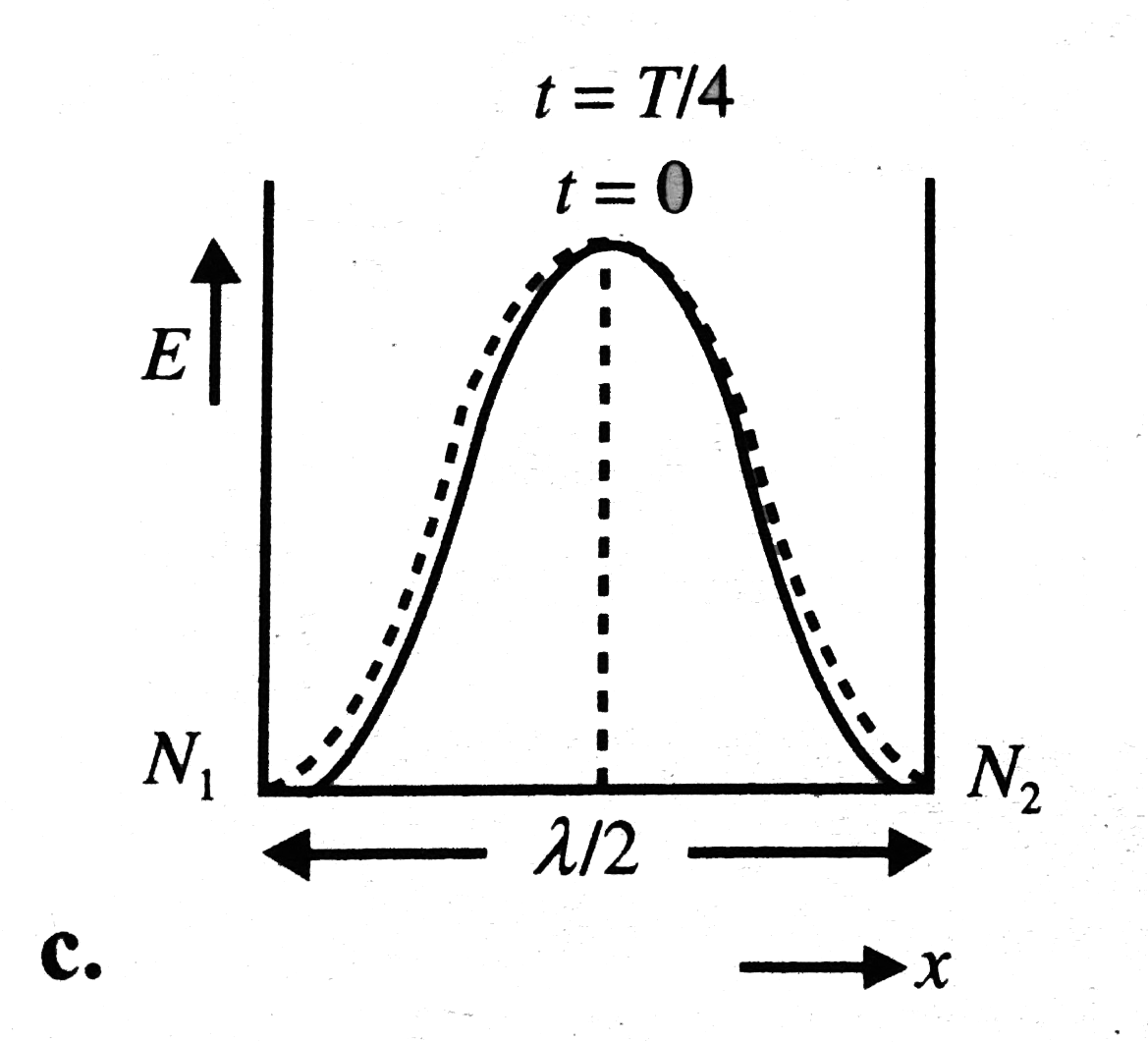
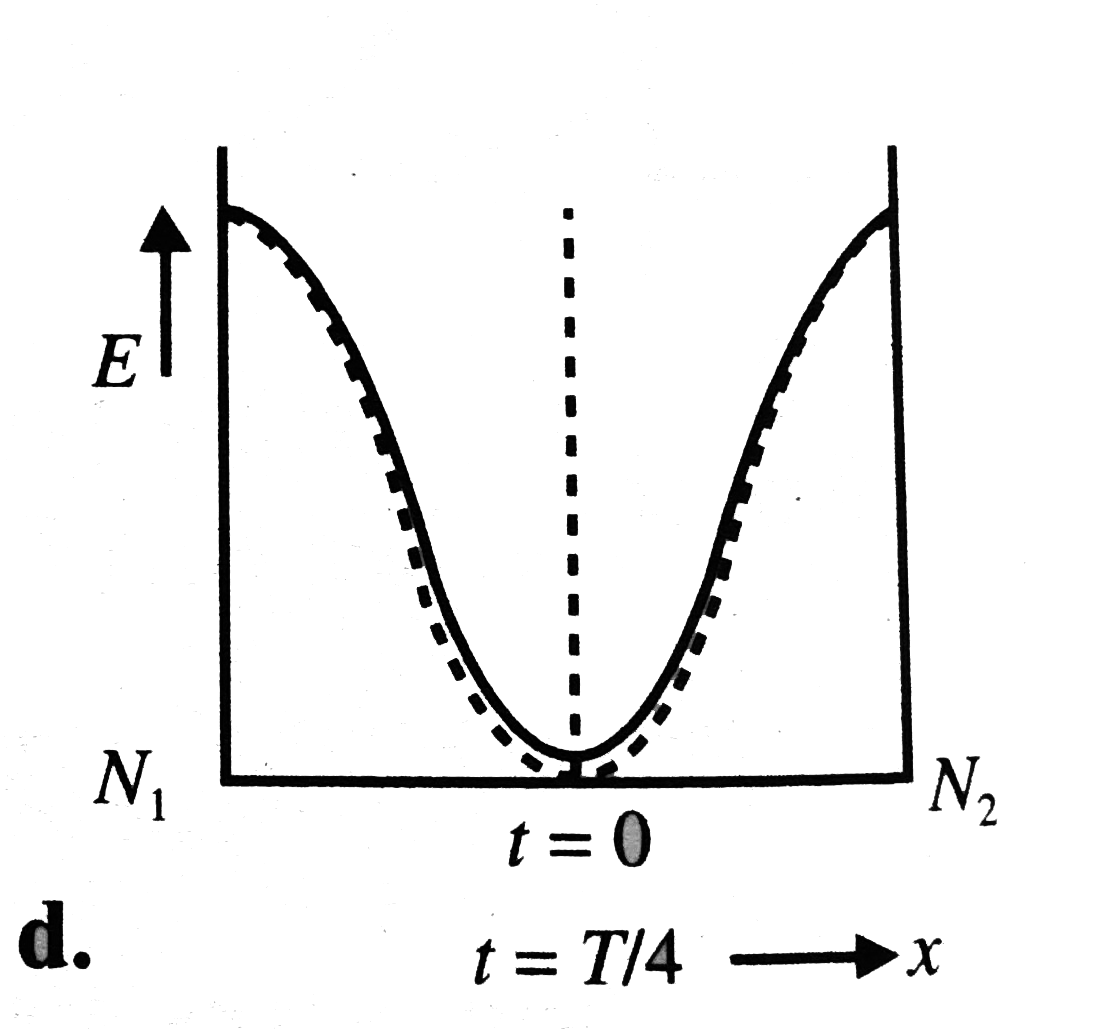
If a graph `E ( = E_(p) + E_(k))` versus `t` , i.e., total space energy density verus time were drawn at the instants of time `t = 0` and `t = T//4`, between two successive nodes separated by distance `lambda//2` which of the following graphs correctly shows the total energy `(E)` distribution at the two instants.

A

B

C

D

Text Solution

AI Generated Solution

The correct Answer is:

To solve the problem of finding the correct graph for the total energy distribution of a longitudinal standing wave at two different time instances, we will follow these steps: ### Step 1: Understand the standing wave equation The given standing wave is represented by the equation: \[ y = a \cos(kx) \cos(\omega t) \] where: - \( a \) is the amplitude, - \( k \) is the wave number, - \( \omega \) is the angular frequency. ### Step 2: Write the expression for total energy density The total energy density \( E \) is the sum of potential energy density \( E_p \) and kinetic energy density \( E_k \): \[ E = E_p + E_k \] The expressions for potential and kinetic energy densities are: \[ E_p = \frac{1}{2} Y \left( \frac{dy}{dx} \right)^2 \] \[ E_k = \frac{1}{2} \rho \left( \frac{dy}{dt} \right)^2 \] where \( Y \) is Young's modulus and \( \rho \) is the density of the medium. ### Step 3: Calculate \( E \) at \( t = 0 \) At \( t = 0 \): \[ y = a \cos(kx) \cos(0) = a \cos(kx) \] Now, we differentiate \( y \) with respect to \( x \) and \( t \): 1. \( \frac{dy}{dx} = -a k \sin(kx) \) 2. \( \frac{dy}{dt} = -a \omega \sin(\omega t) \) Substituting these into the energy density equations: \[ E_p = \frac{1}{2} Y \left(-a k \sin(kx)\right)^2 = \frac{1}{2} Y a^2 k^2 \sin^2(kx) \] \[ E_k = \frac{1}{2} \rho \left(-a \omega \sin(0)\right)^2 = 0 \] Thus, at \( t = 0 \): \[ E = E_p = \frac{1}{2} Y a^2 k^2 \sin^2(kx) \] ### Step 4: Calculate \( E \) at \( t = \frac{T}{4} \) At \( t = \frac{T}{4} \): \[ y = a \cos(kx) \cos\left(\frac{\pi}{2}\right) = 0 \] Now, substituting \( t = \frac{T}{4} \) into the derivatives: 1. \( \frac{dy}{dx} = -a k \sin(kx) \) 2. \( \frac{dy}{dt} = -a \omega \sin\left(\frac{\pi}{2}\right) = -a \omega \) Now substituting into the energy density equations: \[ E_p = 0 \] \[ E_k = \frac{1}{2} \rho \left(-a \omega\right)^2 = \frac{1}{2} \rho a^2 \omega^2 \] Thus, at \( t = \frac{T}{4} \): \[ E = E_k = \frac{1}{2} \rho a^2 \omega^2 \] ### Step 5: Analyze the graphs 1. At \( t = 0 \), the energy density \( E \) is proportional to \( \sin^2(kx) \), which has nodes at \( x = n\frac{\pi}{k} \) (where \( n \) is an integer). 2. At \( t = \frac{T}{4} \), the energy density \( E \) is proportional to \( \cos^2(kx) \), which has nodes at \( x = (n + \frac{1}{2})\frac{\pi}{k} \). ### Step 6: Identify the correct graph From the analysis, the graph for \( E \) at \( t = 0 \) should show peaks at \( x = \frac{\pi}{2k} \) and \( x = \frac{3\pi}{2k} \) (sine squared function), while at \( t = \frac{T}{4} \), the graph should show peaks at \( x = 0 \) and \( x = \pi \) (cosine squared function). Based on the options provided, the correct graph that represents these conditions is **Option A**.

To solve the problem of finding the correct graph for the total energy distribution of a longitudinal standing wave at two different time instances, we will follow these steps: ### Step 1: Understand the standing wave equation The given standing wave is represented by the equation: \[ y = a \cos(kx) \cos(\omega t) \] where: - \( a \) is the amplitude, - \( k \) is the wave number, ...
Promotional Banner

Topper's Solved these Questions

  • SUPERPOSITION AND STANDING WAVES

    CENGAGE PHYSICS ENGLISH|Exercise Integer|9 Videos
  • SUPERPOSITION AND STANDING WAVES

    CENGAGE PHYSICS ENGLISH|Exercise Single Correct Answer Type|56 Videos
  • SUPERPOSITION AND STANDING WAVES

    CENGAGE PHYSICS ENGLISH|Exercise Assertion - Reasoning|6 Videos
  • SOUND WAVES AND DOPPLER EFFECT

    CENGAGE PHYSICS ENGLISH|Exercise Integer|16 Videos
  • THERMODYNAMICS

    CENGAGE PHYSICS ENGLISH|Exercise 24|1 Videos

Similar Questions

Explore conceptually related problems

A longitudinal standing wave y = a cos kx cos omega t is maintained in a homogeneious medium of density rho . Here omega is the angular speed and k , the wave number and a is the amplitude of the standing wave . This standing wave exists all over a given region of space. The space density of the kinetic energy . KE = E_(k) ( x, t) at the point (x, t) is given by

A longitudinal standing wave y = a cos kx cos omega t is maintained in a homogeneious medium of density rho . Here omega is the angular speed and k , the wave number and a is the amplitude of the standing wave . This standing wave exists all over a given region of space. The space density of the potential energy PE = E_(p)(x , t) at a point (x , t) in this space is

In a standing wave, node is a point of

Which of the following represents a standing wave ?

Standing waves can be produced

Standing waves can be produced

A standing wave xi= a sin kx. Cos omegat is maintained in a homogeneous rod with cross - sectional area S and density rho . Find the total mechanical energy confined between the sections corresponding to the adjacent displacement nodes.

The stationary wave y = 2a sinkx cos omega t in a stretched string is the result of superposition of y_(1)=a sin(kx-omegat) and

In a standing transerse wave on a string :

As the e.m. waves travel in free space

CENGAGE PHYSICS ENGLISH-SUPERPOSITION AND STANDING WAVES-Comprehension
  1. A longitudinal standing wave y = a cos kx cos omega t is maintained i...

    Text Solution

    |

  2. A longitudinal standing wave y = a cos kx cos omega t is maintained i...

    Text Solution

    |

  3. A longitudinal standing wave y = a cos kx cos omega t is maintained i...

    Text Solution

    |

  4. In a standing wave experiment , a 1.2 - kg horizontal rope is fixed in...

    Text Solution

    |

  5. In a standing wave experiment , a 1.2 - kg horizontal rope is fixed in...

    Text Solution

    |

  6. In a standing wave experiment , a 1.2 - kg horizontal rope is fixed in...

    Text Solution

    |

  7. In an organ pipe (may be closed or open ) of 99 cm length standing wav...

    Text Solution

    |

  8. In an organ pipe ( may be closed or open of 99 cm length standing wave...

    Text Solution

    |

  9. In an organ pipe (may be closed or open ) of 99 cm length standing wav...

    Text Solution

    |

  10. Estimate the fraction of molecular volume to the actual volume occupie...

    Text Solution

    |

  11. Two plane harmonic sound waves are expressed by the equations. y(1)(...

    Text Solution

    |

  12. Two waves y(1) = A cos (0.5 pi x - 100 pi t) and y(2) = A cos (0.46 pi...

    Text Solution

    |

  13. Two waves y(1) = A cos (0.5 pi x - 100 pi t) and y(2) = A cos (0.46 pi...

    Text Solution

    |

  14. An oscillator of frequency 680 Hz drives two speakers . The speakers a...

    Text Solution

    |

  15. An oscillator of frequency 680 Hz drives two speakers . The speakers a...

    Text Solution

    |

  16. An oscillator of frequency 680 Hz drives two speakers . The speakers a...

    Text Solution

    |

  17. An oscillator of frequency 680 Hz drives two speakers . The speakers a...

    Text Solution

    |

  18. Consider a standing wave formed on a string . It results due to the su...

    Text Solution

    |

  19. Consider a standing wave formed on a string . It results due to the su...

    Text Solution

    |

  20. Consider a standing wave formed on a string . It results due to the su...

    Text Solution

    |
