
Home
Class 12
PHYSICS
A particle starts moving with constant, ...

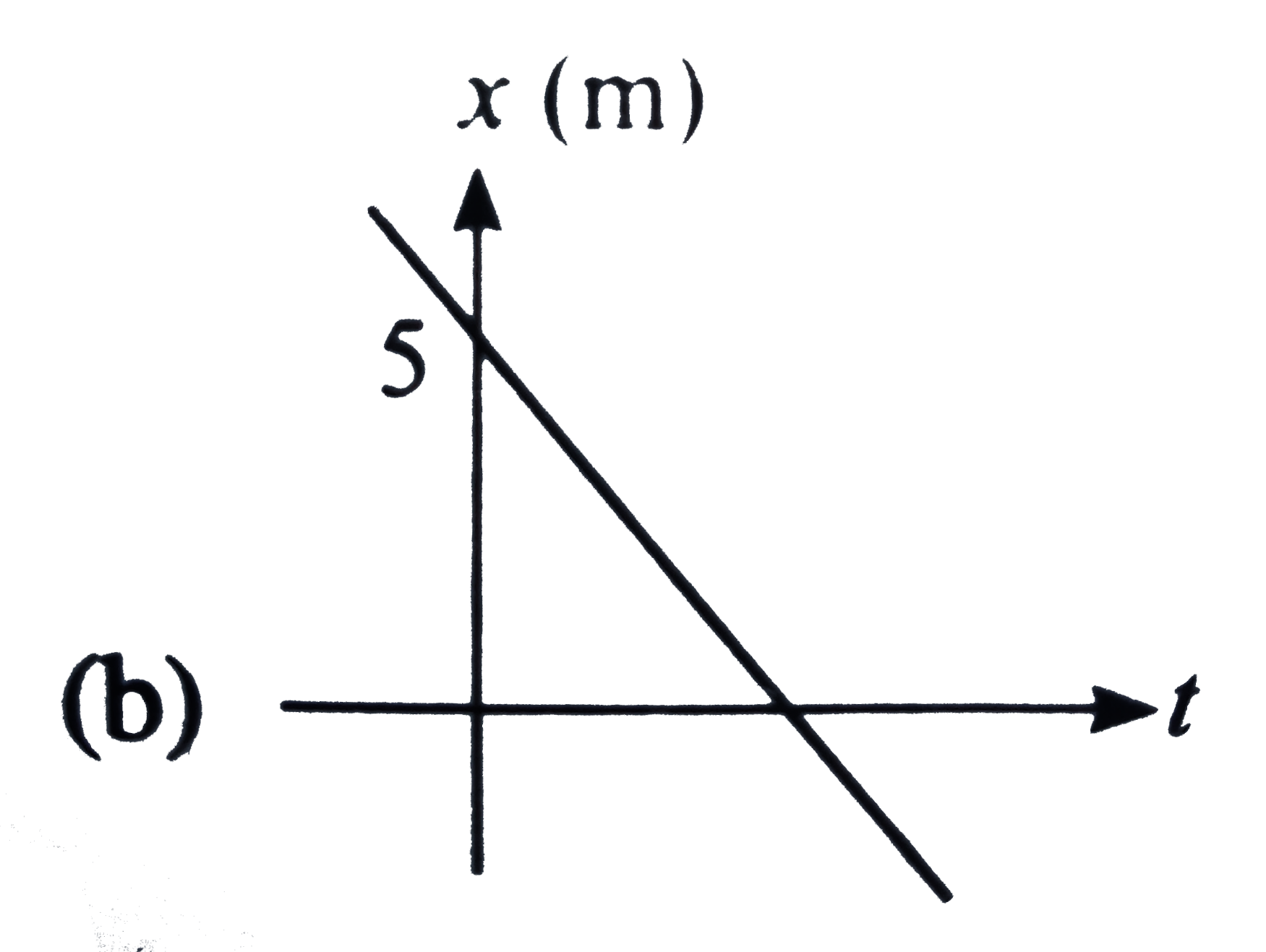
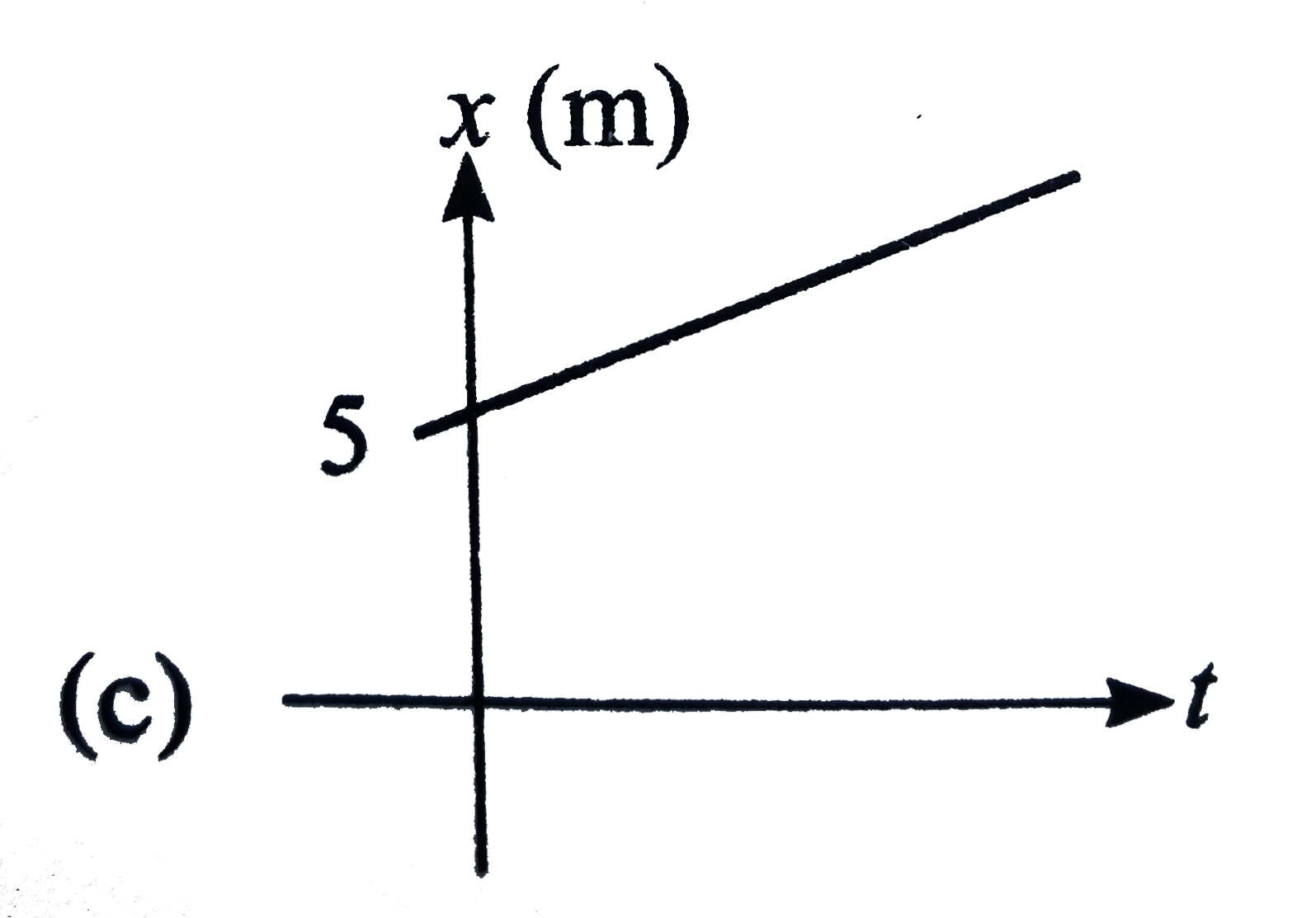
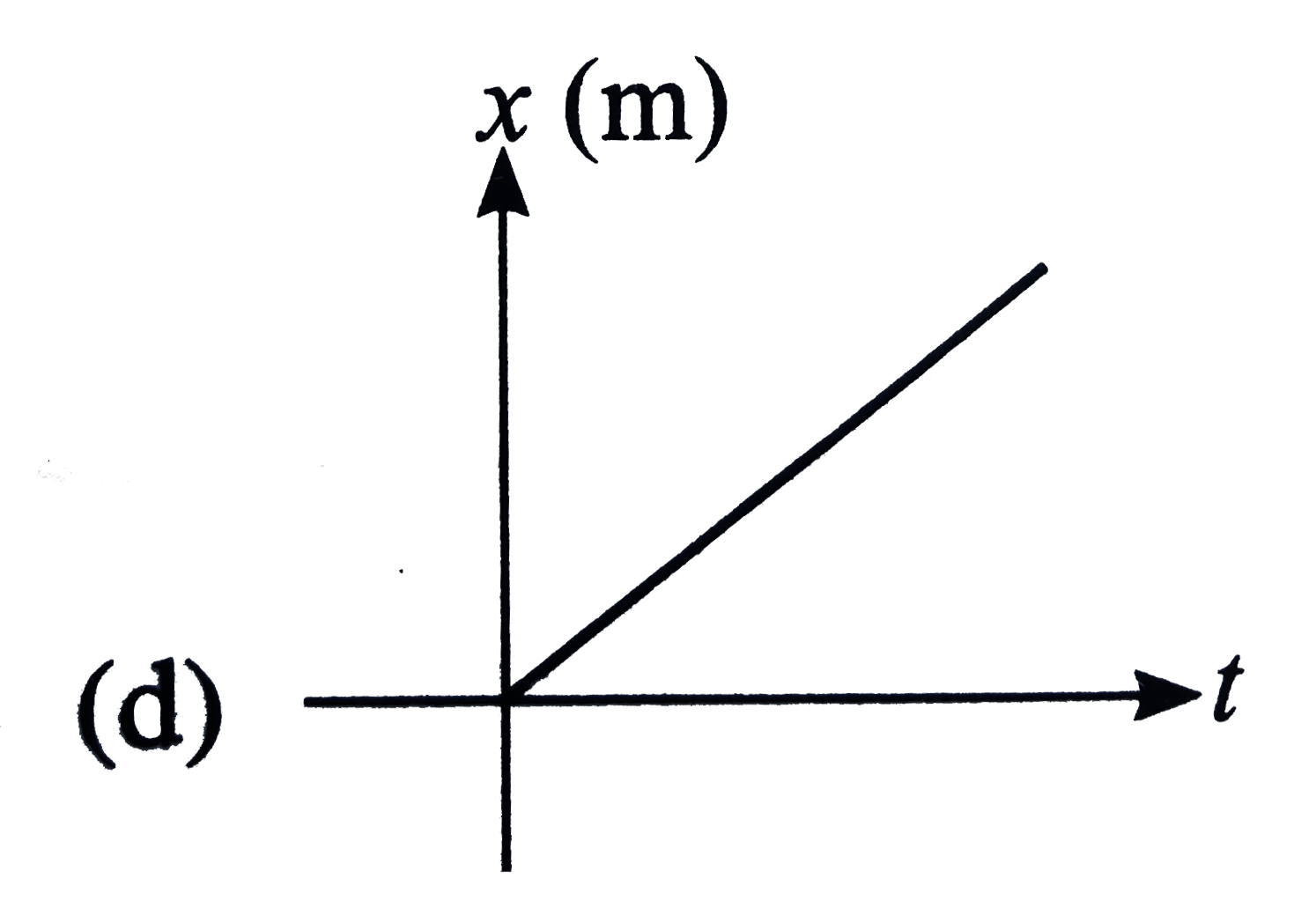
A particle starts moving with constant, velocity `v=2(m)/(s)`, from position `x=5m` The position time graph will be

A

B

C

D

Text Solution

AI Generated Solution

The correct Answer is:

To solve the problem of finding the position-time graph for a particle moving with a constant velocity, we can follow these steps: ### Step 1: Understand the given information The particle starts at position \( x = 5 \, \text{m} \) and moves with a constant velocity \( v = 2 \, \text{m/s} \). ### Step 2: Set up the equation of motion Since the particle is moving with constant velocity, we can use the equation of motion: \[ x(t) = x_0 + vt \] where: - \( x(t) \) is the position at time \( t \), - \( x_0 \) is the initial position, - \( v \) is the constant velocity, - \( t \) is the time. ### Step 3: Substitute the known values Given that \( x_0 = 5 \, \text{m} \) and \( v = 2 \, \text{m/s} \), we substitute these values into the equation: \[ x(t) = 5 + 2t \] ### Step 4: Analyze the equation The equation \( x(t) = 5 + 2t \) is a linear equation in the form \( y = mx + c \), where: - \( m \) (the slope) is \( 2 \), - \( c \) (the y-intercept) is \( 5 \). ### Step 5: Draw the graph 1. The y-intercept (where \( t = 0 \)) is at \( x = 5 \, \text{m} \). 2. The slope of the line is \( 2 \), which means for every 1 second that passes, the position increases by \( 2 \, \text{m} \). 3. Thus, the graph will be a straight line starting from the point \( (0, 5) \) and rising with a slope of \( 2 \). ### Step 6: Identify the characteristics of the graph - The graph is a straight line with a positive slope. - The line crosses the y-axis at \( 5 \, \text{m} \). ### Conclusion The position-time graph of the particle is a straight line starting at \( (0, 5) \) and rising with a slope of \( 2 \).

To solve the problem of finding the position-time graph for a particle moving with a constant velocity, we can follow these steps: ### Step 1: Understand the given information The particle starts at position \( x = 5 \, \text{m} \) and moves with a constant velocity \( v = 2 \, \text{m/s} \). ### Step 2: Set up the equation of motion Since the particle is moving with constant velocity, we can use the equation of motion: \[ ...
Promotional Banner

Topper's Solved these Questions

  • CENGAGE PHYSICS DPP

    CENGAGE PHYSICS ENGLISH|Exercise subjective type|51 Videos
  • CENGAGE PHYSICS DPP

    CENGAGE PHYSICS ENGLISH|Exercise Multiple correct Answer Type|54 Videos
  • CAPACITOR AND CAPACITANCE

    CENGAGE PHYSICS ENGLISH|Exercise Integer|5 Videos
  • COULOMB LAW AND ELECTRIC FIELD

    CENGAGE PHYSICS ENGLISH|Exercise Single Answer Correct Type|22 Videos

Similar Questions

Explore conceptually related problems

A particle starts moving with initial velocity 3m//s along x - axis from origin. Its acceleration is varying with x co-ordinate in parobalic nature as shown in the figure. At x=1m , tangent to the graph makes an angle 45^(@) with positive x - aixs. Then at x=3m ,

At t=0 , a particle at (1,0,0) moves towards point (4,4,12) with a constant velocity of magnitude 65m//s . The position of the particle is measured in metres and time in sec. Assuming constant velocity, the position of the particle at t=2 sec is :

A car breaks a traffic signal with a speed of 40m//s . After 2s , a policeman starts following him with a constant acceleration of 12.5m//s^(2) . Taking the position of signal to be origin, correct position time graph would be

A body is moving with constant acceleration, a= 5 m/s^2 from A to B in straight line AB. The velocity of particle at A and B are 5 m/s and 15 m/s respectively. The velocity at mid-point of AB is

A particle starts from the origin at time t = 0 and moves along the positive x-axis. The graph of velocity with respect to time is shown in figure. What is the position of the particle at time t = 5s ?

A particle is in motion on the x-axis. The variation ofits velocity with position is as shown. The graph is circle and its equation is x^(2)+v^(2)=1 , where x is in m and v in m/s. The correct statement(s) is/are:-

Acceleration of particle moving along the x-axis varies according to the law a=-2v , where a is in m//s^(2) and v is in m//s . At the instant t=0 , the particle passes the origin with a velocity of 2 m//s moving in the positive x-direction. (a) Find its velocity v as function of time t. (b) Find its position x as function of time t. (c) Find its velocity v as function of its position coordinates. (d) find the maximum distance it can go away from the origin. (e) Will it reach the above-mentioned maximum distance?

Two particles A and B are initially 40 m apart, A is behind B . Particle A is moving with uniform velocity of 10 m s^(-1) towared B . Particle B starts moving away from A with constant acceleration of 2 m s^(-1) . The time which there is a minimum distance between the two is .

A particle starts from origin O from rest and moves with a uniform acceleration along the positive x=axis. Identify all figures that correctly represent the motion qualitatively. (a=acceleration , v=velocity, x=displacement,t=time)

A particle is moving along x-direction with a constant acceleration a. The particle starts from x=x_0 position with initial velocity u. We can define the position of the particle with time by the relation x=x_0+ut+(1)/(2)at^2 plot the position of the particle in relation with time is following situations (i) If initial position of the particle is on negativ x-axis, initial velocity is positive and acceleration is negative. (ii) If initial position is positive, initial velocity is negative and acceleration is positive.

CENGAGE PHYSICS ENGLISH-CENGAGE PHYSICS DPP-Single Correct Answer type
  1. The spring force is given by F=-kx, here k is a constant and x is the ...

    Text Solution

    |

  2. A body is attached to a spring whose other end is fixed. If the spring...

    Text Solution

    |

  3. A particle starts moving with constant, velocity v=2(m)/(s), from posi...

    Text Solution

    |

  4. A stone is allowed to fall freely from a certain Height. Neglecting ai...

    Text Solution

    |

  5. If y=x^2+2x-3,y-x graph is

    Text Solution

    |

  6. The velcocity displacement graph of a particle moving along a straight...

    Text Solution

    |

  7. Which of the following best represents the graph of velocity (v) versu...

    Text Solution

    |

  8. Differentiation of sin(x^2) w.r.t. x is

    Text Solution

    |

  9. If y=2sin^2theta+tantheta then (dy)/(dtheta) will be

    Text Solution

    |

  10. If y=sinx and x=3t then (dy)/(dt) will be

    Text Solution

    |

  11. If y=sin(t^2), then (d^2y)/(dt^2) will be

    Text Solution

    |

  12. The displace ment of a body at any time t after starting is given by s...

    Text Solution

    |

  13. if y=x^2sinx+(3x)/(tanx), then (dy)/(dx) will be

    Text Solution

    |

  14. The value of the function (x-1)(x-2)^2 at its maxima is

    Text Solution

    |

  15. The adjacent sides of a rectangle with given perimeter as 100 cm and e...

    Text Solution

    |

  16. The area of a rectangle will be maximum for the given perimeter, when ...

    Text Solution

    |

  17. if x+y=10, thent he maximum value of xy is

    Text Solution

    |

  18. the sum of two numbers is fixed. Then its multiplication is maximum, w...

    Text Solution

    |

  19. If sum of two numbers is 3, then maximum value of the product of first...

    Text Solution

    |

  20. If from a wire of length 36 metre a rectangle of greatest area is made...

    Text Solution

    |
