Home
Class 12
PHYSICS
Two identical small balls each have a ma...

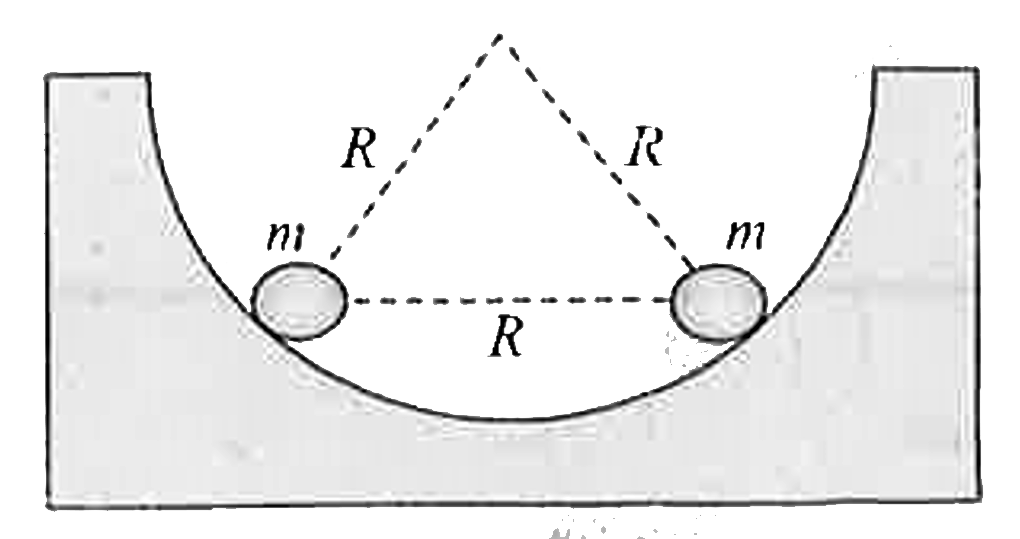
Two identical small balls each have a mass m and charge q. When placed in a hemispherical bowl of radius R with frictionless, nonconductive walls, the bead move, and at equilibrium the line joining the balls is horizontal and the distance between them is R (see figure). Neglect any induced charge on the hemispherical bowl. Then the charge on each bead is : (here `K=(1)/(4piepsilon_(0))`)

A

`q=R((mg)/(Ksqrt(3)))^(1//2)`

B

`q=(R(mg)/(Ksqrt(3)))^(1//2)`

C

`q=R((sqrt(3)mg)/(K))^(1//2)`

D

`q=(R(sqrt(3)mg)/(K))^(1//2)`

Text Solution

Verified by Experts

The correct Answer is:

A
Promotional Banner

Topper's Solved these Questions

  • COULOMB LAW AND ELECTRIC FIELD

    CENGAGE PHYSICS ENGLISH|Exercise Multiple Correct Answer Type|1 Videos
  • COULOMB LAW AND ELECTRIC FIELD

    CENGAGE PHYSICS ENGLISH|Exercise Single Answer Correct Type|22 Videos
  • COULOMB LAW AND ELECTRIC FIELD

    CENGAGE PHYSICS ENGLISH|Exercise Comprehension Type|2 Videos
  • CENGAGE PHYSICS DPP

    CENGAGE PHYSICS ENGLISH|Exercise subjective type|51 Videos
  • ELECTRIC CURRENT & CIRCUITS

    CENGAGE PHYSICS ENGLISH|Exercise Kirchhoff s law and simple circuits|15 Videos

Similar Questions

Explore conceptually related problems

Two identical beads each have a mass m and charge q. When placed in a hemispherical bowl of radius R with frictionless, non-conducting walls, the beads move, and at equilibrium they area distance R apart (figure). Determine the charge on each bead.

Five charges each q are placed at five corners regular pentagon. Distance from corner to the centre of pontagon is r . Then (K=(1)/(4pi epsilon_(0)))

Two identical small conducting spheres having unequal positive charges q_1 and q_2 are separated by a distance r. If they are now made to touch each other and then separated again to the same distance, the electrostatic force between them in this case will be

Two identical small conducting spheres having unequal positive charges q_1 and q_2 are separated by a distance r. If they are now made to touch each other and then separated again to the same distance, the electrostatic force between them in this case will be

Two identical balls having like charges and placed at a certain distance apart repel each other with a certain force. They are brought in contact and then moved apart to a distance equal to half their initial separation. The force of repulsion between them increases 4.5 times in comparision with the initial value. The ratio of the initial charges of the balls is

Two identical metals balls with charges +2Q and -Q are separated by some distance and exert a force F on each other . They are joined by a conducting wire , which is then removed. The force between them will now be

Two identical small equally charged conducting balls are suspended from long threads secured at one point. The charges and masses of the balls are such that they are in equilibrium when the distance between them is a(the length of thread Lgtgta ). Then one of the balls is discharged. what will be the distance b(bltltL) between the balls when equilibrium is restored?

Two equally charged identical small balls kept some fixed disttance apart exert a repulsive force F on each other. A similar uncharged ball, after touching one of them is placed at the mid-point of line joining the two balls. Force experienced by the third ball is

There are two concentric conducting spherical shells of radius r_A and r_B respectively (r_B= 2r_A) . If the inner shell is given a charge Q and outer shell is given a charge 2Q, then the potential difference between the surfaces of the shells will be K=1/(4piepsilon_0)

A particle of charge -q and mass m moves in a circle of radius r around an infinitely long line charge of linear charge density +lamda . Then, time period will be where , k=1/4piepsilon_0)

CENGAGE PHYSICS ENGLISH-COULOMB LAW AND ELECTRIC FIELD-Single Correct Answer Type
  1. Four charges equal to -Q are placed at the four corners of a square an...

    Text Solution

    |

  2. Three charges -q(1), +q(2) and -q(3) are placed as shown in the figure...

    Text Solution

    |

  3. Two similar balloons filled with helium gas are tied to L m long strin...

    Text Solution

    |

  4. Two small spheres of masses M(1) and M(2) are suspended by weightless ...

    Text Solution

    |

  5. Two identical small balls each have a mass m and charge q. When placed...

    Text Solution

    |

  6. Three similar charges +q are placed on 3 corners of an equilateral tri...

    Text Solution

    |

  7. Four similar (+q) are placed at origin O, B, C and D as shown. The ang...

    Text Solution

    |

  8. In the configuration as shown +q charge is placed at origin and Q and ...

    Text Solution

    |

  9. The insulation property of air breaks down at E = 3 xx 10^(6) V//m. Th...

    Text Solution

    |

  10. Two point charges -q and +(q)/(2) are situated at the origin and at th...

    Text Solution

    |

  11. Two point charges +4q and +q are placed at a distance L apart. A thir...

    Text Solution

    |

  12. Three point charges as shown are placed at the vertices of an isoscele...

    Text Solution

    |

  13. In the following four situations charged particles are equal distance ...

    Text Solution

    |

  14. Five point charge each having magnitudes q are placed at the corner of...

    Text Solution

    |

  15. Figure below show regular hexagons, with charges at the vertices. In w...

    Text Solution

    |

  16. Charges q, 2q,3q and 4q are placed at the corners A,B,C and D of a squ...

    Text Solution

    |

  17. Infinite charges of magnitude q each are lying at x = 1, 2, 4, 8,... M...

    Text Solution

    |

  18. Two semicircular rings lying in same plane, of uniform linear charge d...

    Text Solution

    |

  19. Two concentric rings, one of radius R and total charge +Q and second o...

    Text Solution

    |

  20. An infinitely long wire is kept along z-axis from z= oo to z=oo, havin...

    Text Solution

    |
