Home
Class 11
CHEMISTRY
An ideal gas is taken around the cycle A...

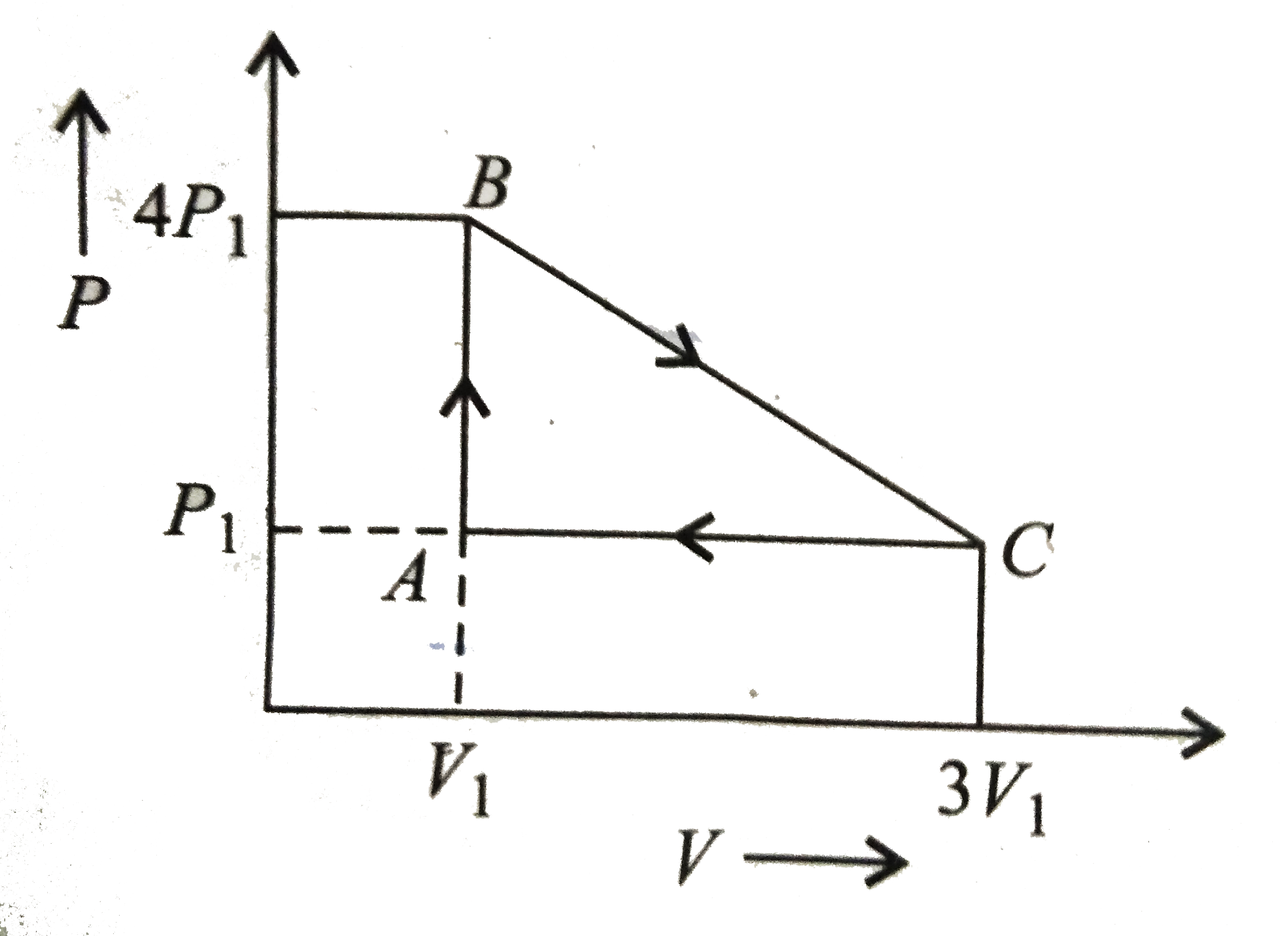
An ideal gas is taken around the cycle `ABCD` shown in the `P_V` diagram below. The net work done by the gas during the cycle is equal to

A

`12 P_(1)V_(1)`

B

`6P_(1)V_(1)`

C

`3P_(1)V_(1)`

D

`P_(1)V_(1)`

Text Solution

Verified by Experts

`w = DeltaP DeltaV = (4P_(1)-P_(1)) (3V_(1) - V_(1)) = 3(P_(1)V_(1))`
Promotional Banner

Topper's Solved these Questions

  • THERMODYNAMICS

    CENGAGE CHEMISTRY ENGLISH|Exercise Exercise|1 Videos
  • THERMODYNAMICS

    CENGAGE CHEMISTRY ENGLISH|Exercise Ex 6.1|26 Videos
  • STOICHIOMETRY

    CENGAGE CHEMISTRY ENGLISH|Exercise Archives Subjective|33 Videos

Similar Questions

Explore conceptually related problems

An ideal gas is taken around the cycle ABCA as shown in the P-V diagram. The total work done by the gas during the cycle is

An ideal gas is taken around the cycle ABCA as shown in P-V diagram. The net work done by the gas during the cycle is equal to :

An ideal gas is taken around the cycle ABCA as shown in P-V diagram. The net work done by the gas during the cycle is equal to :

An ideal gas is taken around the cycle ABCA shown in P - V diagram. The net work done by the gas during the cycle is equal to

An ideal gas is taken around the cycle ABCA shown in P - V diagram. The net work done by the gas during the cycle is equal to

An ideal monoatomic gas is taken round the cycle ABCDA as shown in the P-V diagram. The work done during the cycle is

An ideal monoatomic gas is taken round the cycle ABCDA as shown in the P-V diagram. The work done during the cycle is

An ideal monoatomic gas is taken round the cycle ABCDA as shown in the P-V diagram. The work done during the cycle is

One mole of a monatomic ideal gas is taken along the cycle ABCA as shown in the diagram. The net heat absorbed by the gas in the given cycle is

An ideal gas is taken around ABCA as shown in the above P-V diagram. The work done during a cycle is

CENGAGE CHEMISTRY ENGLISH-THERMODYNAMICS-Archives (Subjective)
  1. An ideal gas is taken around the cycle ABCD shown in the PV diagram be...

    Text Solution

    |

  2. The enthalpies for the following reactions (DeltaH^(Theta)) at 25^(@)C...

    Text Solution

    |

  3. The standared enthalpies of formation at 298K for C C1(g), H(2)O(g), C...

    Text Solution

    |

  4. Given that: i. C(s) + O(2)(g) rarr CO(2)(g) , DeltaH =- 94.05 kcal ...

    Text Solution

    |

  5. The following statement is true only under some specific conditions. W...

    Text Solution

    |

  6. The bond dissociation energies of gaseous H(2),Cl(2), and HCl are 100,...

    Text Solution

    |

  7. The standard molar heat of formation of ethane, carbon dioxide and wat...

    Text Solution

    |

  8. An intimate mixture of ferric oxide and aluminium is used as solid fue...

    Text Solution

    |

  9. The enthalpy of combustion of H(2), cyclohexene (C(6)H(10)) and cycloh...

    Text Solution

    |

  10. CsOH +HCI rarr CsCI +H(2)O, DeltaH =- 13.4 kcal mol^(-1)……….(i) CsOH...

    Text Solution

    |

  11. Determine enthalpy change for, C(3)H(8(g))+H(2(g))rarr C(2)H(6(g))+C...

    Text Solution

    |

  12. Compute the heat of formation of liquid methyl alcohol in kilojoule pe...

    Text Solution

    |

  13. From the following data, calculate the enthalpy change for the combust...

    Text Solution

    |

  14. The standard heat of formation values of SF(6)(g), S(g), and F(g) are ...

    Text Solution

    |

  15. Show that the reaction CO(g) +(1//2)O(2)(g) rarr CO(2)(g) at 300K ...

    Text Solution

    |

  16. A sample of argon gas at 1atm pressure and 27^(@)C expands reversibly ...

    Text Solution

    |

  17. Determine the enthalpy of formation of B(2)H(6)(g) in kJ/mol of the fo...

    Text Solution

    |

  18. The standart potential of the following cell is 0.23 at 15^(@)C and 0....

    Text Solution

    |

  19. When 1pentyne (A) is treated with 4N alcoholic KOH at 175^(@)C, it is ...

    Text Solution

    |

  20. Two moles of a perfect gas undergo the following processes: a. A rev...

    Text Solution

    |

  21. C(v) values of He is always (3R)/(2) but C(v) values of H(2) is (3R)/(...

    Text Solution

    |

