Home
Class 11
CHEMISTRY
The persentage of ammonia produced from ...

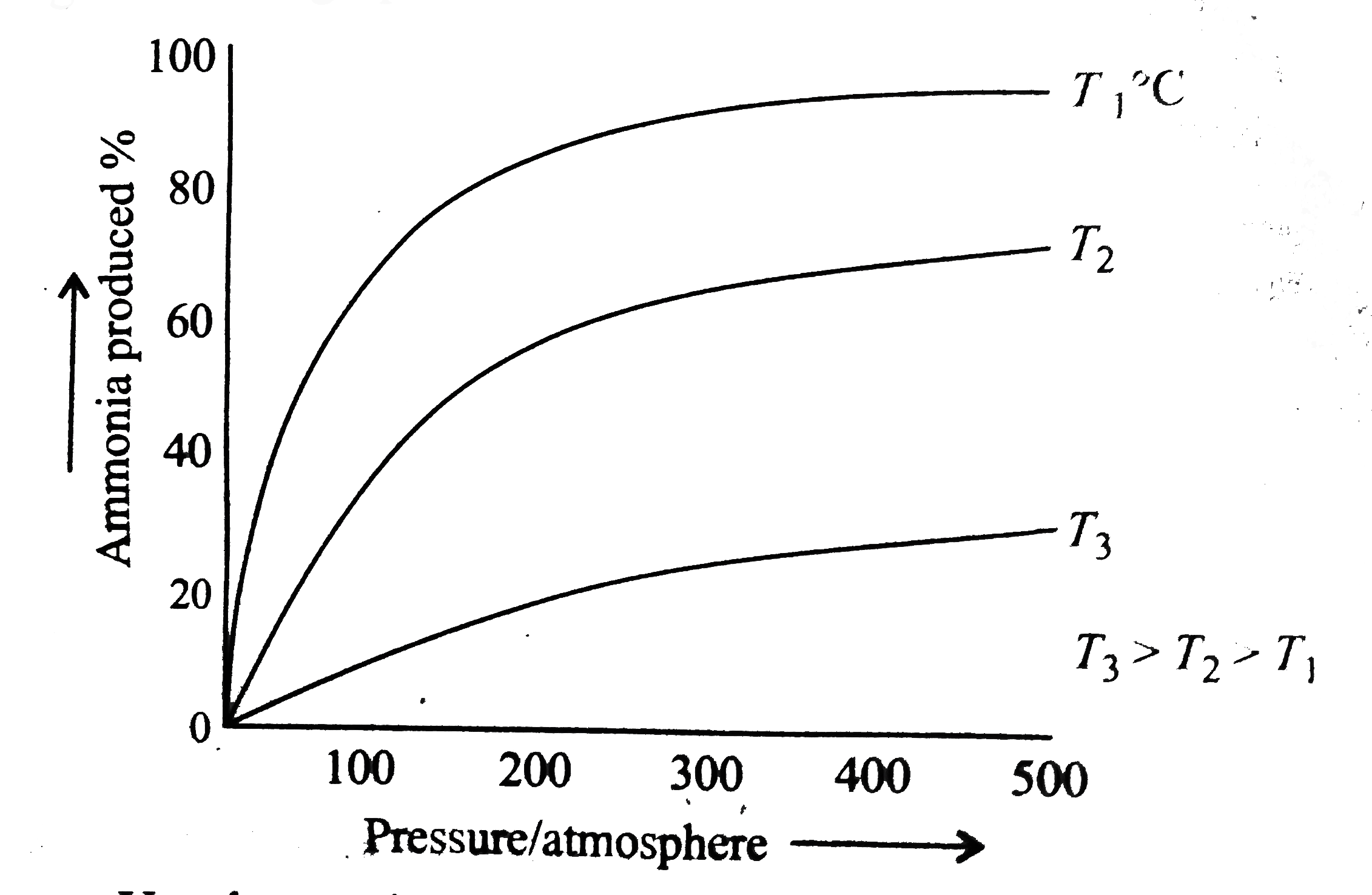
The persentage of ammonia produced from nitrogen and hydrogen under conditions of temperature and pressure is given in the graph

Use the graph answering the following questions:
What happens to the percentage of ammonia produced when the temperature is increased

A

The `%` is decreased

B

The `%` is increased

C

No effect

D

Cannot be predicted

Text Solution

Verified by Experts

The correct Answer is:

A
Promotional Banner

Topper's Solved these Questions

  • CHEMICAL EQUILIBRIUM

    CENGAGE CHEMISTRY ENGLISH|Exercise Exercises (Multiple Correct)|26 Videos
  • CHEMICAL EQUILIBRIUM

    CENGAGE CHEMISTRY ENGLISH|Exercise Exercises (Single Correct)|58 Videos
  • CHEMICAL EQUILIBRIUM

    CENGAGE CHEMISTRY ENGLISH|Exercise Exercises (Subjective)|46 Videos
  • CHEMICAL BONDING AND MOLECULAR STRUCTURE

    CENGAGE CHEMISTRY ENGLISH|Exercise Archives Subjective|15 Videos
  • CLASSIFICATION AND NOMENCLATURE OF ORGANIC COMPOUNDS

    CENGAGE CHEMISTRY ENGLISH|Exercise Analytical and Descriptive Type|3 Videos

Similar Questions

Explore conceptually related problems

The persentage of ammonia produced from nitrogen and hydrogen under conditions of temperature and pressure is given in the graph Use the graph answering the following questions: What happens to the percentage of ammonia produced when the pressure is increased?

The persentage of ammonia produced from nitrogen and hydrogen under conditions of temperature and pressure is given in the graph Use the graph answering the following questions: What conditions of pressure produce the highest percentage of ammonia?

Answer the following: What happens to enzymes if the temperature is increased.

Read the bar graph and answer the following questions. What information is given by the bar graph?

Look at the given figure and answer the following questions: What change in temperature is seen when this change takes place?

Observe the bar graph given below : Read the bar graph carefully and answer the following questions : What was the total sale during the week?

Nitrogen and hydrogen combine to form ammonia under high temperature and pressure conditions. This is an example of

In the industrial preparation of ammonia by Haber process from nitrogen and hydrogen, the reaction is carried in the temperature range of 450^@C to 500^@C and in a pressure range of 200 atm to 300 atm. Now answer the following question. What is the name of the catalyst used in the reaction?

Observe the bar graph given below : Read the bar graph carefully and answer the following questions : What is the ratio between the minimum sale and the maximum sale?

In the industrial preparation of ammonia by Haber process from nitrogen and hydrogen, the reaction is carried in the temperature range of 450^@C to 500^@C and in a pressure range of 200 atm to 300 atm. Now answer the following question. The reaction is not carried out at a lower temperature. Give one reason.

CENGAGE CHEMISTRY ENGLISH-CHEMICAL EQUILIBRIUM-Exercises (Linked Comprehensive)
  1. One "mole" of NH(4)HS(s) was allowed to decompose in a 1-L container a...

    Text Solution

    |

  2. One "mole" of NH(4)HS(s) was allowed to decompose in a 1-L container a...

    Text Solution

    |

  3. The persentage of ammonia produced from nitrogen and hydrogen under co...

    Text Solution

    |

  4. The persentage of ammonia produced from nitrogen and hydrogen under co...

    Text Solution

    |

  5. The persentage of ammonia produced from nitrogen and hydrogen under co...

    Text Solution

    |

  6. The synthesis of ammonia is given as: N(2)(g)+3H(2)(g) hArr 2NH(3)(g...

    Text Solution

    |

  7. The synthesis of ammonia is given as: N(2)(g)+3H(2)(g) hArr 2NH(3)(g...

    Text Solution

    |

  8. The synthesis of ammonia is given as: N(2)(g)+3H(2)(g) hArr 2NH(3)(g...

    Text Solution

    |

  9. The synthesis of ammonia is given as: N(2)(g)+3H(2)(g) hArr 2NH(3)(g...

    Text Solution

    |

  10. The synthesis of ammonia is given as: N(2)(g)+3H(2)(g) hArr 2NH(3)(g...

    Text Solution

    |

  11. Phosphorous pentachloride when heated in a sealed tube at 700 K it und...

    Text Solution

    |

  12. Phosphorous pentachloride when heated in a sealed tube at 700 K it und...

    Text Solution

    |

  13. Phosphorous pentachloride when heated in a sealed tube at 700 K it und...

    Text Solution

    |

  14. Phosphorous pentachloride when heated in a sealed tube at 700 K it und...

    Text Solution

    |

  15. Phosphorous pentachloride when heated in a sealed tube at 700 K it und...

    Text Solution

    |

  16. Decomposition of ammonium chloride is an endothermic reaction. The equ...

    Text Solution

    |

  17. Decomposition of ammonium chloride is an endothermic reaction. The equ...

    Text Solution

    |

  18. Decomposition of ammonium chloride is an endothermic reaction. The equ...

    Text Solution

    |

  19. Decomposition of ammonium chloride is an endothermic reaction. The equ...

    Text Solution

    |

  20. Decomposition of ammonium chloride is an endothermic reaction. The equ...

    Text Solution

    |
