Home
Class 11
CHEMISTRY
Acidic solution is defined as a solution...

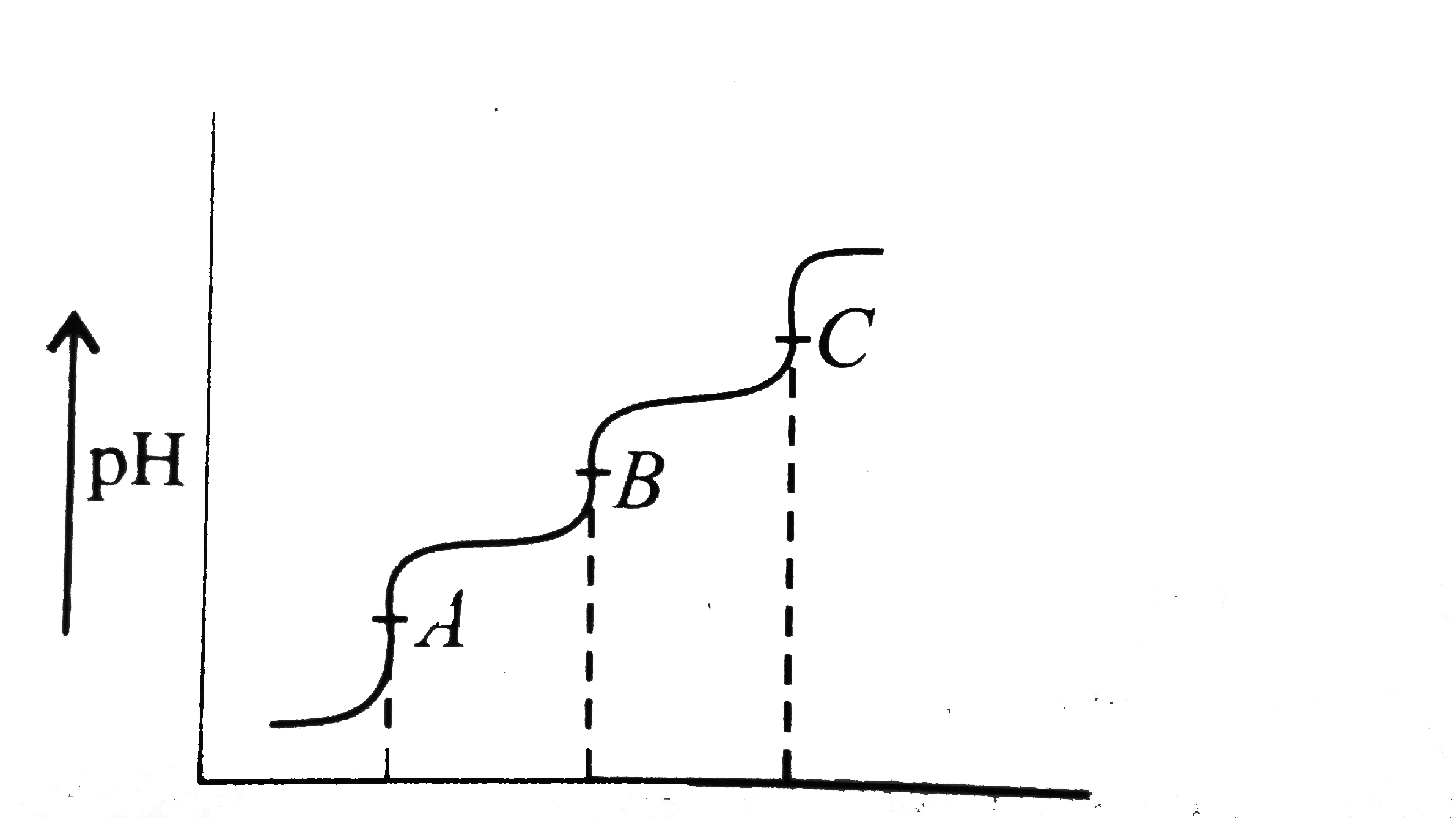
Acidic solution is defined as a solution whose `[H^(o+)] gt [overset(Theta)OH]`. Base solution has `[overset(Theta)OH] gt [H^(o+)]`. During acid-base titrations, `pH` of the mixture will change depending on the amount base added. This variation is shown in the form of graph by making plot as titration curves `100mL` of `1.0 M H_(3)A (K_(a_(1)) = 10^(-3), K_(a_(2)) = 10^(-5), K_(a_(3)) = 10^(-7))` is titrated against `0.1M NaOh`. The titration curve is as follows.

What is the `pH` at point `A?

A

`11.0`

B

`10.2`

C

`9.7`

D

`7.7`

Text Solution

Verified by Experts

The correct Answer is:

C

At point `C,Na_(3)A` is formed, hydrolysis of `A^(3-)` occurs and hydrolysis of `Na_(2)HA` is supressed, `(K_(a_(3))` is considered) due to common ion `[overset(Theta)OH]` effect
`A^(3+) + H_(2)O hArr HA^(2-) + overset(Theta)OH`
`HA^(2-)+H_(2)O hArr H_(2)A^(Theta) + overset(Theta)OH`
At point `C` salt `Na_(3)A`(salt of `W_(A)//S_(B))` is formed. since the concentration of `NaOH` and `H_(3)A (0.1)` are equal. so the volume of `NaOH` used at point `C` is `3` times the volume of `H_(3)A` used.
Total volume of solution `= 100 mL (H_(3)A)+ 300 mL (NaOH) = 400 mL`.
`M_(1)V_(1) (Before) = M_(2)V_(2) (After)`
`0.1 xx 100 = M_(2) xx 400`
`M_(2) =(0.1)/(4) = 0.025`
Hence the concentration of salt `(Na_(3)A)` formed at point `C =0.025`.
Using hydrolysis equation for `N_(3)A` (using `K_(a_(3))` value).
`pH = (1)/(2) (pK_(w) + pK_(a_(2)) + log C)`
`= (1)/(2) (14 + 7 + log 25 xx 10^(-3)) = (1)/(2) (21 - 1.6) = 9.7`
`:. pH = 6.7`.
Promotional Banner

Topper's Solved these Questions

  • IONIC EQUILIBRIUM

    CENGAGE CHEMISTRY ENGLISH|Exercise Exercises Multiple Correct|33 Videos
  • IONIC EQUILIBRIUM

    CENGAGE CHEMISTRY ENGLISH|Exercise Exercises Single Correct|121 Videos
  • IONIC EQUILIBRIUM

    CENGAGE CHEMISTRY ENGLISH|Exercise Exercises Subjective(Coordination Equilibria)|2 Videos
  • HYDROGEN, WATER AND HYDROGEN PEROXIDE

    CENGAGE CHEMISTRY ENGLISH|Exercise Subjective Archive (Subjective)|3 Videos
  • ISOMERISM

    CENGAGE CHEMISTRY ENGLISH|Exercise Assertion-Reasoning Type|1 Videos

Similar Questions

Explore conceptually related problems

Acidic solution is defined as a solution whose [H^(o+)] gt [overset(Theta)OH] . Base solution has [overset(Theta)OH] gt [H^(o+)] . During acid-base titrations, pH of the mixture will change depending on the amount base added. This variation is shown in the form of graph by making plot as titration curves 100mL of 1.0 M H_(3)A (K_(a_(1)) = 10^(-3), K_(a_(2)) = 10^(-5), K_(a_(3)) = 10^(-7)) is titrated against 0.1M NaOh . The titration curve is as follows. What will be the change in pH from point B to point C?

In a solution of 0.1M H_(3)PO_(4) acid (Given K_(a_(1))=10^(-3),K_(a_(2))=10^(-7),K_(a_(3))=10^(-12)) pH of solution is

In a solution of 0.1M H_(3)PO_(4) acid (Given K_(a_(1))=10^(-3),K_(a_(2))=10^(-7),K_(a_(3))=10^(-12)) Concentration of H_(2)PO_(4)^(-) is

In a solution of 0.1M H_(3)PO_(4) acid Given K_(a_(1))=10^(-3),K_(a_(2))=10^(-7),K_(a_(3))=10^(-12)) Concentration of HPO_(4)^(2-) is

Ratio of [HA^(+)] in 1L of 0.1M H_(3)A solution [K_(a_(1))=10^(-5),K_(a_(2))=10^(-8)K_(a_(3))=10^(-11)] & upon addition of 0.1 mole HCl to it will be :

Calculate the changes in pH of 0.1MNaHA solution after diluting it to ten times the original volume.(Given that for H_(3)A:K_(a_(1))=10^(-4),K_(a_(2))=10^(-7),K_(a_(3))=10^(-11))

Hin is an acidic indicator (K_(Ind) =10^(-7)) which dissociates into aqueous acidic solution of 30mL of 0.05M H_(3)PO_(4) (K_(1) = 10^(-3), K_(2) = 10^(-7), K_(3) = 10^(-13)) Calculate the [(Ind^(Theta))/(Hin)]

In 0.1M HCl solution, 0.1M NaOH solution is added gradually then identify the correct graph in this titration

What is the pH of 0.01M H_(2)S solution ? Also determine [HS^(-)] & [S^(2-)] Given: For H_(2)S ,K_(a_(1))=9xx10^(-8),K_(a_(2))=1.2xx10^(-13)

In acid-base titration, 0.1MHCl solution was added to the NaOH solution of unknown strength. Which of the following correctly shown the change of pH of the titration mixture in this experiment?

CENGAGE CHEMISTRY ENGLISH-IONIC EQUILIBRIUM-Exercises Linked Comprehension
  1. If methyl orange is used as a solution at pH = 2 containing the indic...

    Text Solution

    |

  2. Acidic solution is defined as a solution whose [H^(o+)] gt [overset(Th...

    Text Solution

    |

  3. Acidic solution is defined as a solution whose [H^(o+)] gt [overset(Th...

    Text Solution

    |

  4. Acidic solution is defined as a solution whose [H^(o+)] gt [overset(Th...

    Text Solution

    |

  5. In equalitative analysis, cations of graph II as well as group IV both...

    Text Solution

    |

  6. In equalitative analysis, cations of graph II as well as group IV both...

    Text Solution

    |

  7. In equalitative analysis, cations of graph II as well as group IV both...

    Text Solution

    |

  8. In equalitative analysis, cations of graph II as well as group IV both...

    Text Solution

    |

  9. The degree of dissociation of weak electrolyde is inversely proportion...

    Text Solution

    |

  10. The degree of dissociation of weak electrolyde is inversely proportion...

    Text Solution

    |

  11. The degree of dissociation of weak electrolyde is inversely proportion...

    Text Solution

    |

  12. The following solutions are mixed: 500mL of 0.01 M AgNO(3) and 500mL s...

    Text Solution

    |

  13. The following solutions are mixed: 500mL of 0.01 M AgNO(3) and 500mL s...

    Text Solution

    |

  14. The following solutions are mixed: 500mL of 0.01 M AgNO(3) and 500mL s...

    Text Solution

    |

  15. When 1.5mol of CuCI(2).2H(2)O is dissolved in enough water to make 1.0...

    Text Solution

    |

  16. When 1.5mol of CuCI(2).2H(2)O is dissolved in enough water to make 1.0...

    Text Solution

    |

  17. When 1.5mol of CuCI(2).2H(2)O is dissolved in enough water to make 1.0...

    Text Solution

    |

  18. Acid rain takes place dur to combination of acidic oxides with water a...

    Text Solution

    |

  19. Acid rain takes place dur to combination of acidic oxides with water a...

    Text Solution

    |

  20. In atmosphere, SO(2) and NO are oxidised to SO(3) and NO(2), respectiv...

    Text Solution

    |
