Home
Class 11
CHEMISTRY
In acid-base titration react rapidly to ...

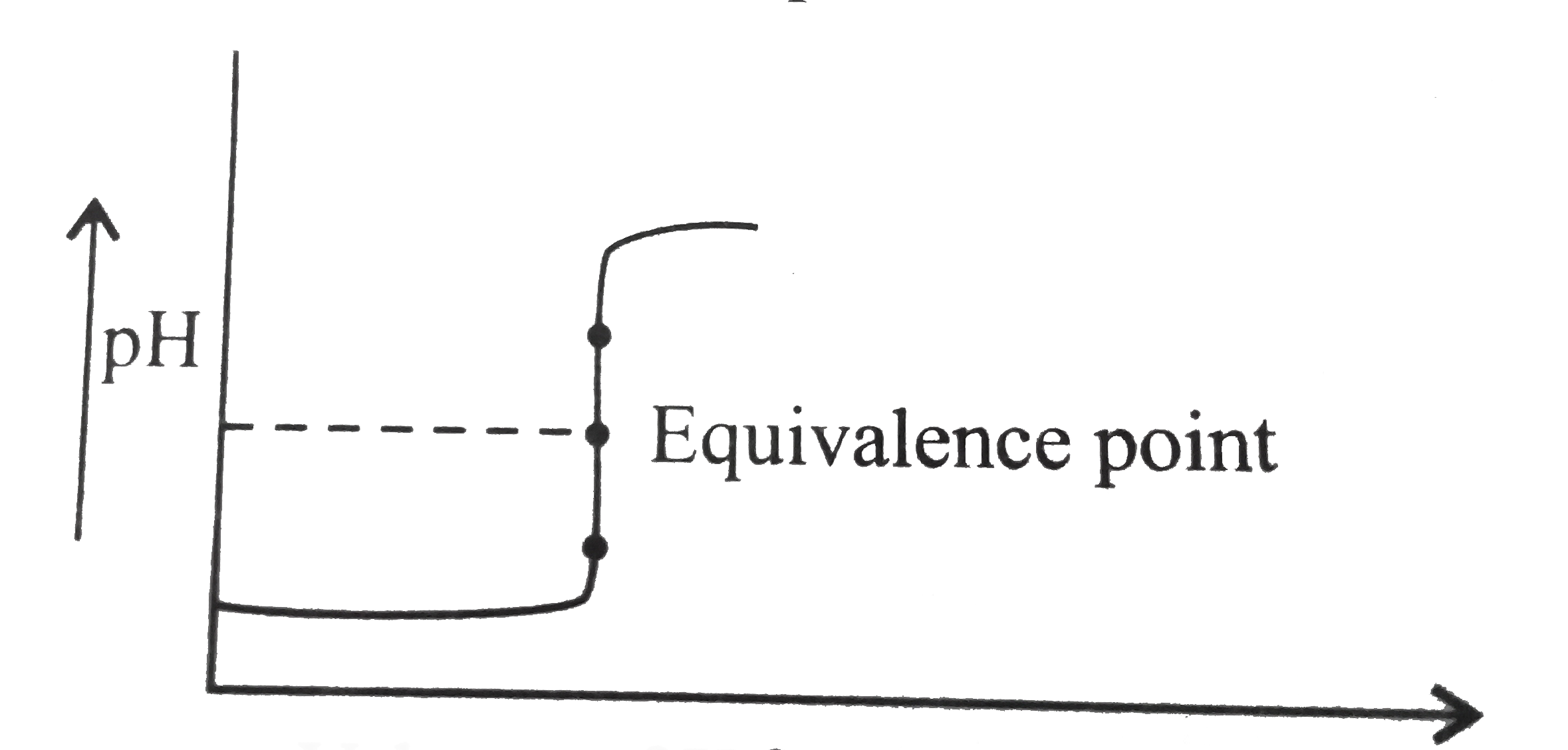
In acid-base titration react rapidly to neutralise each other. Equivalence point is a point at which the acid and the base (or oxidising agent and reducing agent) have beem added in equivalent quantities. The end point in the point at which the titration stops. since the purpose of the indicator is to stop the titration close to the point at which the acid and base were added in equivalent quantities, it is important that the equivalent point and the end point be as close as must change colour at a `pH` close to that of a solution of the salt of the acid base. Singificantly, the `pH` changes most rapidly near the equivalent point. The exact shape of a titration curve depends on `K_(a)` and `K_(b)` of acid and base.

The `pH` at equivalence point is

A

`2`

B

`3`

C

`7`

D

`11`

Text Solution

Verified by Experts

The correct Answer is:

C
Promotional Banner

Topper's Solved these Questions

  • IONIC EQUILIBRIUM

    CENGAGE CHEMISTRY ENGLISH|Exercise Exercises Multiple Correct|33 Videos
  • IONIC EQUILIBRIUM

    CENGAGE CHEMISTRY ENGLISH|Exercise Exercises Single Correct|121 Videos
  • IONIC EQUILIBRIUM

    CENGAGE CHEMISTRY ENGLISH|Exercise Exercises Subjective(Coordination Equilibria)|2 Videos
  • HYDROGEN, WATER AND HYDROGEN PEROXIDE

    CENGAGE CHEMISTRY ENGLISH|Exercise Subjective Archive (Subjective)|3 Videos
  • ISOMERISM

    CENGAGE CHEMISTRY ENGLISH|Exercise Assertion-Reasoning Type|1 Videos

Similar Questions

Explore conceptually related problems

In acid-base titration react rapidly to neutralise each other. Equivalence point is a point at which the acid and the base (or oxidising agent and reducing agent) have beem added in equivalent quantities. The end point in the point at which the titration stops. since the purpose of the indicator is to stop the titration close to the point at which the acid and base were added in equivalent quantities, it is important that the equivalent point and the end point be as close as must change colour at a pH close to that of a solution of the salt of the acid base. Singificantly, the pH changes most rapidly near the equivalent point. The exact shape of a titration curve depends on K_(a) and K_(b) of acid and base. The curve represents the titration of

In acid-base titration react rapidly to neutralise each other. Equivalence point is a point at which the acid and the base (or oxidising agent and reducing agent) have beem added in equivalent quantities. The end point in the point at which the titration stops. since the purpose of the indicator is to stop the titration close to the point at which the acid and base were added in equivalent quantities, it is important that the equivalent point and the end point be as close as must change colour at a pH close to that of a solution of the salt of the acid base. Singificantly, the pH changes most rapidly near the equivalent point. The exact shape of a titration curve depends on K_(a) and K_(b) of acid and base. Which of the following curves indicates the titration of a weak diprotic acid by KOH of equivalent strength?

In acid-base titration react rapidly to neutralise each other. Equivalence point is a point at which the acid and the base (or oxidising agent and reducing agent) have beem added in equivalent quantities. The end point in the point at which the titration stops. since the purpose of the indicator is to stop the titration close to the point at which the acid and base were added in equivalent quantities, it is important that the equivalent point and the end point be as close as must change colour at a pH close to that of a solution of the salt of the acid base. Singificantly, the pH changes most rapidly near the equivalent point. The exact shape of a titration curve depends on K_(a) and K_(b) of acid and base. The following curve represents titration curve of HCI against KOH . The pH at equivalent point is Examine the titration curve below and answer the question.

Nitric acid acts as an oxidising agent while nitrous acid can act both as an oxidising as well as reducing agent ?

Nitric acid acts as an oxidising agent while nitrous acid can act both as an oxidising as well as reducing agent ?

Why the pH at the equivalence point of a titration may differ from 7 ?

An acid-base titration consists of the controlled addition of a dissolved base to a dissolved acid (or the reverse). Acid and base react rapidly to neutralize each other. At the equivalence point, equivalents of reacting substances are equal. The pH during a titration changes every time with a drop of titrant added, but the rate of this change varies enormously. A titration curve, graph of pH as a function of the volume of titrant, displays in detail how the pH changes over the course of an acid base titration. Significantly. the pH changes most rapidly near the equivalence point. The exact shape of a titration curve depends on the K_(a) and K_(b) of acid and base The pH at equivalence point is:

In which of the following acid-base titration, the pH is greater than 8 at the equivalence point ?

The best indicator for the detection of the end point in the titration of a weak acid and a strong base is

Which indicator is most commonly used for the titration of a strong acid against a strong base?

CENGAGE CHEMISTRY ENGLISH-IONIC EQUILIBRIUM-Exercises Linked Comprehension
  1. In atmosphere, SO(2) and NO are oxidised to SO(3) and NO(2), respectiv...

    Text Solution

    |

  2. In atmosphere, SO(2) and NO are oxidised to SO(3) and NO(2), respectiv...

    Text Solution

    |

  3. In acid-base titration react rapidly to neutralise each other. Equival...

    Text Solution

    |

  4. In acid-base titration react rapidly to neutralise each other. Equival...

    Text Solution

    |

  5. The suitable indicator for the titration is

    Text Solution

    |

  6. In acid-base titration react rapidly to neutralise each other. Equival...

    Text Solution

    |

  7. In acid-base titration react rapidly to neutralise each other. Equival...

    Text Solution

    |

  8. Physical and chemical equilibrium can respond to a change in their pre...

    Text Solution

    |

  9. Physical and chemical equilibrium can respond to a change in their pre...

    Text Solution

    |

  10. Physical and chemical equilibria can respond to a change in their pres...

    Text Solution

    |

  11. H(3)PO(4) is a tribasic acid with pK(a(1)), pK(a(2)) and pK(a(3)) 1.12...

    Text Solution

    |

  12. H(3)PO(4) is a tribasic acid with pK(a(1)), pK(a(2)) and pK(a(3)) 1.12...

    Text Solution

    |

  13. H(3)PO(4) is a tribasic acid with pK(a(1)), pK(a(2)) and pK(a(3)) 1.12...

    Text Solution

    |

  14. The number of moles of KMnO(4) required to oxidise 1 mol of Fe(C(2)O(4...

    Text Solution

    |

  15. Aqueous solutions of Na(2)C(2)O(4) and CaCI(2) are mixed and precipita...

    Text Solution

    |

  16. Aqueous solutions of Na(2)C(2)O(4) and CaCI(2) are mixed and precipita...

    Text Solution

    |

  17. Aqueous solutions of Na(2)C(2)O(4) and CaCI(2) are mixed and precipita...

    Text Solution

    |

  18. Hin is an acidic indicator (K(Ind) =10^(-7)) which dissociates into aq...

    Text Solution

    |

  19. Hin is an acidic indicator (K(Ind) =10^(-7)) which dissociates into aq...

    Text Solution

    |

  20. Hin is an acidic indicator (K(Ind) =10^(-7)) which dissociates into aq...

    Text Solution

    |
