Home
Class 11
CHEMISTRY
Calculate the oxidation number of sulphu...

Calculate the oxidation number of sulphur , chromium and nitrogen in `H_(2)SO_(5) , Cr_(2)O_(7)^(2-) ` and `NO_(3)^(-)` . Suggest structure of these compounds . Count for the fallacy .

Text Solution

Verified by Experts
a. Oxidation number of S in `H_(2)SO_(5)`
By convenctional method, the oxidation number of `S` in `H_(2)SO_(5)` is
`2(+1)+x+5(-2)=0` or, `x=+8`
This is impossible because the maximum oxidation number of `S` cannot be more than six since it has only six electrons in the valence shell. This fallacy is overcome if we calculate the oxidation number of S by chemical bonding method.
`H-O-underset(O)underset(||)overset(O)overset(||)(S)-O-O-H`
`underset(("for H"))(2xx(+1))+underset(("for S"))(x)+underset("for(O-O)")(2(-1))+underset(("for other O atoms"))(3xx(-2)=0)`
or `x=+6`
b. Oxidation number of `Cr` in `CrO_(5)`
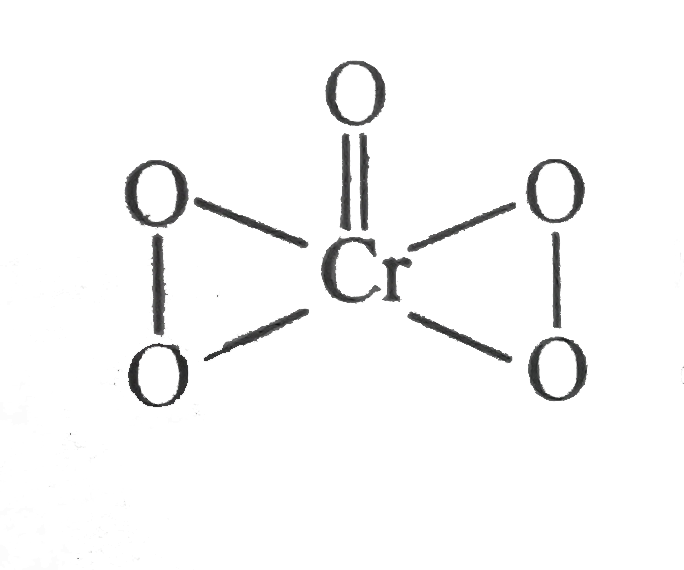
According to conventional method, oxidation number of `Cr` is: `x+5(-2)=0` or `x=+10`. Thus is impossible because the maximum oxidation number of `Cr` cannot be more than six since it has `3d^(5) 4s^(1)` outer orbital configuration. This fallacy is removed if we calculate oxidation number of `Cr` by chemical bonding method. The structure of. `CrO_(5)` is (Butterfly structure)

From the structure, the oxidation number of `Cr` can be calculated as follows:
`x+4(-1)+1(-2)=0` or `x=+6`
`("for O-O") ("for=O")`
c. Oxidation number of `N` in `NO_(3)^(Θ)`.
According to conventional method, oxidation number of `N` is `NO_(3)^(Θ)=x+3(-2)=-1` or `x=+5`
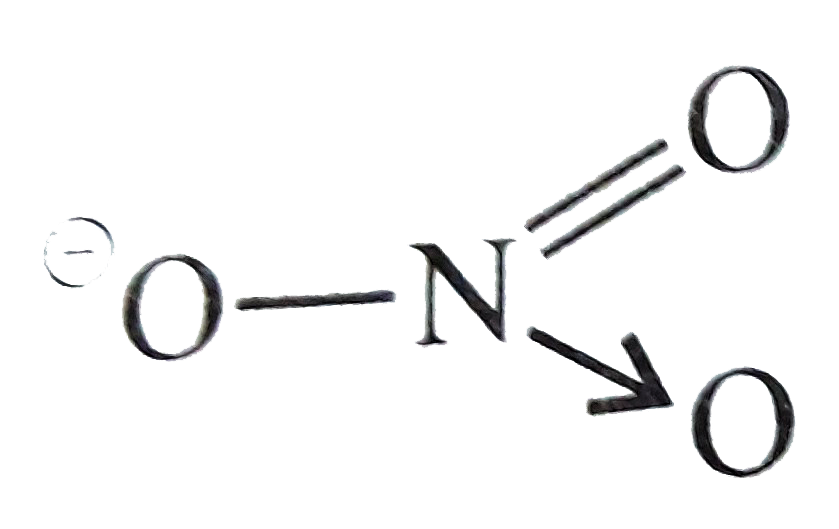
According to the chemical bonding method,

`underset(("for O"^(Θ)))(x+1(-1))+underset(("for=O"))(1(-2))+underset(("for "rarr))(1(-2)=0)`
or `x=5`
Thus, there is no fallacy about the oxidation number of `N` in `NO_(3)^(Θ)` whether one calculates by conventional methoc or by chemical bonding method.
Promotional Banner

Topper's Solved these Questions

  • NCERT BASED EXERCISE

    CENGAGE CHEMISTRY ENGLISH|Exercise Atomic Structure|94 Videos
  • NCERT BASED EXERCISE

    CENGAGE CHEMISTRY ENGLISH|Exercise Thermodynamics|50 Videos
  • NCERT BASED EXERCISE

    CENGAGE CHEMISTRY ENGLISH|Exercise Chemical Equilibrium|73 Videos
  • ISOMERISM

    CENGAGE CHEMISTRY ENGLISH|Exercise Assertion-Reasoning Type|1 Videos
  • ORGANIC REACTION MECHANISM

    CENGAGE CHEMISTRY ENGLISH|Exercise Analytical and Descriptive|6 Videos

Similar Questions

Explore conceptually related problems

Calculate the oxidation number of sulphur, chromium, and nitrogen in H_(2)SO_(5), Cr_(2)O_(7)^(2-) and NO_(3)^(Θ) . Suggest the structure of these compounds. Count for the fallacy.

Calculate the oxidation number of nitrogen in NO_(3)^(-) . Suggest structure of this compound. Count for the fallacy.

Calculate the oxidation number of the underlined element in the following ions. ul(Cr_(2))O_(7)^(2-)

The oxidation number of sulphur in H_(2)S_(2)O_(8) is:

Calculate the oxidation number of Sulphur in H_(2)SO_(5) . Suggest structure of this compounds. Count for the fallacy.

Calculate the oxidation number of Chromium in CrO_(5) . Suggest structure of this compound. Count for the fallacy.

Calculate the oxidation number of the underlined element in the following molecules. K_(2)ul(Cr_(2))O_(7)

Calculate the oxidation number of nitrogen in the following oxides. N_(2)O,NO,N_(2)O_(3),NO_(2),N_(2)O_(5)

The oxidation state of sulphur in H_(2)SO_(5) and chromium in K_(2)Cr_(2)O_(7) respectively is :-

Find the oxidation number of sulphur in the following compounds: H_(2)S,H_(2)SO_(4),S_(2)O_(4)^(2-),S_(2)O_(8)^(2-),HSO_(3)^(ө) .

CENGAGE CHEMISTRY ENGLISH-NCERT BASED EXERCISE-Redox Reaction
  1. Justify that the following reactions are redox reactions: (a) CuO(s...

    Text Solution

    |

  2. Fluorine reacts with ice and results in the change: H(2)O(s) + F(2)...

    Text Solution

    |

  3. Calculate the oxidation number of sulphur , chromium and nitrogen in H...

    Text Solution

    |

  4. Write the formula for the following compounds: (a) Mercury (II) chlo...

    Text Solution

    |

  5. Suggest a list of the substances where carbon can exhibit oxidation st...

    Text Solution

    |

  6. While sulphur dioxide and hydrogen peroxide can act as oxidising as we...

    Text Solution

    |

  7. Consider the reactions : (a) 6 CO(2) (g) + 6 H(2)O (1) to C(6) H(12)...

    Text Solution

    |

  8. The compound AgF(2) is unstable compound. However, if formed, the comp...

    Text Solution

    |

  9. Whenever a reaction between an oxidising agent and a reducing agent is...

    Text Solution

    |

  10. How do you account for the following observations ? Though alkaline ...

    Text Solution

    |

  11. Identify the substance oxidised and reduced, oxidising agent and reduc...

    Text Solution

    |

  12. Consider the reactions : 2 S(2)O(3)^(2-) (aq) I(2) (s) to S(4) O(6)^...

    Text Solution

    |

  13. Justify giving reactions that among halogens, fluorine is the best oxi...

    Text Solution

    |

  14. Why does the following reaction occur ? XeO(6)^(4-) (aq) + 2 F^(-) (...

    Text Solution

    |

  15. Consider the reactions : (a) H(3)PO(2) (aq) + 4 AgNO(3) (aq) + 2 H...

    Text Solution

    |

  16. Balance the following redox reactions by ion-electron method. MnO(4)...

    Text Solution

    |

  17. Balance the following equations in basic medium by ion electron method...

    Text Solution

    |

  18. What sorts of informations you can draw from the following reaction ? ...

    Text Solution

    |

  19. Mn^(3+) ions are unstable in solution and undergo disproportionation t...

    Text Solution

    |

  20. Consider the elements : Cs ,Ne , I and F (a) Identify the element...

    Text Solution

    |