Home
Class 11
CHEMISTRY
Balance the following redox reactions by...

Balance the following redox reactions by ion-electron method.
`MnO_(4)^(-)(aq)+I^(-)(aq)toMnO_(2)(s)+I_(2)(s)` (in basic medium)

Text Solution

Verified by Experts
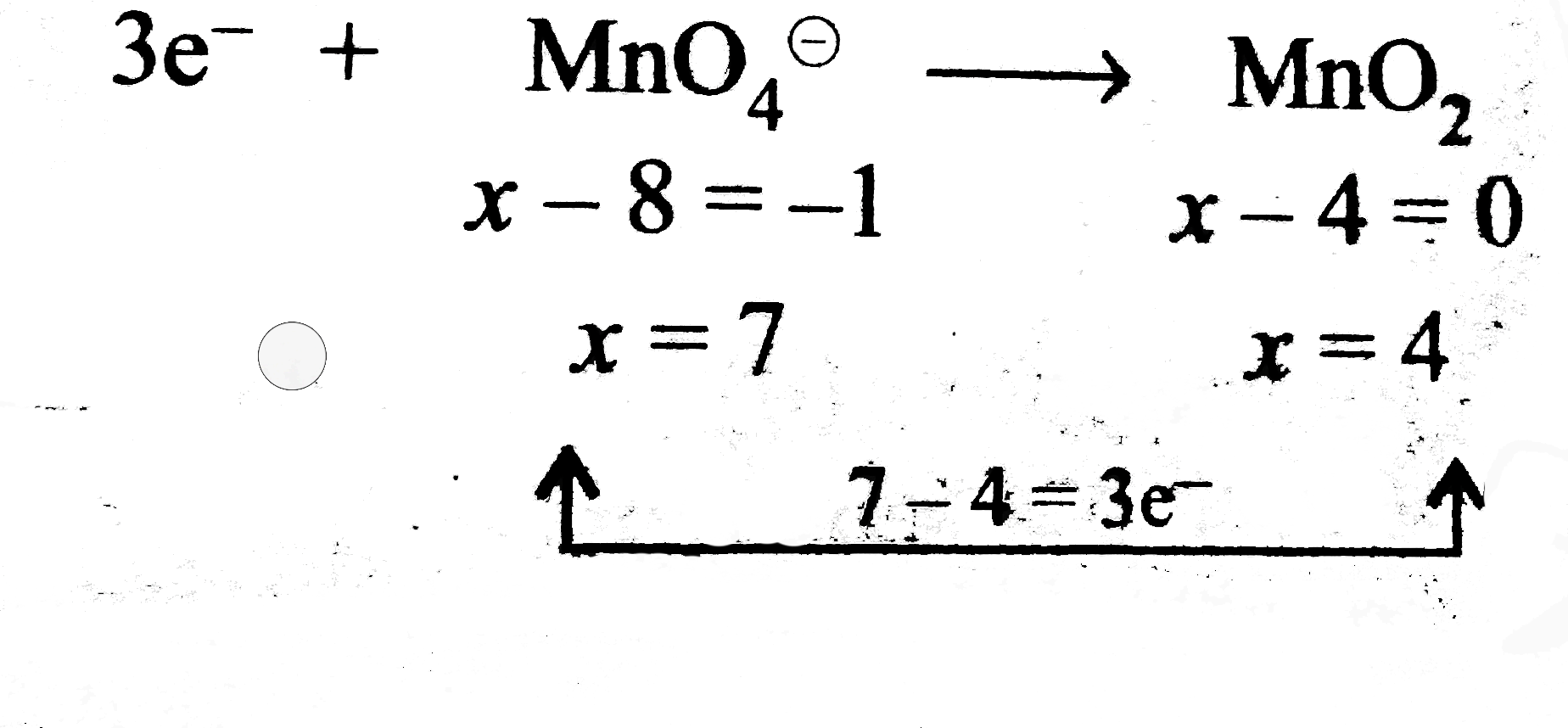
a. Balancing of reduction half equation
i.
ii. Balance atoms by adding `2H_(2)O` to RHS of equation (i)
`3e^(-)+MnO_(4)^(Θ)rarrMnO_(2)+2H_(2)O`
iii. Balance `H` atoms by adding `4H_(2)O` to LHS and add simultaneously of `4overset(Θ)OH` to RHS (basic medium)
`overset(2)cancel(4H_(2)O)+3e^(-)+MnO_(4)^(Θ)rarrMnO_(2)+cancel(2H_(2)O)+4overset(Θ)OH`
iv. Balancing of oxidation half equation
`2I^(Θ)rarrI_(2)e^(-)`
v. Multiply equation (iii) by `2` and equation (iv) by `3` and add them
`{:(4H_(2)O+cancel(6e^(-))+2MnO_(2)+8overset(Θ)OH),(6I^(Θ)rarr3I_(2)+cancel(6e^(-))),(ulbar(4H_(2)O+6I^(Θ)+2MnO_(4)^(Θ)rarr2MnO_(2)+8overset(Θ)OH)):}`
b. The balanced half reactions are:
Oxidation half equation:
`SO_(2)(g)+2H_(2)O(l)rarrHSO_(4)^(Θ)(aq)+3H^(o+)(aq)+2e^(-)`....(i)
Reduction half equation:
`MnO_(4)^(Θ)(aq)+8H^(o+)(aq)+5e^(-) rarr Mn^(2+)(aq)+4H_(2)O(l)` ...(ii)
Multiply equation (i) by `5` and add it to equation (ii) by `2` and add, we have,
`2MnO_(4)^(Θ)(aq)+5SO_(2)(g)+2H_(2)O(l)+H^(o+)rarr2Mn^(2+)(aq)+5HSO_(4)^(Θ)(aq)`
c. Oxidation half equation: ltbr `Fe^(2+)(aq)rarrFe^(3+)(aq)+e^(-)`...(i)
Reduction half equation: `H_(2)O_(2)(aq)+2Fe^(+2)(aq)+2H^(o+)(aq)+2e^(-)rarr2H_(2)O(l)`.....(ii)
Multiply equation (i) by `2` and add it to equation (ii), we have,
`H_(2)O_(2)(aq)+2Fe^(+2)(aq)+2H^(o+)(aq)rarr2Fe^(3+)(aq)+2H_(2)O(l)`
d. Oxidation half equation:
`SO_(2)(g)+2H_(2)O(l)rarrSO_(4)^(2-)(aq)+4H^(o+)(aq)+2e^(-)`.....(i)
Reduction half equation
`Cr_(2)O_(7)^(2-)(aq)+14H^(o+)(aq)+6e^(-)rarr2Cr^(3+)(aq)+7H_(2)O(l)`..(ii)
Multiply equation (i) and add it to equation (ii), we have,
`Cr_(2)O_(7)^(2-)(aq)+3SO_(2)(q)+2H^(o+)rarr2Cr^(3+)(aq)+3SO_(4)^(2-)(aq)+H_(2)O(l)`
Promotional Banner

Topper's Solved these Questions

  • NCERT BASED EXERCISE

    CENGAGE CHEMISTRY ENGLISH|Exercise Atomic Structure|94 Videos
  • NCERT BASED EXERCISE

    CENGAGE CHEMISTRY ENGLISH|Exercise Thermodynamics|50 Videos
  • NCERT BASED EXERCISE

    CENGAGE CHEMISTRY ENGLISH|Exercise Chemical Equilibrium|73 Videos
  • ISOMERISM

    CENGAGE CHEMISTRY ENGLISH|Exercise Assertion-Reasoning Type|1 Videos
  • ORGANIC REACTION MECHANISM

    CENGAGE CHEMISTRY ENGLISH|Exercise Analytical and Descriptive|6 Videos

Similar Questions

Explore conceptually related problems

Balance the following redox reactions by ion-electron method. MnO_(4)^(-)(aq)+SO_(2)(g)toMn^(2+)(aq)+HSO_(4)^(-)(aq) (in acidic solution)

Balance the following redox reactions by ion-electron method. H_(2)O_(2)(aq)+Fe^(2+)(aq)toFe^(3+)(aq)+H_(2)O(l) (in acidic solution)

Balance the following equations by ion electron method. MnO_(4)^(-)+SnO_(2)^(2-)+H_(2)OtoMnO_(2)+SnO_(3)^(2-)+OH^(-)

Balance the following redox reactions by ion-electron method. Cr_(2)O_(7)^(2-)+SO_(2)(g)toCr^(3+)(aq)+SO_(4)^(2-)(aq) (in acidic solution)

Balance the following equations by ion electron method. AsO_(3)^(3-)+I_(2)+H_(2)OtoAsO_(4)^(3-)+H^(+)+I^(-)

Balance the equation by ion electron method MnO_(4)^(-) + Br^(-) to Mn^(2+) + Br_(2) (acidic medium)

Balance the following reaction by the oxidation number method - MnO_(4)^(-)+Fe^(+2)rarrMn^(+2)+Fe^(+3)

Balance the equation by lon-electron method (ii) MnO_(4)^(-) + H_(2)C_(2)O_(4) to Mn^(2+) + CO_(2) (In acidic medium)

Balance the following reaction by oxidation number method: CrO_(4)^(2-)+I^(ө)rarrCr^(3+)+IO_(3)^(ө) ( in alkaline or basic medium)

Balance the following half-reactions in acidic medium: (a) IO_(3)^(Ө)(aq) rarr I_(3)^(Ө)(aq)

CENGAGE CHEMISTRY ENGLISH-NCERT BASED EXERCISE-Redox Reaction
  1. Write the formula for the following compounds: (a) Mercury (II) chlo...

    Text Solution

    |

  2. Suggest a list of the substances where carbon can exhibit oxidation st...

    Text Solution

    |

  3. While sulphur dioxide and hydrogen peroxide can act as oxidising as we...

    Text Solution

    |

  4. Consider the reactions : (a) 6 CO(2) (g) + 6 H(2)O (1) to C(6) H(12)...

    Text Solution

    |

  5. The compound AgF(2) is unstable compound. However, if formed, the comp...

    Text Solution

    |

  6. Whenever a reaction between an oxidising agent and a reducing agent is...

    Text Solution

    |

  7. How do you account for the following observations ? Though alkaline ...

    Text Solution

    |

  8. Identify the substance oxidised and reduced, oxidising agent and reduc...

    Text Solution

    |

  9. Consider the reactions : 2 S(2)O(3)^(2-) (aq) I(2) (s) to S(4) O(6)^...

    Text Solution

    |

  10. Justify giving reactions that among halogens, fluorine is the best oxi...

    Text Solution

    |

  11. Why does the following reaction occur ? XeO(6)^(4-) (aq) + 2 F^(-) (...

    Text Solution

    |

  12. Consider the reactions : (a) H(3)PO(2) (aq) + 4 AgNO(3) (aq) + 2 H...

    Text Solution

    |

  13. Balance the following redox reactions by ion-electron method. MnO(4)...

    Text Solution

    |

  14. Balance the following equations in basic medium by ion electron method...

    Text Solution

    |

  15. What sorts of informations you can draw from the following reaction ? ...

    Text Solution

    |

  16. Mn^(3+) ions are unstable in solution and undergo disproportionation t...

    Text Solution

    |

  17. Consider the elements : Cs ,Ne , I and F (a) Identify the element...

    Text Solution

    |

  18. Chlorine is used to purify drinking water. Excess of chlorine is harmf...

    Text Solution

    |

  19. Refer to the periodic table given in your book and now answer the foll...

    Text Solution

    |

  20. In Ostwald’s process for the manufacture of nitric acid, the first ste...

    Text Solution

    |

