Home
Class 12
CHEMISTRY
AX,AY,BX, and BY have rock salt type str...

`AX,AY,BX`, and `BY` have rock salt type structure with following internuclear distances:
`|{:("Salt","Anion-anion","Cation-anion"),(,"distance in"Å,"distance in"Å),(AX,2.40,1.70),(AY,1.63,1.15),(BX,2.66,1.88),(By,2.09,1.48):}|`
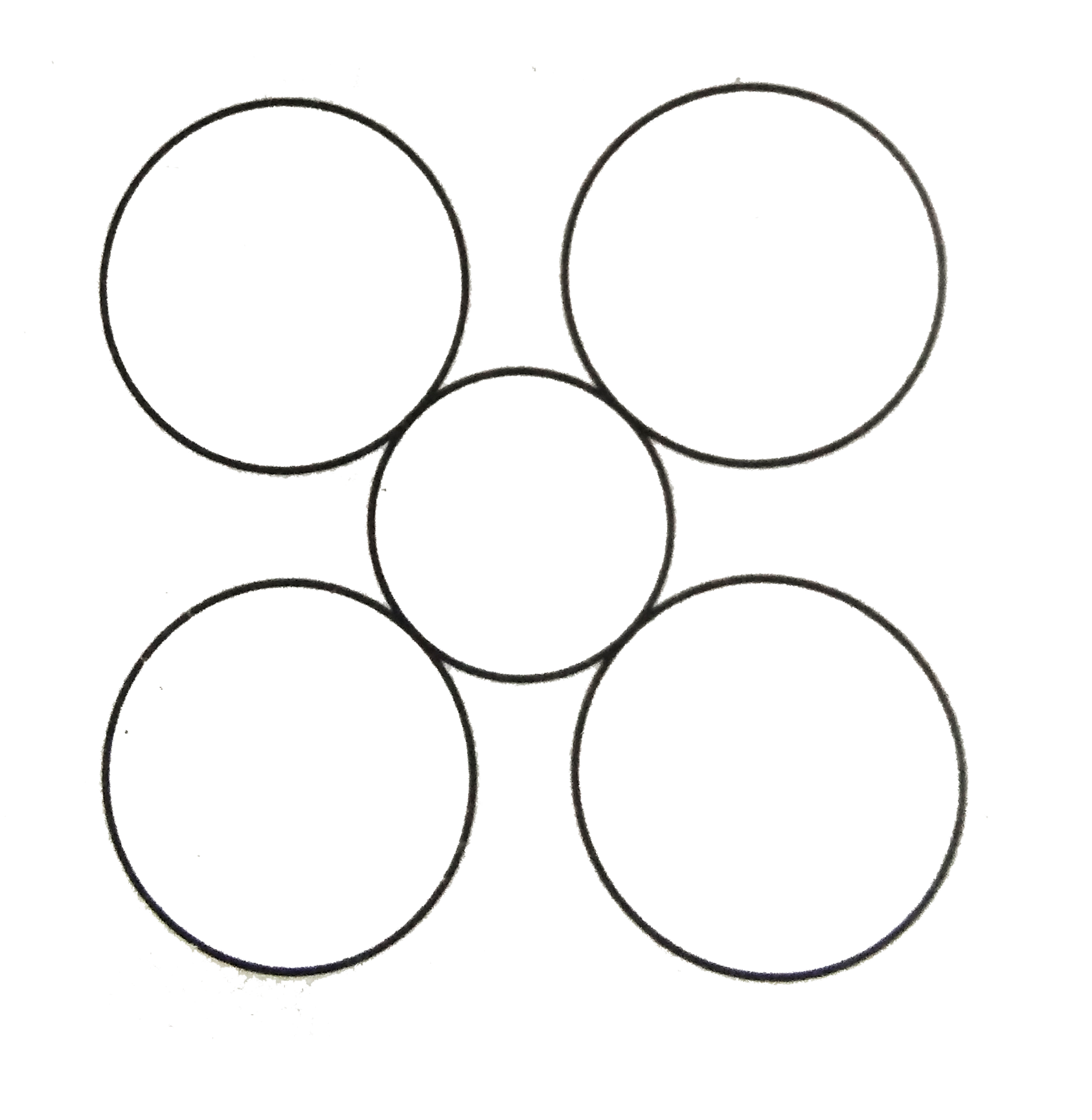
The structure given below is of

(a)`AX`
(b)`AY, BX`
(c)`AY, BX , BY`
(d)`AY, BX , BY and KCI`

A

`AX`

B

`AY, BX`

C

`AY, BX , BY`

D

`AY, BX , BY and KCI`

Text Solution

Verified by Experts

The correct Answer is:

D

`Y^(ɵ)` is small than `X^(ɵ)`.
The difference in internucler distanc between `AX` and `BX` indicates that the cation must not be touching apl the anions in `AX` (smaller cation, larger anion) [see `Q.10`, Fig.(a)]. There must ve anion-anion contact is this compound.
`:.` Anion-anion ditance = `2r_(ɵ)`
The remaining radius ratio is represented in (see `Q.9` Figure].
b. Radius of `X^(ɵ)(r_(ɵ)) = (2.40)/(2) = 1.20Å`
Radius of `B^(o+)(r_(o+)) = (1.88 - 1.20)Å = 0.68Å`
c. Similarly, radius of `Y^(ɵ)(r_(ɵ)) = (1.48 - 0.68) = 0.80 Å`
Radius of `A^(o+)(r_(o+)) = (1.15 - 0.80)Å = 0.35 Å`
As explained above.
Promotional Banner

Topper's Solved these Questions

  • SOLID STATE

    CENGAGE CHEMISTRY ENGLISH|Exercise Exercises (Multiple Correct)|39 Videos
  • SOLID STATE

    CENGAGE CHEMISTRY ENGLISH|Exercise Exercises (Single Correct)|72 Videos
  • SOLID STATE

    CENGAGE CHEMISTRY ENGLISH|Exercise Solved Examples|13 Videos
  • REDUCTION AND OXIDATION REACTION OF ORGANIC COMPOUNDS

    CENGAGE CHEMISTRY ENGLISH|Exercise SUBJECTIVE TYPE|4 Videos
  • SOLUTIONS

    CENGAGE CHEMISTRY ENGLISH|Exercise Ex 2.3 (Objective)|9 Videos

Similar Questions

Explore conceptually related problems

AX,AY,BX , and BY have rock salt type structure with following internuclear distances: |{:("Salt","Anion-anion","Cation-anion"),(,"distance in"Å,"distance in"Å),(AX,2.40,1.70),(AY,1.63,1.15),(BX,2.66,1.88),(By,2.09,1.48):}| Which of the following structure is, respectively, by Ax ? (a) (b) (c) (d)

AX,AY,BX , and BY have rock salt type structure with following internuclear distances: |{:("Salt","Anion-anion","Cation-anion"),(,"distance in"Å,"distance in"Å),(AX,2.40,1.70),(AY,1.63,1.15),(BX,2.66,1.88),(By,2.09,1.48):}| Ionic radii of X^(o+) and Y^(Θ) , respectively, are

AX,AY,BX , and BY have rock salt type structure with following internuclear distances: |{:("Salt","Anion-anion","Cation-anion"),(,"distance in"Å,"distance in"Å),(AX,2.40,1.70),(AY,1.63,1.15),(BX,2.66,1.88),(By,2.09,1.48):}| A salt MY crystallizes in the CsCl structure. The anions at the corners touch each other and cation is in the centre. The radius ratio (r_(o+)//r_(Θ)) for this structure is

AX,AY,BX , and BY have rock salt type structure with following internuclear distances: |{:("Salt","Anion-anion","Cation-anion"),(,"distance in"Å,"distance in"Å),(AX,2.40,1.70),(AY,1.63,1.15),(BX,2.66,1.88),(By,2.09,1.48):}| Ionic radii of A^(o+) and B^(o+) , respectively, are a. 0.35 and 0.68 Å b. 0.68 and 0.35 Å c. 1.20 and 0.80 Å d. 0.80 and 1.20 Å

DIfferentiate the following w.r.t x : (1)/(ax^2+bx+c)

A, B C and D are the points of intersection with the coordinate axes of the lines ax+by=ab and bx+ay=ab, then

If Ax+By=1 is a normal to the curve ay=x^(2) , then :

If ax^2+bx+c=0 and cx^2 + bx+a=0(a,b,c in R) have a common non-real roots, then which of the following is not true ?

Find the points on the curve ax^(2)+2bxy+ay^(2)=c, 0ltaltbltc, whose distance from the origin is minimum.

STATEMENT - 1 : In rock salt structure, all the octahedral voids in the close packing of anions are occupied by cations. and STATEMENT - 2 : In rock salt structure, the distance of closest approach between two anions equal to half the face diagonal of the unit cell.
