Home
Class 12
CHEMISTRY
0.6 mL of acetic acid (CH(3)COOH). Havin...

0.6 mL of acetic acid `(CH_(3)COOH)`. Having density `1.06" g "mL^(-1)`, is dissolved in 1 litre of water. The depression in freezing point observed for this strength of acid was `0.0205^(@)C`. Calculate the van't Hoff factor and the dissociation constant of acid.

Text Solution

Verified by Experts
`Mw_(2)(CH_(3)COOH)=60 g "mol"^(-1)`,
`W_(2)(CH_(3)COOH)=v xx d`
`=0.6xx1.06`
`=0.636 g`
Molality (m)of acetic acid,
`(W_(2)xx1000)/(Mw_(2)xxW_(1))` [[1 L of `H_(2)O=1000` g],[Since `d_(H_(2)O)= 1 g mL^(-1)]]`
`=(0.636xx1000)/(60xx1000)=0.0106 "mol" kg^(-1)`
Substituting the values in the equation
`DeltaT_(f)=iK_(f)xxm`
`0.0205 K=i xx 1.86 K kg^(-1) xx 0.0106 "mol" kg^(-1)`
`:. i=1.041`
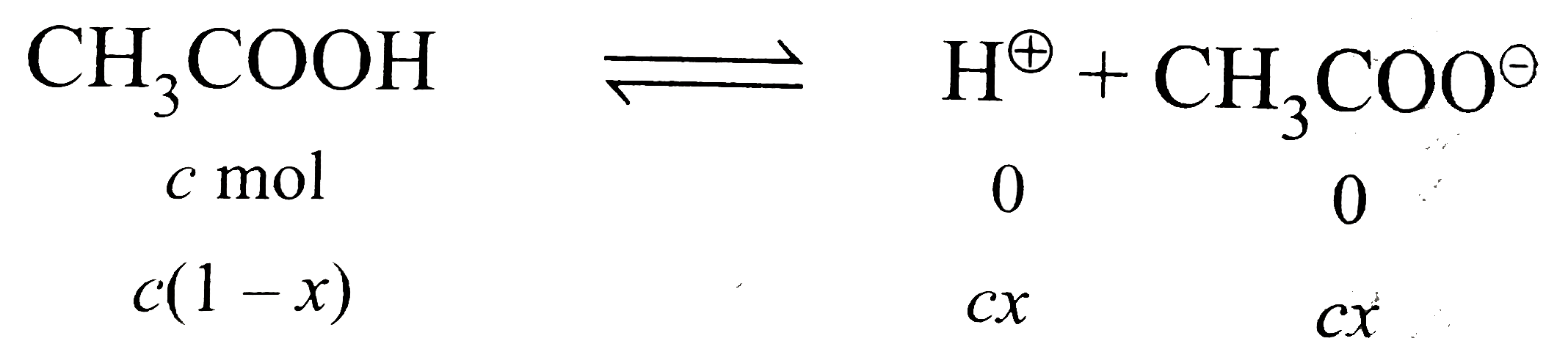
Acetic acid is a week electrolyte and dissociates in water.
Let x is the degree of dissociation of acetic acid. Thus,

Total number of moles at equiibrium
`=c(1-chi)+cx+cx=c(1+x)`
`:.i="Number of moles at equilibrium"/"Number of moles initially"=(c(1+x))/c`
`:.1.041=1+x rArr x= 0.041`
`=(0.0106mxx0.041xx0.041)/(1.00-0.041)`
`=1.86xx10^(-5)`
Promotional Banner

Topper's Solved these Questions

  • SOLUTIONS

    CENGAGE CHEMISTRY ENGLISH|Exercise Solved Examples|40 Videos
  • SOLUTIONS

    CENGAGE CHEMISTRY ENGLISH|Exercise Exercises (Linked Comprehension)|58 Videos
  • SOLID STATE

    CENGAGE CHEMISTRY ENGLISH|Exercise Ex 1.2 (Objective)|9 Videos
  • SURFACE CHEMISTRY

    CENGAGE CHEMISTRY ENGLISH|Exercise Archives Subjective|2 Videos

Similar Questions

Explore conceptually related problems

0.6 mL of acetic acid (CH_(3)COOH) having density 1.06 g mL^(-1) is dissolved in 1 L of water. The depression in freezing point observed for this strength of acid was 0.0205^(@)C .Calculate the Van't Hoff factor and dissociation constant of the acid. K_(f) for H_(2)O=1.86 K kg ^(-1) "mol"^(-1))

19.5g of CHM_(2)FCOOH is dissolved in 500g of water . The depression in the freezing point of water observed is 1.0^(@)C . Calculate the Van't Hoff factor and dissociation constant of fluoroacetic acid.

1.355 g of a substance dissolved in 55 g of CH_(3)COOH produced a depression in the freezing point of 0.618^(@)C . Calculate the molecular weight of the substance (K_(f)=3.85)

By dissolving 13.6 g of a substance in 20 g of water, the freezing point decreased by 3.7^(@)C . Calculate the molecular mass of the substance. (Molal depression constant for water = 1.863K kg mol^(-1))

A 0.01 molal solution of ammonia freezes at -0.02^(@)C . Calculate the van't Hoff factor, i and the percentage dissociation of ammonia in water. (K_(f(H_(2O))))=1.86 deg "molal"^(-1) .

Acetic acid associates in benzene to form a dimer. 1.65 g of acetic acid when dissolved in 100 g of benzene raised the boiling point by 0.36^(@)C . Calculate the Van't Hoff factor and degree of association of acetic acid. ( K_(b) for benzene= 2.57^(@)C )

When 20 g of napthanoic acid (C_(11)H_(8)O_(2)) is dissolved in 50 g of benzene (K_(f)=1.72 K kg/mol) a freezing point depression of 2 K is observed. The van't Hoff factor (i) is

The freezing point depression constant for water is 1.86^(@)Cm^(-1) . If 5.00g NaSO_(4) is dissolved in 45.0 g H_(2)O the freezing point is changed by -3.82^(@)C . Calculate the van't Hoff factor for Na_(2)SO_(4) .

2g of benzoic acid (C_(6)H_(5)COOH) dissolved in 25g of benzene shows a depression in freezing point equal to 1.62K .Molal depression constant for benzene is 4.9Kkgmol^(-1) .What is the percentage association of acid if it forms dimer in solution?

