Home
Class 11
CHEMISTRY
0.2 g of a monobasic acid gave 0.5 g of ...

0.2 g of a monobasic acid gave 0.5 g of `CO_2` and 0.089 g of `H_2 O`. 0.122 g of the same acid requires 10 mL of 0.1 N NaOH for complete neutralisation. Determine the molecular formula of the compound.

Text Solution

Verified by Experts
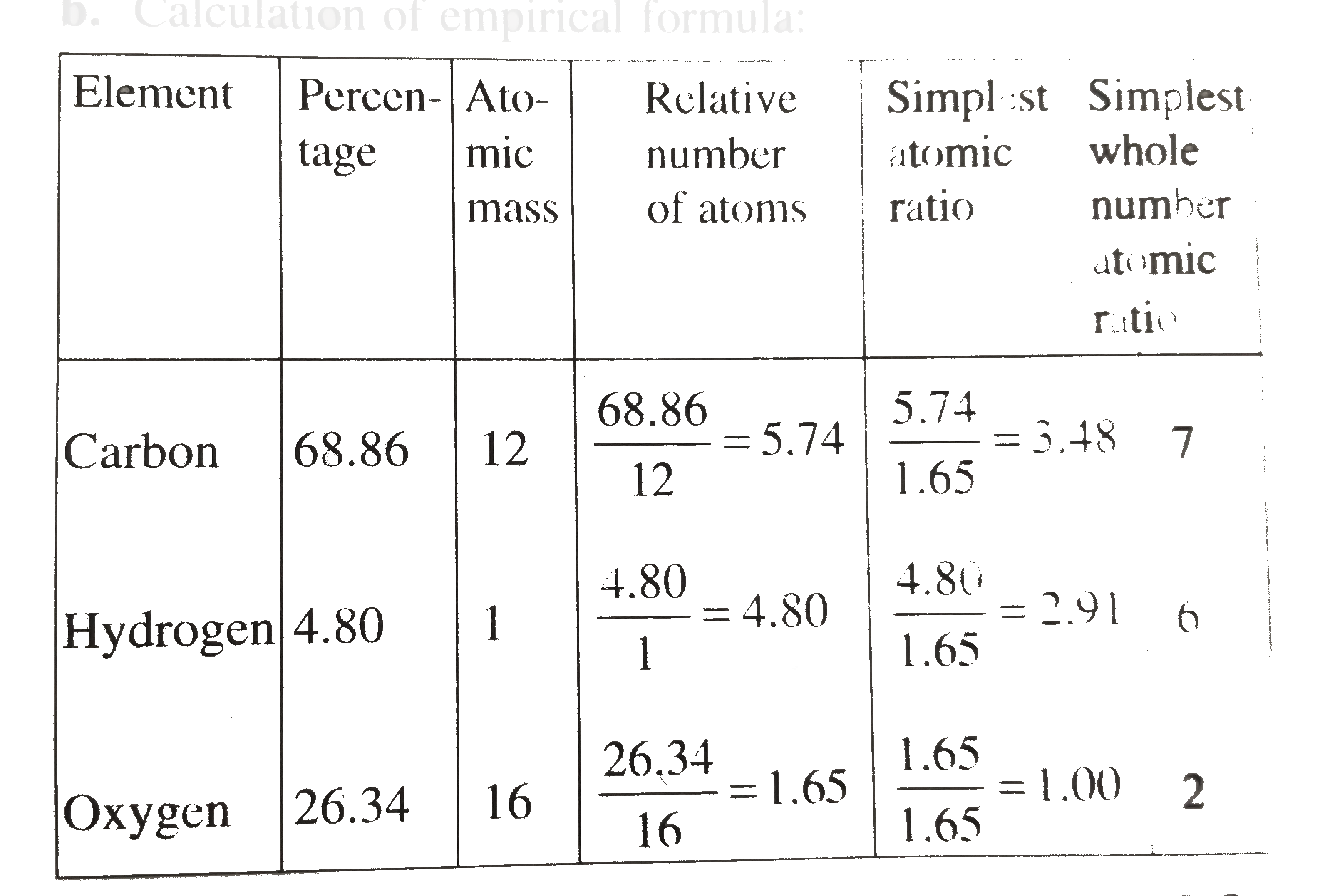
Calculation of percentage compression
(i). Percentage of carbon `=(12)/(44)xx("mass of "CO_2" produced")/("mass of substance of taken")xx100`
`=(12)/(44)xx(0.505)/(0.2)xx100=68.86%`
(ii). Percentage of hydrogen
`=(2)/(18)xx("mass of "H_2O" produced")/("mass of substance taken")xx100`
(iii) percentage of oxygen `=100-`("Percentage of "C`+`" percetage of H")
`=100-(68.86+4.8)`
`=26.34%`
(b).
(c) Calculation of molecular mass:
mEq. of `NaOH=25xx(1)/(10)=2.5` mEq. of acid `=2.5`
Equivelent of acid`=2.5xx10^-3`
equivalength of acid `=`
`Ew=("weight")/("equivalent of acid")=(0.305)/(2.5xx10^-3)`
molecular formula:
(d). calculation of molecular formula
Empirical formula `(C_7H_6O_2)` mass of the compound `=(7xx12+6xx1+16xx2)=122`
`n=("molecular mass")/("empirical formula mass")=(122)/(122)=1` Thus, molecular formula of the compound `=nxx`("Empirical formula")`=1xx(C_7H_6O_2)=C_7H_6O_2`
Promotional Banner

Topper's Solved these Questions

  • PURIFICATION OF ORGANIC COMPOUNDS AND QUALITATIVE AND QUANTITATIVE ANALYSIS

    CENGAGE CHEMISTRY ENGLISH|Exercise SOLVED EXAMPLES|17 Videos
  • PURIFICATION OF ORGANIC COMPOUNDS AND QUALITATIVE AND QUANTITATIVE ANALYSIS

    CENGAGE CHEMISTRY ENGLISH|Exercise Subjective Type|11 Videos
  • PERIODIC CLASSIFICATION OF ELEMENTS AND GENERAL INORGANIC CHEMISTRY

    CENGAGE CHEMISTRY ENGLISH|Exercise Exercises (Archives )Subjective|4 Videos
  • REDOX REACTIONS

    CENGAGE CHEMISTRY ENGLISH|Exercise Archives (Integers)|1 Videos

Similar Questions

Explore conceptually related problems

0.126 g of acid required 20 mL of 0.1 N NaOH for complete neutralisation. The equivalent mass of an acid is

0.075 g of a monobasic acid required 10 mL of N//12 NaOH solution for complete neutralisation. Calculate the molecular mass of the acid

0.14 gm of an acid required 12.5 ml of 0.1 N NaOH for complete neuturalisation.The equivalent mass of the acid is:

A monobasic acid has 68.9% C and 4.8% H. 0.122 g of acid require 10 mL of N/10 caustic soda solution for neutralisation. What is the molecular formula of the compound?

An organic compound contains 69.4% carbon and 5.8% hydrogen. A sample of 0.303 g of this compound was analysed for nitrogen by Kjeldahl's method. The ammonia evolved was absorbed in 50 mL of 0.05 M H_2 SO_4 . The excess acid required 25 mL of 0.1 M NaOH for neutralisation. Determine the molecular formula of the compound, if its molecular mass is 121.

A mono acid base gave the following results : (1) On combustion 0.20 g of the base gave 0.58 g of CO_2 and 0.15 g of water. (ii) In Duma's method, 0.3 g of it gave 32.7 mL nitrogen at 288 K and 760 mm pressure. (iii) 0.54 g of it required 12.50 mL of 0.4 N HCl for complete neutralisation. Determine the molecular formula of the base.

0.16 gm of a dibasic organic acid required 25.0 ml of (N)/(10)NaOH for complete neutralisation. Calculate its molucular mass.

0.16 g of dibasic acid required 25 ml of decinormal NaOH solution for complete neutralisation. The molecular weight of the acid will be

0.45 gm of an organic compound gave on combution 0.792 gm of CO_2 and 0.324gm of water. 0.24 gm of the same substance was Kjeldahlised and the ammonia liberated was absorbed in 50.0 ml of (M)/(8H_2SO_4) . The excess acid required 77.0 ml of (N)/(10)NaOH for complete neutralisation. Calculate the empirical formula of the compound.

It has been found that 0.290 g of an organic compound containing C, H and O on complete combustion yielded 0.66 g of CO_2 and 0.27 g of H_2O . The vapour density of the compound is found to be 29.0. Determine the molecular formula of the compound.

