Home
Class 11
CHEMISTRY
Account of the following observations ...

Account of the following observations
(a) Ammonium salts are more soluble in water than the corresponding sodium salts
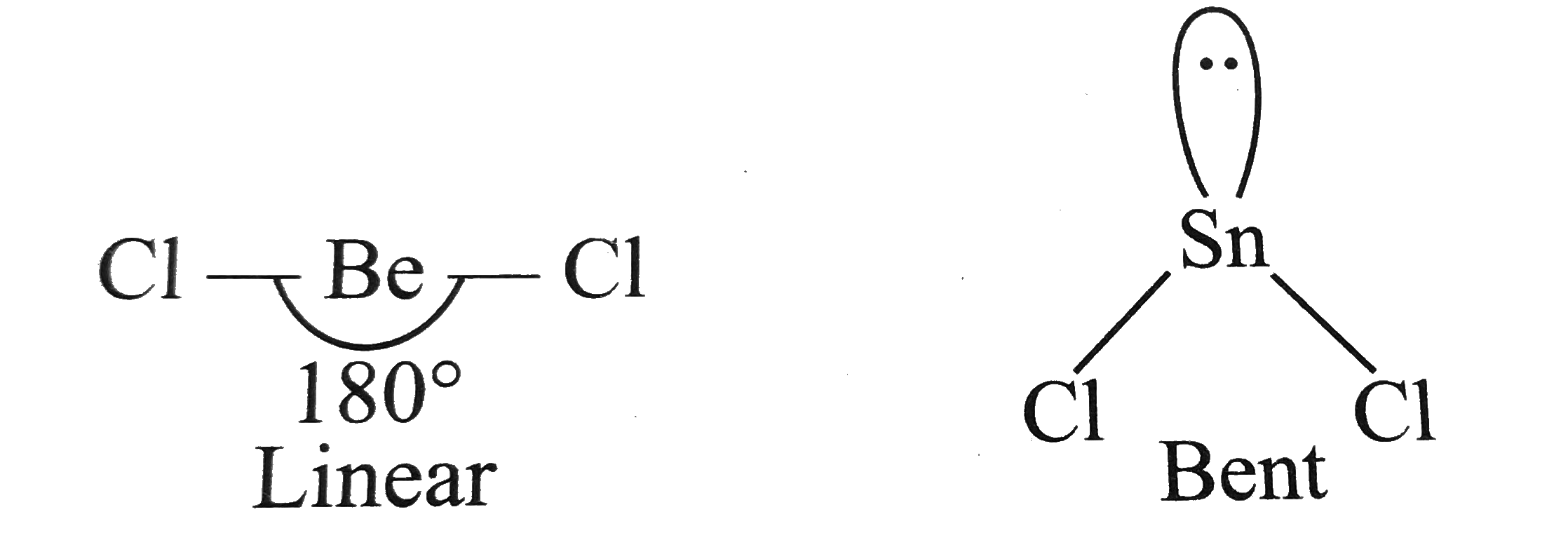
(b) `BeCI_(2)` is linear but `SnCI_(2)` is angular
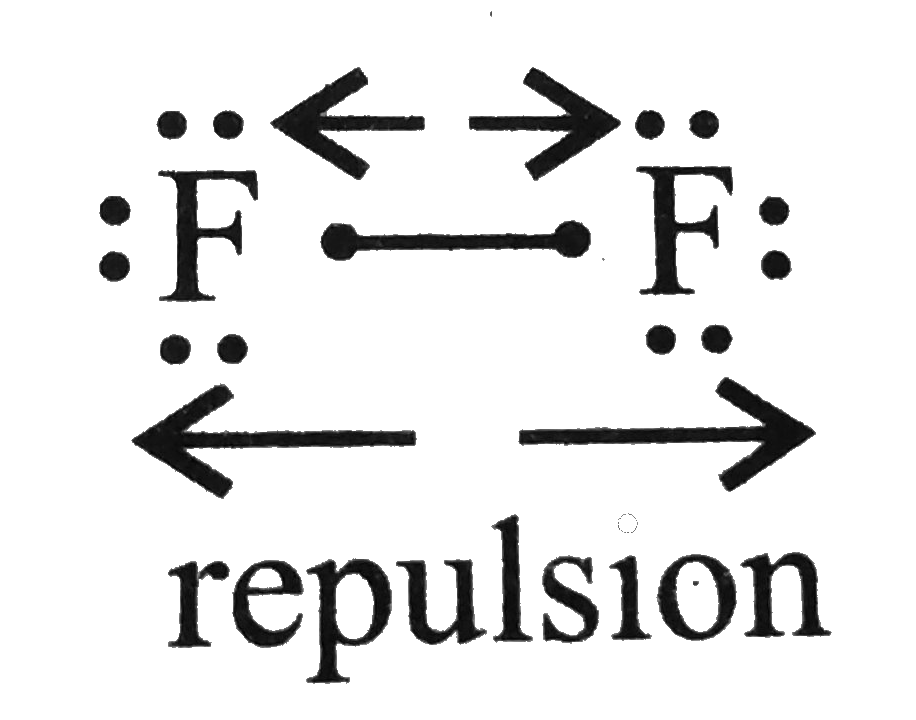
(c ) `F_(2)` gas is more reactive than `CI_(2)` gas
(d) The bond lengths of both `O-O` bonds in ozone are equal .

Text Solution

Verified by Experts
`overset(o+)NH_(4)(sp^(3)` hybridised, tetrahedral geometry) shows dipole moment and thus is polar So it bonds with water This gives an extra intermolecular attraction Whereas, `Na^(o+)` fails to from dipole moment bonds
(b) In `BeCI_(2)` Be is sp hybridised whereas in `SnCI_(2)` Sn is `sp^(2)` hybridised and has one lp over central metal This gives an angular shape to `SnCI_(2)` molecule
(c ) The bond energy of `F_(2)` is much lower than that of `CI_(2)` (Decreasing bond energies of halogens `CI_(2) gt Br_(2) gt F_(2) gt I_(2))`
In `F_(2)` molecule due to extremely small size of F-atom higher interelectronic repulsions dominate over nuclear-electrons attractive forces (bond formation) This results in very weak bond strength of `F-F` bond Hence, `F_(2)` gas is more reactive than `CI_(2)` gas
(d) `O_(3)` molecule shows resonance which results in equal bond lenghts

.
Promotional Banner

Topper's Solved these Questions

  • CHEMICAL BONDING AND MOLECULAR STRUCTURE

    CENGAGE CHEMISTRY ENGLISH|Exercise Ex 2 .2 Subjective (Molecular Orbital Theory)|4 Videos
  • CHEMICAL BONDING AND MOLECULAR STRUCTURE

    CENGAGE CHEMISTRY ENGLISH|Exercise Ex 2 .2 Objective|34 Videos
  • CHEMICAL BONDING AND MOLECULAR STRUCTURE

    CENGAGE CHEMISTRY ENGLISH|Exercise Solved Examples|36 Videos
  • ATOMIC STRUCTURE

    CENGAGE CHEMISTRY ENGLISH|Exercise Concept Applicationexercise(4.3)|19 Videos
  • CHEMICAL EQUILIBRIUM

    CENGAGE CHEMISTRY ENGLISH|Exercise Subjective type|1 Videos

Similar Questions

Explore conceptually related problems

Compounds of group 2 elements are less soluble in water than the corresponding salts of group 1 elements due to

D_2O is more polar than H_2O.

Assertion (A): CIF is more reactive than F_(2) . Reason (R ): The F-F bons is weaker than CIF bond.

Assertion (A): O_(2) is stronger reducing agent than F_(2) Reason (R ): F_(2) is more electronegative.

Assertion (A) : P_(4) is more reactive than N_(2) Reason (R) : P-P bonds are relatively weaker than N-=N

A : N_(2) is more stable than O_(2) . R : Bond order of N_(2) is more than that of O_(2) .

Account for the following : (i) PCl_(5) is more covalent than PCl_(3) . (ii) Iron on reaction with HCl forms FeCl_(2) and not FeCl_(3) . (iii) The two O-O bond lengths in the ozone molecule are equal.

(a) Account for the following : (i) Acidic character increases from H_(2)O to H_(2) Te. (ii) F_(2) is more reactive than ClF_(3) , whereas ClF_(3) is more reactive than Cl_(2) . (b) Draw the structure of (i) XeF_(2) , (ii) XeOF_(4) .

Which of the following is correct statement ? (a) AlCl_(3) is conducting in fused state (b) Mobility of Li^(+) ion in water is greater than Cs^(+) ion ( c) MCl_(2) is more volatile than MCl_(4) (d) BeSO_(4) is more soluble in water than BaSO_(4)