Home
Class 12
CHEMISTRY
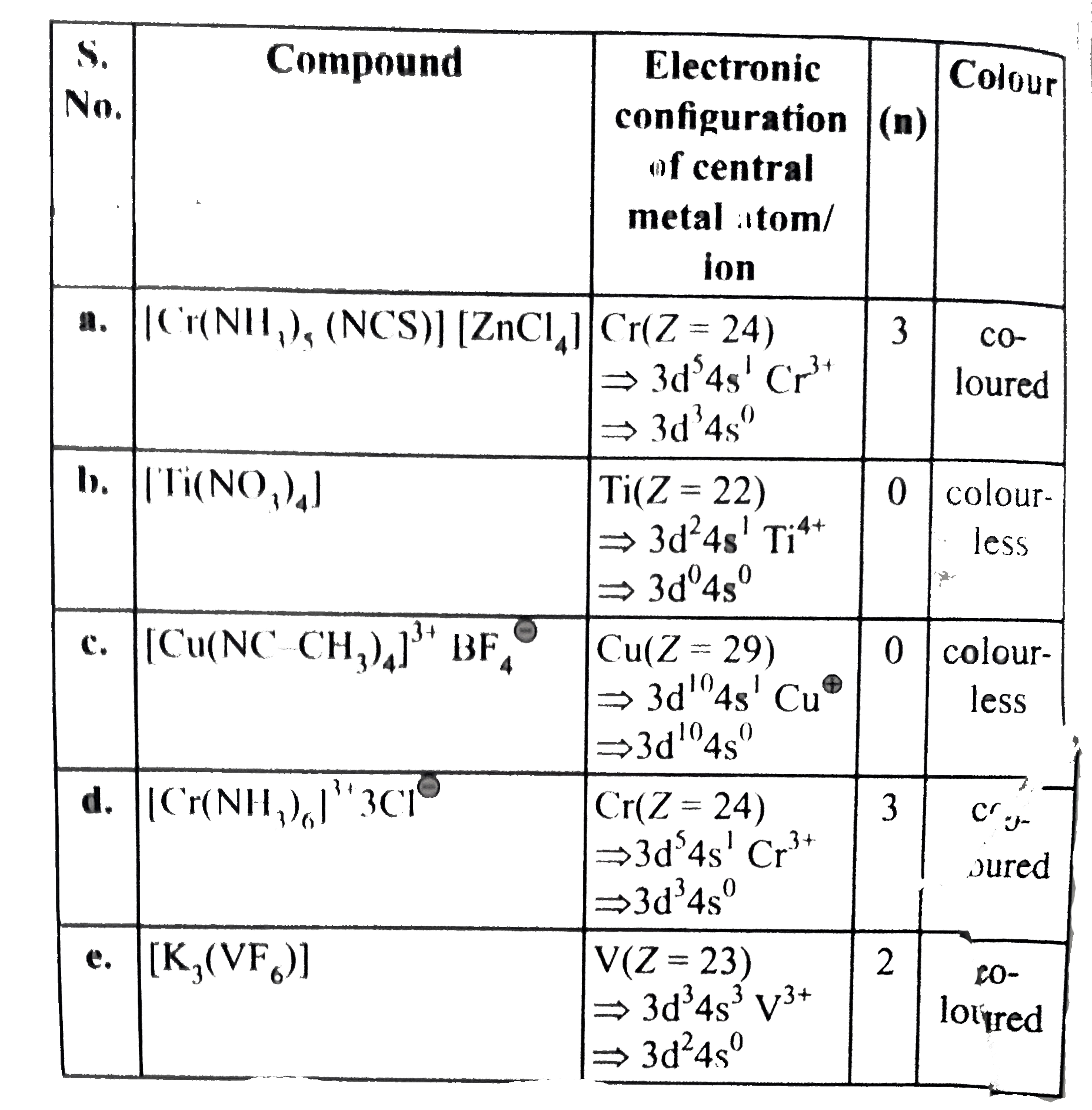
Identify the complex which are coloured ...

Identify the complex which are coloured and which are colourless Explain
(a) `[Cr(NH_(3))_(5)(NCS)][ZnCI_(4)]`
(b) `[Ti(NO_(3))_(4)]`

Text Solution

Verified by Experts
Promotional Banner

Topper's Solved these Questions

  • COORDINATION COMPOUNDS

    CENGAGE CHEMISTRY ENGLISH|Exercise Ex 7.2 Objective|8 Videos
  • COORDINATION COMPOUNDS

    CENGAGE CHEMISTRY ENGLISH|Exercise Exercises Linked Comprehension|38 Videos
  • COORDINATION COMPOUNDS

    CENGAGE CHEMISTRY ENGLISH|Exercise Ex 7.1 Objective (Isomerism)|12 Videos
  • CHEMICAL KINETICS

    CENGAGE CHEMISTRY ENGLISH|Exercise Archives Subjective|23 Videos
  • D AND F BLOCK ELEMENTS

    CENGAGE CHEMISTRY ENGLISH|Exercise Archives Subjective|29 Videos

Similar Questions

Explore conceptually related problems

[Co(NH_(3))_(5)NO_(2)]SO_(4) shows

Identify the complexes which are expected to be coloured. a. [Ti(NO_(3))_(4)] , b. [Cu(NC CH_(3))_(4)]^(o+) BF_(4)^(ɵ) c. [Cr(NH_(3))_(6)]^(3+)3Cl^(ɵ) , d. K_(3)[VF_(6)]

The correct IUPAC name of the following compound is [Cr(NH_(3))_(5)(NCS)][ZnCl_(4)]

Complex compound [ Cr(NCS)(NH_(3))_(5)][ZnCl_(4)] will be,

The correct IUPAC name of the complex [Cr(NH_3)_5(NCS)][ZnCl_4] is

Arrange the following compounds in order of increasing molar conductivity . (i) K[Co(NH_(3))_(2)(NO_(2))_(4)]" " (ii) [Cr(NH_(3))_(3)(NO_(2))_(3)] (iii) [Cr(NH_(3))_(5)(NO_(2))]_(3)[Co(NO_(2))_(6)]_(2)" " (iv) [Cr(NH_(3))_(6)]Cl_(3)

Total number of paramagnetic complexes which are inner orbital complexes : (i) [Cr(NH_(3))_(6)]Cl_(3) " " (ii)[Co(NH_(3))_(6)](NO_(3))_(2)" " (iii)[Ni(NH_(3))_(6)]SO_(4) (iv) K_(2)[PtCl_(6)]. " " (v) [V(H_(2)O)_(6)]SO_(4) " " (vi) [Mn(NH_(3))_(6)]SO_(4) (vii)[Fe(H_(2)O)_(5)(NO)]SO_(4) " " (viii)K_(3)[CuCl_(4)]" " Na_(4)[Fe(CN)_(5)(NOS)]

Two research students were instruced intructed to synthesise the complex [Co(NH_(3))_(5)(NO_(2))]Br_(2) They synthesised the complexes with identical molecular formula molar mass geometry conductane and spin but they differed in colour Based on the above facts answer the following questions Complexes synthesised can be (i) [Cr(NH_(3))_(5)(NO_(2))Br_(2) ,(ii) [Cr(NH_(3))_(5)(ONO)]Br_(2) (iii) [Cr(NH_(3))_(5)Br_(2)]NO_(2) (iv) All of these .

Which of the following coordination compounds exhibits ionisation isomerism (a) [Cr(NH_(3))_(6)]CI_(3) (b) [Cr(en)_(3)CI_(3)] (c ) [Cr(en)_(3)]CI_(3) (d) [Co(NH_(3))_(5)Br]SO_(4) .

Among (a) -(d) the complexes that can display geometical isomerism are : (a) [Pt(NH_(3))_(3)Cl]^(+) (b) [Pt(NH_(3))Cl_(5)]^(-) (c) [Pt (NH_(3))_(2)Cl(NO_(2))] (d) [Pt(NH_(3))_(4)CIBr]^(2+)

