Home
Class 11
CHEMISTRY
Explain : (a)ClCH2OCH3 (chloromethyl m...

Explain :
(a)`ClCH_2OCH_3` (chloromethyl methyl ether) undergoes `SN^1` reaction.
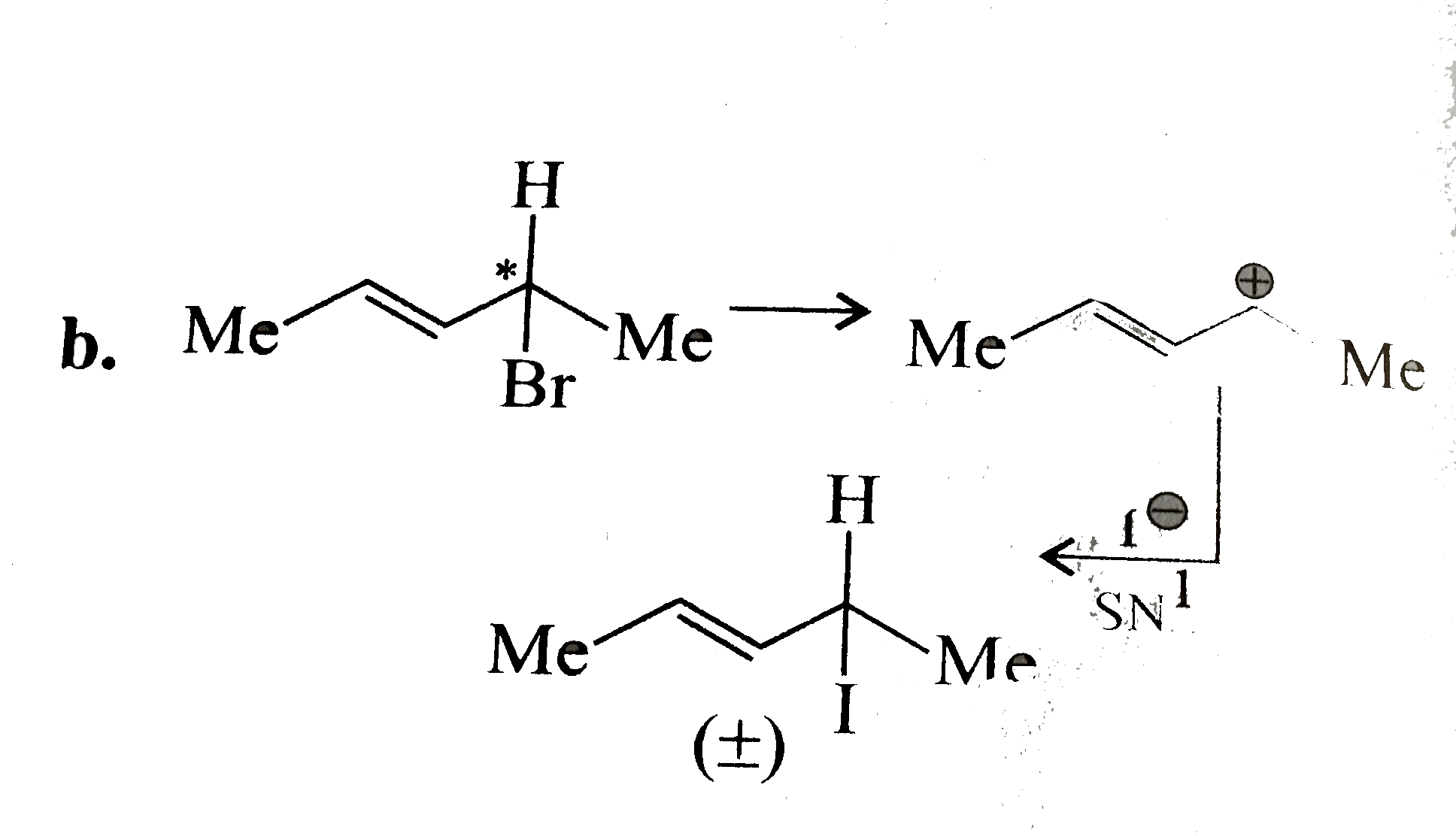
(b) `(+)-4` -Bromo-2-pentene forms a racemic mixture on treatment with `NaI`.

Text Solution

Verified by Experts
(a) Although it is `1^@ RX`, the corresponding carbonium ion is resonance stabilised.
`.^(oplus)CH_2 -overset(ddot) underset (ddot) N -CH_3 leftrightarrow CH_2 = -overset (ddot) underset(oplus)O-CH_3`
(b) .
Promotional Banner

Topper's Solved these Questions

  • ORGANIC REACTION MECHANISM

    CENGAGE CHEMISTRY ENGLISH|Exercise Subjective|19 Videos
  • ORGANIC REACTION MECHANISM

    CENGAGE CHEMISTRY ENGLISH|Exercise Comprehension|35 Videos
  • ORGANIC REACTION MECHANISM

    CENGAGE CHEMISTRY ENGLISH|Exercise Analytical and Descriptive|6 Videos
  • NCERT BASED EXERCISE

    CENGAGE CHEMISTRY ENGLISH|Exercise Chemical Equilibrium|73 Videos
  • P-BLOCK GROUP 13 - BORON FAMILY

    CENGAGE CHEMISTRY ENGLISH|Exercise Exercise Archives (Subjecive)|9 Videos

Similar Questions

Explore conceptually related problems

3 methyl -2- pentene on reaction with HOCI gives

Methyl phenyl ether reaction with HNO_3 and H_2SO_4 results .

Explain: a. alpha -Halocarbonyl compounds, even the 3^(@) types like , do not undergo SN^(1) reaction. b. Which is more reactive: (i) PrCI or (ii) MeCOCH_(2)CI with NaI/acetone ? c. Acetals and ketals are regenerated back to carbonyl. compounds with H_(3)O^(o+) but not with overset(Θ)(OH) . d. Cyclohexane is more reactive than cyclopenatone with HCN.

Give the order of reactivity towards SN^(1) reaction of the followig: a. i. 1- Bromopentane ii. 2- Bromopenatane iii. 2- Bromo -2 methyl butane

Explain : a. Vinyl chloride is unreactive in nucliphillic 4- subsitution reactions. b. Neopenthyl bromide undergoes nucliphillic substituion reactions very slowly. c. 3- Bromocyclohexane is more reactive than 4- bromovyclohexane in hydrolysis with aqueous NaOH . d. ter- Butyl chloride reacts with aqueous sodium hydroxide by SN^(1) mechanishm while n- butuyl chloride reacts by SN^(2) medchanism.

Bromobenzene on treatment with fuming H_(2)SO_(4) gives a compound which one treatment with Cl_(2)//AlCl_(3) gives (A), (A) on distillation with dil. H_(2)SO_(4) gives (B). (B) on treatment with an eq. of Mg in dry ether gives (C ). (C ) on treatment with CH_(3)CHO followed by hydrolysis gives (D). (D) on treatment with NaOl gives (E). Identify the structures of (A) to (E).

1,4-Pentadiene reacts with excess of HCl in the presence of benzoyl peroxide to give compound X , which upon reaction with excess of Mg in dry ether forms Y . Compound Y on treatment with ethyl acelate followed by treatment with dilute acid yields Z . Identify the structure of componds. X, Y and Z .

Statement-I: Optically active 2-idoibutane on treatment with NaI in acetone undergoes racemisation. Because Statement-II: Repeated Walden inversions on the reactant and its product evantually gives a racemic mixure.

Read the given passage and answer the questions number 1 to 5 that follow: The substitution reaction of alkyl halide mainly occurs by S_N 1 and S_N 2 mechanism. Whatever mechanism alkyl halides follow for the substitution reaction to occur, the polarity of the carbon halogen bond is responsible for these substitution reactions. The rate of S_N 1 reactions are governed by the stability of carbocation whereas for S_N 2 reactions steric factor is the deciding factor. If the starting material is a chiral compound, we may end up with an inverted product or racemic mixture depending upon the type of mechanism followed by alkyl halide. Cleavage of ethers with HI also governed by steric factor and stability of carbocation, which indicates that in organic chemistry, these two major factors help us in deciding the kind of product formed 1. Predict the stereochemistry of the product formed if an optically active alkyl halide undergoes substitution reaction by S_N 1 mechanism. 2. Name the instrument used for measuring the angle by which the plane polarised light is rotated. 3. Predict the major product formed when 2-Bromopentane reacts with alcoholic KOH. 4. Give one use of CHI_3 5. Write the structures of the products formed when anisole is treated with HI.

CENGAGE CHEMISTRY ENGLISH-ORGANIC REACTION MECHANISM-Solved Example
  1. Give the order of (a) nucleophilicity (b) basic character, and (c) fug...

    Text Solution

    |

  2. Give the most reactive substrate in each of the following pair with ov...

    Text Solution

    |

  3. Outline the synthesis of following compounds from suitable nucleophile...

    Text Solution

    |

  4. Give a suitable mechanism for the following : .

    Text Solution

    |

  5. Predict the order of reactivity of the following halides with (a) NaI ...

    Text Solution

    |

  6. Explain : (a)ClCH2OCH3 (chloromethyl methyl ether) undergoes SN^1 re...

    Text Solution

    |

  7. Write the products of the following SN reactions. .

    Text Solution

    |

  8. Complete the following reaction

    Text Solution

    |

  9. Bromobenzene can be dehydrobrominated to benzyne by three possible rou...

    Text Solution

    |

  10. Classify the following reactions as addition, elimination, substitutio...

    Text Solution

    |

  11. From the following elimination reactions, predict which one is Hofman...

    Text Solution

    |

  12. Which one is more reactive towards acidcatalysed hydration ? Predict t...

    Text Solution

    |

  13. Which one hydrolyses at a faster rate by SN^1 mechanism ? .

    Text Solution

    |

  14. Explain :

    Text Solution

    |

  15. What are the products of addition of D2 to trans-2-pentene.

    Text Solution

    |

  16. Meso-2,3-dibromobutane reacts with iodide ion more rapidly than does (...

    Text Solution

    |

  17. Mustard gas (ClCH2CH2)2-S hydrolysed by water to Cl(CH2)2 S(CH2)2 OH m...

    Text Solution

    |

  18. Give the product, indicating stereo-chemistry of cyclohexene with Br2

    Text Solution

    |

  19. 1,2-Dimethylcyclohexene undergoes only trans-addition with HBr in no...

    Text Solution

    |

  20. Complete the following and state the relations between configurations ...

    Text Solution

    |

