
Home
Class 11
CHEMISTRY
Which of the following reactions would g...

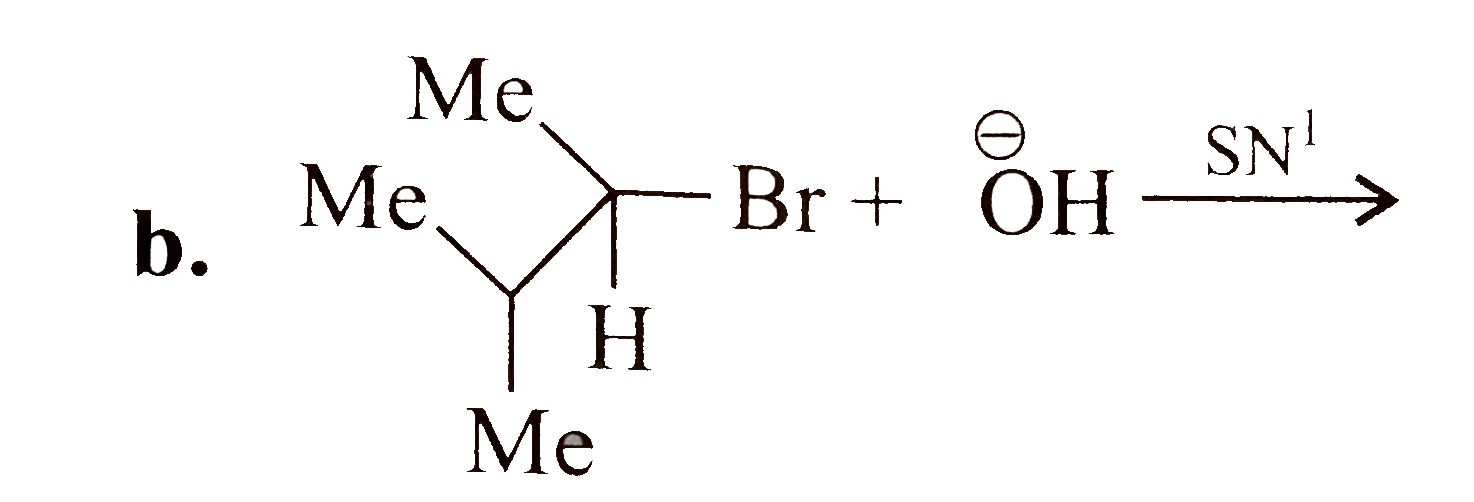
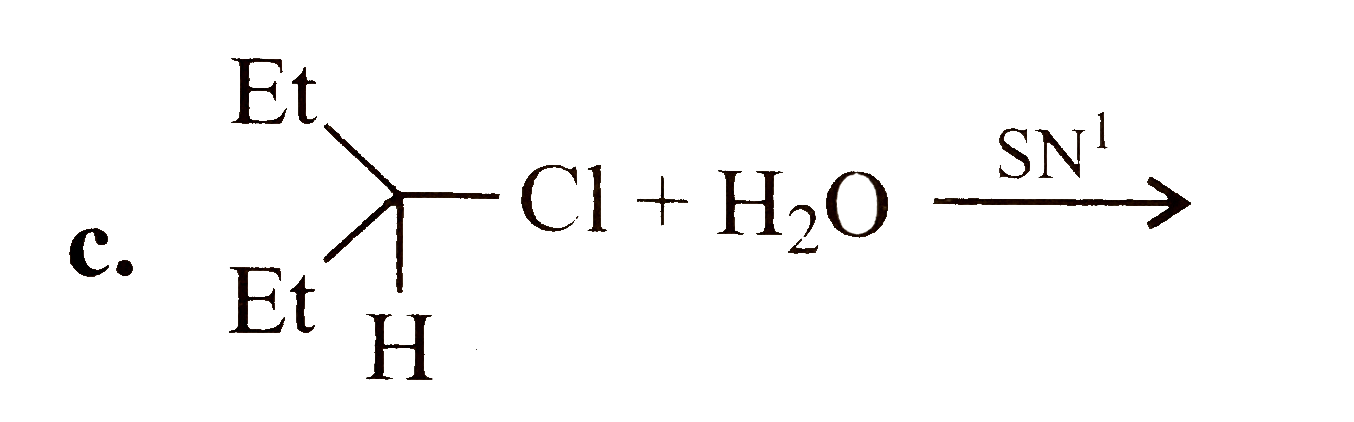
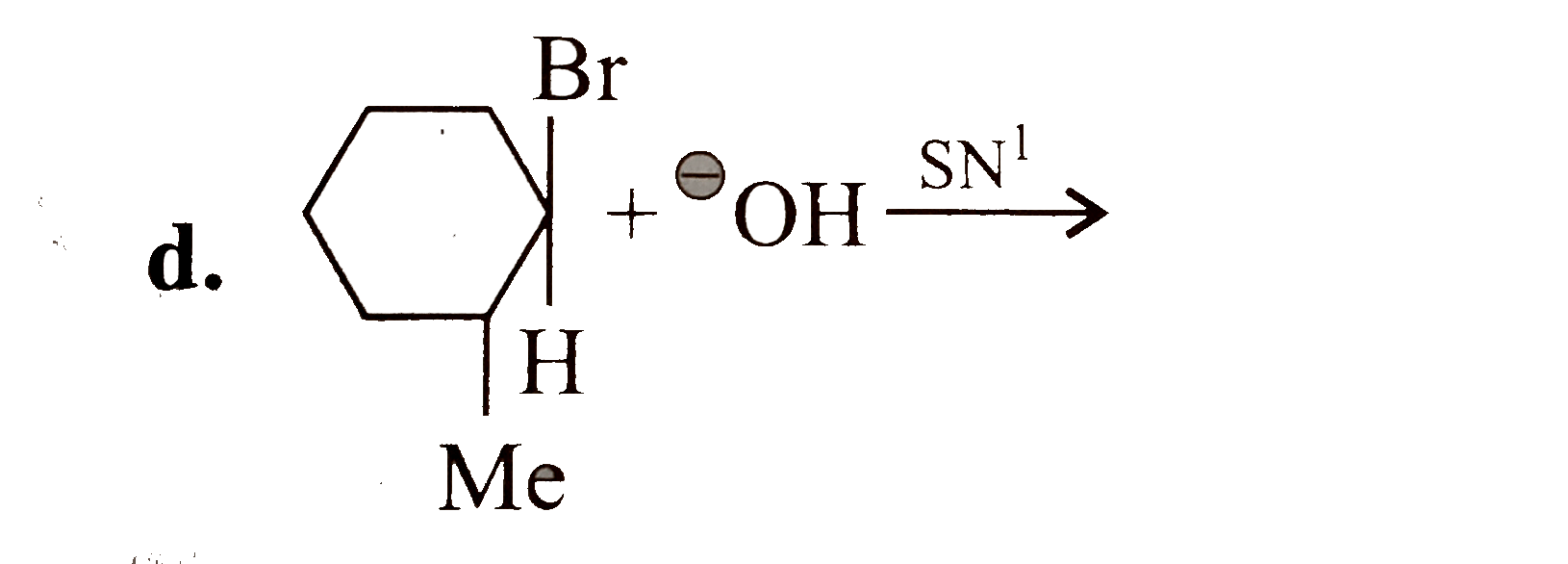
Which of the following reactions would give racemised and retention products ?

A

B

C

D

Text Solution

AI Generated Solution

The correct Answer is:

To determine which reactions would give racemized and retention products, we need to analyze the nature of the reactions involved, particularly focusing on whether they are SN1 reactions. SN1 reactions are characterized by the formation of a planar carbocation intermediate, which allows for attack from either side, leading to a mixture of products. ### Step-by-Step Solution: 1. **Understanding SN1 Mechanism**: - In SN1 reactions, the leaving group departs first, forming a carbocation. This carbocation is planar and can be attacked by the nucleophile from either side. - If the carbon atom is chiral, this can lead to both retention (where the configuration remains the same) and racemization (where both configurations are formed). 2. **Analyzing the Options**: - **Option A**: The carbon atom has four different groups (methyl, ethyl, hydrogen, and bromine). When bromine leaves, it forms a chiral carbocation. The nucleophile (OH-) can attack from either side, leading to both retention and racemized products. Therefore, this option is correct. - **Option B**: This carbon atom is also chiral with four different groups. Similar to option A, the leaving of bromine forms a planar carbocation, allowing for both types of products (retention and racemization). This option is also correct. - **Option C**: The carbon atom has two ethyl groups, making it achiral. Since there is no chiral center, it cannot produce racemized or retention products. This option is incorrect. - **Option D**: This carbon atom is chiral. Upon the departure of the leaving group, a planar carbocation is formed, allowing for attack from both sides. This results in both retention and racemized products. Thus, this option is correct. 3. **Conclusion**: - The reactions that would give racemized and retention products are found in options A, B, and D. ### Final Answer: The correct options that give racemized and retention products are A, B, and D.

To determine which reactions would give racemized and retention products, we need to analyze the nature of the reactions involved, particularly focusing on whether they are SN1 reactions. SN1 reactions are characterized by the formation of a planar carbocation intermediate, which allows for attack from either side, leading to a mixture of products. ### Step-by-Step Solution: 1. **Understanding SN1 Mechanism**: - In SN1 reactions, the leaving group departs first, forming a carbocation. This carbocation is planar and can be attacked by the nucleophile from either side. - If the carbon atom is chiral, this can lead to both retention (where the configuration remains the same) and racemization (where both configurations are formed). ...
Promotional Banner

Topper's Solved these Questions

  • ORGANIC REACTION MECHANISM

    CENGAGE CHEMISTRY ENGLISH|Exercise Single correct|43 Videos
  • ORGANIC REACTION MECHANISM

    CENGAGE CHEMISTRY ENGLISH|Exercise Assertion-Reasoning|12 Videos
  • ORGANIC REACTION MECHANISM

    CENGAGE CHEMISTRY ENGLISH|Exercise Comprehension|35 Videos
  • NCERT BASED EXERCISE

    CENGAGE CHEMISTRY ENGLISH|Exercise Chemical Equilibrium|73 Videos
  • P-BLOCK GROUP 13 - BORON FAMILY

    CENGAGE CHEMISTRY ENGLISH|Exercise Exercise Archives (Subjecive)|9 Videos

Similar Questions

Explore conceptually related problems

Which of the following reactions would give propanal ?

Which of the following reactions would give caproic acid ?

Which of the following reactions would give pentan-2-ol ?

Which of the following reaction/s give same product?

Which of the following reactions would give a good yield of hydrocarbon product ?

Which of the following substrates will gave racemised product?

CENGAGE CHEMISTRY ENGLISH-ORGANIC REACTION MECHANISM-Multiple Correct
  1. Which of the following reactions are correct ?

    Text Solution

    |

  2. Which of the following reactions would give racemised and retention pr...

    Text Solution

    |

  3. Which of the following statements are correct statements ?

    Text Solution

    |

  4. In which of the following species containing both nucleophile and leav...

    Text Solution

    |

  5. Which of the following statements are correct ?

    Text Solution

    |

  6. Which of the following are SN^2 reactions ?

    Text Solution

    |

  7. Vinyl bromide undergoes :

    Text Solution

    |

  8. The halogen atom in RX can easily be replaced by nucleophiles such as ...

    Text Solution

    |

  9. Which of the following statements are correct ?

    Text Solution

    |

  10. Which of the following reactions represents SN reaction ?

    Text Solution

    |

  11. Which of the following reactions are feasible ?

    Text Solution

    |

  12. Which of the following transformations are feasible ?

    Text Solution

    |

  13. In which of the following reactions, the intermediate species acyl nit...

    Text Solution

    |

  14. Which of the following statements are correct ?

    Text Solution

    |

  15. Which of the following is//are the rate determining step (s) of the gi...

    Text Solution

    |

  16. The products in the given reaction are : .

    Text Solution

    |

  17. Which of the following statements are correct about the addition of HB...

    Text Solution

    |

  18. Which of the following statements are correct ?

    Text Solution

    |

  19. In which of the following reactions, rearrangement is possible ?

    Text Solution

    |

  20. Which of the following is an example of nucleophilic addition to aceta...

    Text Solution

    |
