Home
Class 11
CHEMISTRY
Which of the following are SN^2 reaction...

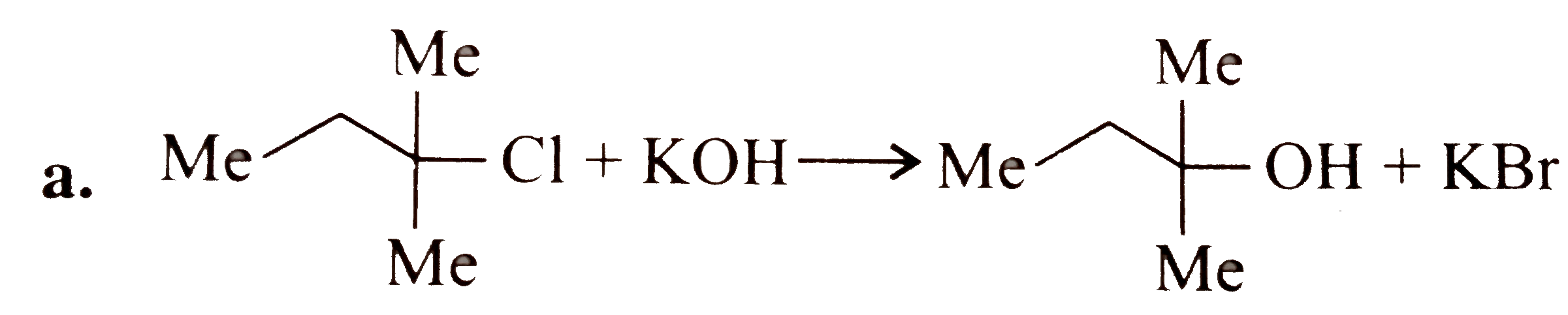
Which of the following are `SN^2` reactions ?

A

B

`Me_3 C - Br + KOH rarr Me_3 C - OH + KBr`

C

`Et - I + EtONa rarr Et - O - Et + NaI`

D

`Et - Cl + NaOH rarr EtOh + NaCl`

Text Solution

Verified by Experts

The correct Answer is:

C, D

`1^@ RX` undergoes `SN^2` reaction.
Promotional Banner

Topper's Solved these Questions

  • ORGANIC REACTION MECHANISM

    CENGAGE CHEMISTRY ENGLISH|Exercise Single correct|43 Videos
  • ORGANIC REACTION MECHANISM

    CENGAGE CHEMISTRY ENGLISH|Exercise Assertion-Reasoning|12 Videos
  • ORGANIC REACTION MECHANISM

    CENGAGE CHEMISTRY ENGLISH|Exercise Comprehension|35 Videos
  • NCERT BASED EXERCISE

    CENGAGE CHEMISTRY ENGLISH|Exercise Chemical Equilibrium|73 Videos
  • P-BLOCK GROUP 13 - BORON FAMILY

    CENGAGE CHEMISTRY ENGLISH|Exercise Exercise Archives (Subjecive)|9 Videos

Similar Questions

Explore conceptually related problems

SN reaction is given by these compounds, which have a nuclophilic group and a good leaving EWG . It should be stable after leaving with bonding pair of overline(e)'s and it should have high polarisability. Nucliphilic aliphatic substituion reaction is mainly of two types SN^(-1) and SN^(2). SN^(-1) mechanism is a two step process. Reaction velocity of SN^(-1) depends only on the concentration of the subtrate. It proceeds via the formation of carbocation, optically active substrate gives (o+) and (o-) froms of the product. In most of the cases, the product usually consists of 5-20% inverted and (95-80%) racemised species. The more stable is the carbocation, the greater is the propotion of racemission. In solvolysis reaction, the more nucleophillic is the solvent, the greater is the proportion of inversion. Which of the following gives SN^(1) reaction?

SN reaction is given by these compounds, which have a nuclophilic group and a good leaving EWG . It should be stable after leaving with bonding pair of overline(e)'s and it should have high polarisability. Nucliphilic aliphatic substituion reaction is mainly of two types SN^(-1) and SN^(2). SN^(-1) mechanism is a two step process. Reaction velocity of SN^(-1) depends only on the concentration of the subtrate. It proceeds via the formation of carbocation, optically active substrate gives (o+) and (o-) froms of the product. In most of the cases, the product usually consists of 5-20% inverted and (95-80%) racemised species. The more stable is the carbocation, the greater is the propotion of racemission. In solvolysis reaction, the more nucleophillic is the solvent, the greater is the proportion of inversion. Which of the following will give SN reaction?

SN reaction is given by these compounds, which have a nuclophilic group and a good leaving EWG . It should be stable after leaving with bonding pair of overline(e)'s and it should have high polarisability. Nucliphilic aliphatic substituion reaction is mainly of two types SN^(-1) and SN^(2). SN^(-1) mechanism is a two step process. Reaction velocity of SN^(-1) depends only on the concentration of the subtrate. It proceeds via the formation of carbocation, optically active substrate gives (o+) and (o-) froms of the product. In most of the cases, the product usually consists of 5-20% inverted and (95-80%) racemised species. The more stable is the carbocation, the greater is the propotion of racemission. In solvolysis reaction, the more nucleophillic is the solvent, the greater is the proportion of inversion. Which of the following gives SN^(1) reaction? Select the correct answer.

State which of the following are oxidation reactions and which are reduction reactions: [i] ZnrarrZn^(2+) [ii] SrarrS^(2-) [iii] Sn^(2+)rarrSn [iv] Fe^(2+)rarrFe^(3+)

Write the products of the following SN reactions. .

In which of the following reactions, SN^2 rate increases on changing the solvent from (95 % acetone + 5 % H_2 O ) to (80 % acetone + 20 % H_2O ) ?

SN^(2) reaction is a bimolecular reaction which takes places by the formation of T.S. Veolcity of the reaction depends on the concentration of the substrate as well as the nucleophile. The reaction is favoureed by strong Nu^(o-) and in the presence of polar aprotic sovlent, optically active halides give. Walken inversion by SN^(2) mechanism. The presence of hero group (atom) at beta-C atom, unsaturation at beta-C and (-overset(O)overset(||)(C)-) group at alpha-C atomn favor SN^(2) mechanism. Allyl halides and benzyl halides give SN^(1) and SN^(2) reactions. Allyl halides alos give SN^(2) mechanism EDG at ortho- and para- postions in benzyl halides favors SN^(1) mechanism, wheras EWG favors SN^(2) mechanism. Which of the following will give SN^(1) reaction?

Which of the following reactions represents SN reaction ?

Which of the following will give SN^(2) mechanism?

Given : E^(@) (Cu^(2+//Cu) = 0.337V and E^(@) (Sn^(2+//Sn) = -0.136V . Which of the following statements is correct?

CENGAGE CHEMISTRY ENGLISH-ORGANIC REACTION MECHANISM-Multiple Correct
  1. In which of the following species containing both nucleophile and leav...

    Text Solution

    |

  2. Which of the following statements are correct ?

    Text Solution

    |

  3. Which of the following are SN^2 reactions ?

    Text Solution

    |

  4. Vinyl bromide undergoes :

    Text Solution

    |

  5. The halogen atom in RX can easily be replaced by nucleophiles such as ...

    Text Solution

    |

  6. Which of the following statements are correct ?

    Text Solution

    |

  7. Which of the following reactions represents SN reaction ?

    Text Solution

    |

  8. Which of the following reactions are feasible ?

    Text Solution

    |

  9. Which of the following transformations are feasible ?

    Text Solution

    |

  10. In which of the following reactions, the intermediate species acyl nit...

    Text Solution

    |

  11. Which of the following statements are correct ?

    Text Solution

    |

  12. Which of the following is//are the rate determining step (s) of the gi...

    Text Solution

    |

  13. The products in the given reaction are : .

    Text Solution

    |

  14. Which of the following statements are correct about the addition of HB...

    Text Solution

    |

  15. Which of the following statements are correct ?

    Text Solution

    |

  16. In which of the following reactions, rearrangement is possible ?

    Text Solution

    |

  17. Which of the following is an example of nucleophilic addition to aceta...

    Text Solution

    |

  18. In which of the reactions, there is a migration of alkyl group to carb...

    Text Solution

    |

  19. Which of the following statements are correct ?

    Text Solution

    |

  20. Which of the following statements/reactions are correct ?

    Text Solution

    |
