


Home
Class 11
CHEMISTRY
In which of the reactions, there is a mi...

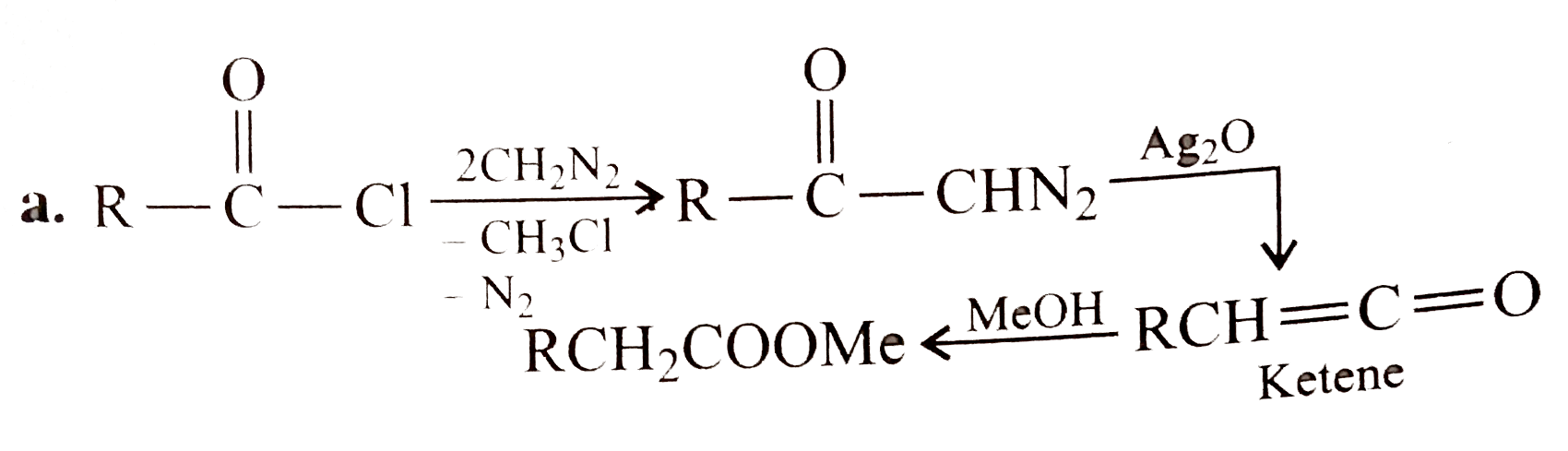
In which of the reactions, there is a migration of alkyl group to carbene `(ddot C H_2)`, i.e., rearrangement occurs ?

A

B

C

D

Text Solution

AI Generated Solution

The correct Answer is:

To determine in which reactions there is a migration of an alkyl group to a carbene, we will analyze the provided options step by step. ### Step 1: Understand the concept of carbene A carbene is a neutral species containing a carbon atom with only six valence electrons, making it highly reactive. Carbenes can undergo rearrangements where groups attached to the carbon can migrate. ### Step 2: Analyze the reactions We will examine each of the four options to see if they involve the formation of a carbene and if a rearrangement occurs. #### Option A: Orn-Destert Reaction - In this reaction, a carbene is formed. - There is a rearrangement where an alkyl group migrates to the carbene. - **Conclusion**: This option involves migration of an alkyl group to the carbene. #### Option B: Wulff Rearrangement - This reaction also leads to the formation of a carbene. - It involves the migration of an alkyl group (or aldehyde group) to the carbene. - **Conclusion**: This option involves migration of an alkyl group to the carbene. #### Option C: Another Rearrangement Reaction (not specified) - Similar to the previous two, if this reaction forms a carbene and involves rearrangement, it would also show migration. - **Conclusion**: This option likely involves migration of an alkyl group to the carbene. #### Option D: Hoffmann Bromamide Reaction - This reaction does not form a carbene; instead, it leads to the formation of a nitrene. - Since there is no carbene formation, there is no rearrangement involving migration. - **Conclusion**: This option does NOT involve migration of an alkyl group to a carbene. ### Step 3: Final Conclusion Based on the analysis: - Options A, B, and C involve the migration of an alkyl group to a carbene. - Option D does not involve carbene formation and thus does not involve migration. ### Final Answer The reactions in which there is a migration of an alkyl group to carbene (i.e., rearrangement occurs) are **Option A, Option B, and Option C**. ---

To determine in which reactions there is a migration of an alkyl group to a carbene, we will analyze the provided options step by step. ### Step 1: Understand the concept of carbene A carbene is a neutral species containing a carbon atom with only six valence electrons, making it highly reactive. Carbenes can undergo rearrangements where groups attached to the carbon can migrate. ### Step 2: Analyze the reactions We will examine each of the four options to see if they involve the formation of a carbene and if a rearrangement occurs. ...
Promotional Banner

Topper's Solved these Questions

  • ORGANIC REACTION MECHANISM

    CENGAGE CHEMISTRY ENGLISH|Exercise Single correct|43 Videos
  • ORGANIC REACTION MECHANISM

    CENGAGE CHEMISTRY ENGLISH|Exercise Assertion-Reasoning|12 Videos
  • ORGANIC REACTION MECHANISM

    CENGAGE CHEMISTRY ENGLISH|Exercise Comprehension|35 Videos
  • NCERT BASED EXERCISE

    CENGAGE CHEMISTRY ENGLISH|Exercise Chemical Equilibrium|73 Videos
  • P-BLOCK GROUP 13 - BORON FAMILY

    CENGAGE CHEMISTRY ENGLISH|Exercise Exercise Archives (Subjecive)|9 Videos

Similar Questions

Explore conceptually related problems

In which of the following reaction migration of alkyl group from ''C'' to ''N'' terminus is not occuring

Consider the following reactions: I. C_(2)H_(5) - I + NH_(3) rarr C_(2) H_(5) N^(o+)H_(3) + I^(o-) II. C_(2)H_(5) - I + ddot(P)H_(3) rarr C_(2)H_(5) P^(o+)H_(5) + I^(o-) III. C_(2)H_(5) - I + EtO^(o-) rarr C_(2) H_(5) - OEt + I^(o-) IV. Me - overset(o+)(S) - Me_(2) + O^(o-)H rarr Me-OH + Me_(2)S In which of the above reactions does the rate of SN^(2) reactions increases with increase in solvent polarity?

Identify the reaction for which Delta H != Delta E

Hofmann rearrangement In the Hofmann rearrangement an unsubstitued amide is treated with sodium hydroxide and bromine to give a primary amine that has one carbon lesser than starting amide. Gneral reaction: If the migrating group is chiral then its configuration is retained. Electron releasing effects in the migrating group increase reactivity of Hofmann rearangement. Which of the following compound(s) cannot give Hoffman rearrangement:

Hofmann rearrangement In the Hofmann rearrangement an unsubstitued amide is treated with sodium hydroxide and bromine to give a primary amine that has one carbon lesser than starting amide. Gneral reaction: If the migrating group is chiral then its configuration is retained. Electron releasing effects in the migrating group increase reactivity of Hofmann rearangement. Arrange the following amides according to their relative reactivity when reacted with Br_(2) in excess of strong base:

In which of the following reactions, the intermediate species acyl nitrene (R-overset(O)overset(||)(C)-ddot(N: )) and intermediate compound alkyl isocyanate (R - N = C = O) are involved ?

Carbene intermediates are produced by the photolysis of diazomethane (CH_2N_2) or kenene (CH_2 = C = O) . They are also produced by the reaction of CHX_3 with base or by Simmons-Smith reaction. There are two types of carbenes, singlet and triplet. They are so called due to their spin state. Which carbene is produced in the following reactions ? .

Carbene intermediates are produced by the photolysis of diazomethane (CH_2N_2) or kenene (CH_2 = C = O) . They are also produced by the reaction of CHX_3 with base or by Simmons-Smith reaction. There are two types of carbenes, singlet and triplet. They are so called due to their spin state. Singlet and triplet carbene are same in :

CENGAGE CHEMISTRY ENGLISH-ORGANIC REACTION MECHANISM-Multiple Correct
  1. Which of the following reactions are feasible ?

    Text Solution

    |

  2. Which of the following transformations are feasible ?

    Text Solution

    |

  3. In which of the following reactions, the intermediate species acyl nit...

    Text Solution

    |

  4. Which of the following statements are correct ?

    Text Solution

    |

  5. Which of the following is//are the rate determining step (s) of the gi...

    Text Solution

    |

  6. The products in the given reaction are : .

    Text Solution

    |

  7. Which of the following statements are correct about the addition of HB...

    Text Solution

    |

  8. Which of the following statements are correct ?

    Text Solution

    |

  9. In which of the following reactions, rearrangement is possible ?

    Text Solution

    |

  10. Which of the following is an example of nucleophilic addition to aceta...

    Text Solution

    |

  11. In which of the reactions, there is a migration of alkyl group to carb...

    Text Solution

    |

  12. Which of the following statements are correct ?

    Text Solution

    |

  13. Which of the following statements/reactions are correct ?

    Text Solution

    |

  14. Which of the following statements is//are correct ?

    Text Solution

    |

  15. Consider the following reactions : (I) Me - underset ((A)) -= - Me o...

    Text Solution

    |

  16. Consider the following reactions : Which of the following stateme...

    Text Solution

    |

  17. Consider the following reactions : Which of the following stateme...

    Text Solution

    |

  18. Which of the following statements/reactions are correct ?

    Text Solution

    |

  19. Consider the following compounds Which of the following statements are...

    Text Solution

    |

  20. Which of the following reactions are both stereospecific and regiosele...

    Text Solution

    |
