Home
Class 11
CHEMISTRY
Which of the following compounds would u...

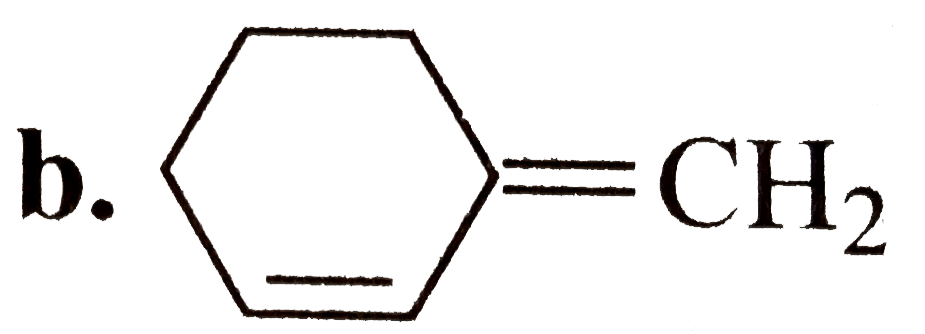
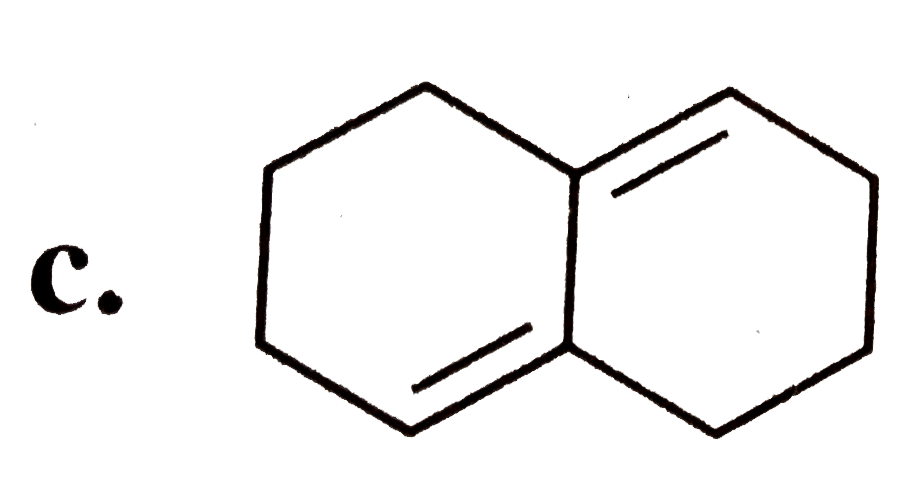
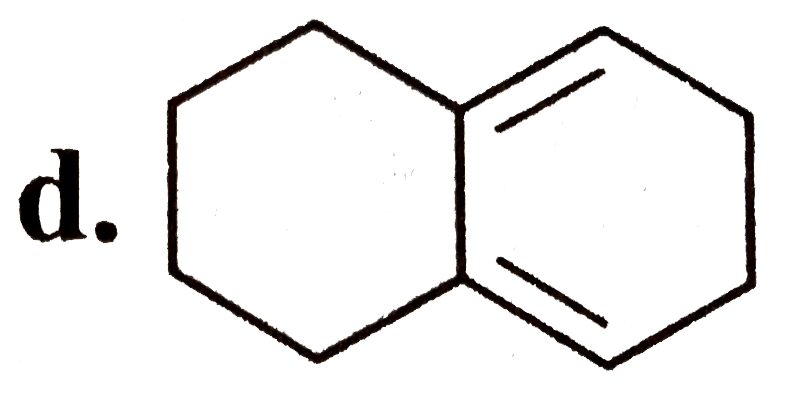
Which of the following compounds would undergo Diels-Alder reaction with dienophile (e.g., Maleic anhydride) ?

A

`HC -= C - C -= CH`

B

C

D

Text Solution

AI Generated Solution

The correct Answer is:

To determine which of the given compounds would undergo a Diels-Alder reaction with a dienophile such as maleic anhydride, we need to analyze the structural requirements for the Diels-Alder reaction. ### Step-by-Step Solution: 1. **Understanding the Diels-Alder Reaction**: The Diels-Alder reaction is a [4+2] cycloaddition reaction between a diene and a dienophile. For a compound to act as a diene, it must have at least two conjugated double bonds (a diene system) that can react with a dienophile. 2. **Identifying the Diene**: - A diene must have two double bonds that are in a conjugated system. - The diene should preferably be in a cis configuration to allow for effective overlap of orbitals during the reaction. 3. **Electron Donating and Withdrawing Groups**: - The diene should have an electron-donating group (EDG) that enhances its reactivity. - The dienophile (like maleic anhydride) should have an electron-withdrawing group (EWG) to facilitate the reaction. 4. **Analyzing Each Compound**: - **Compound A**: Check if it has a diene structure. If it is a di-ine (more than two double bonds), it does not qualify as a diene for this reaction. - **Compound B**: Identify if it has a diene. If the diene is not in the same ring, it cannot participate in the Diels-Alder reaction. - **Compound C**: Check the configuration of the double bonds. If the diene is in a trans configuration, it will not effectively overlap with the dienophile. - **Compound D**: Confirm if it has a diene in the same ring and if there is an electron-donating group present. 5. **Conclusion**: After analyzing the compounds based on the above criteria, we find that **Compound D** meets all the necessary conditions for undergoing a Diels-Alder reaction with maleic anhydride. ### Final Answer: The compound that would undergo a Diels-Alder reaction with a dienophile (e.g., Maleic anhydride) is **Compound D**.
Promotional Banner

Topper's Solved these Questions

  • ORGANIC REACTION MECHANISM

    CENGAGE CHEMISTRY ENGLISH|Exercise Assertion-Reasoning|12 Videos
  • ORGANIC REACTION MECHANISM

    CENGAGE CHEMISTRY ENGLISH|Exercise Archives|8 Videos
  • ORGANIC REACTION MECHANISM

    CENGAGE CHEMISTRY ENGLISH|Exercise Multiple Correct|30 Videos
  • NCERT BASED EXERCISE

    CENGAGE CHEMISTRY ENGLISH|Exercise Chemical Equilibrium|73 Videos
  • P-BLOCK GROUP 13 - BORON FAMILY

    CENGAGE CHEMISTRY ENGLISH|Exercise Exercise Archives (Subjecive)|9 Videos

Similar Questions

Explore conceptually related problems

Explain why neither of the following compounds undergoes Diels - Alder reaction with dienophile (e.g. maleic anhydride ). a. HC-=C-C-=CH b. c.

Which of the following reaction would undergo Diels-Alder reaction ? .

Which of the following compounds will undergo Cannizzaro reaction ?

Which of the following compound will undergo tautomerism?

Which of the following compounds undergo E2 reaction with maximum rate?

Which of the following compounds will not undergo Friedel Craft's reaction with benzene ?

Which of the following compound do not undergo enolisation?

Which of the following compounds will not undergo Friedel - Crafts reaction easily ?

Which of the following compounds will not undergo Friedel - Crafts reaction easily ?

Which of the following compound does undergo aldol condensation

CENGAGE CHEMISTRY ENGLISH-ORGANIC REACTION MECHANISM-Single correct
  1. In which of the following reactions, retention of configuration takes ...

    Text Solution

    |

  2. Necessary conditions for Fiels-Alder reactions are :

    Text Solution

    |

  3. Which of the following compounds would undergo Diels-Alder reaction wi...

    Text Solution

    |

  4. Which of the following reaction would undergo Diels-Alder reaction ? ...

    Text Solution

    |

  5. The decresing order of reactivity towards SE (substitution by electrop...

    Text Solution

    |

  6. Which of the following is a free radical susbtitution reaction ?

    Text Solution

    |

  7. Reagent I and II, respectively, are :

    Text Solution

    |

  8. Which product is racemic in the above reaction ?

    Text Solution

    |

  9. Consider the following reactions.

    Text Solution

    |

  10. Which of the following is a non-aromatic compound ?

    Text Solution

    |

  11. The decreasing order of reactivity towards ArSN reaction of the follow...

    Text Solution

    |

  12. Consider the following reaction : The product is :

    Text Solution

    |

  13. Refer to Q.No. 38 and find out which of the following statements is w...

    Text Solution

    |

  14. Which of the following is not a rearrangement reaction ?

    Text Solution

    |

  15. Arrange the following in the reactions order of NA (nucleophilic addit...

    Text Solution

    |

  16. Arrange the following in the decreasing order of nucleophilic acyl sub...

    Text Solution

    |

  17. Which of the following reactions will not give Hofmann alkene ?

    Text Solution

    |

  18. Which of the following is the best method for the preparation of compo...

    Text Solution

    |

  19. Which statement is correct about the above reaction ?

    Text Solution

    |

  20. An alkyl halide of formula C6 H13 Br on treatment with potassium t-but...

    Text Solution

    |
