Home
Class 12
CHEMISTRY
Hydrocarbon (X), C(7)H(12), on reaction ...

Hydrocarbon (X), `C_(7)H_(12)`, on reaction with boron hydride followed by treatment with `CH_(3)COOH` yields (A). On reductive ozonolysis (A) yields a mixture of two aldehydes, (B) and (C ). Of these, only (B) can undergo Cannizzaro reaction. (A) exists in two geometrical isomer, `(A-1)` and `(A-2)`, of which `(A-2)` is more stable. Gives structures of (X), (A), (B), (C ), `(A-1)`, and `(A-2)` with proper reasoning.

Text Solution

Verified by Experts
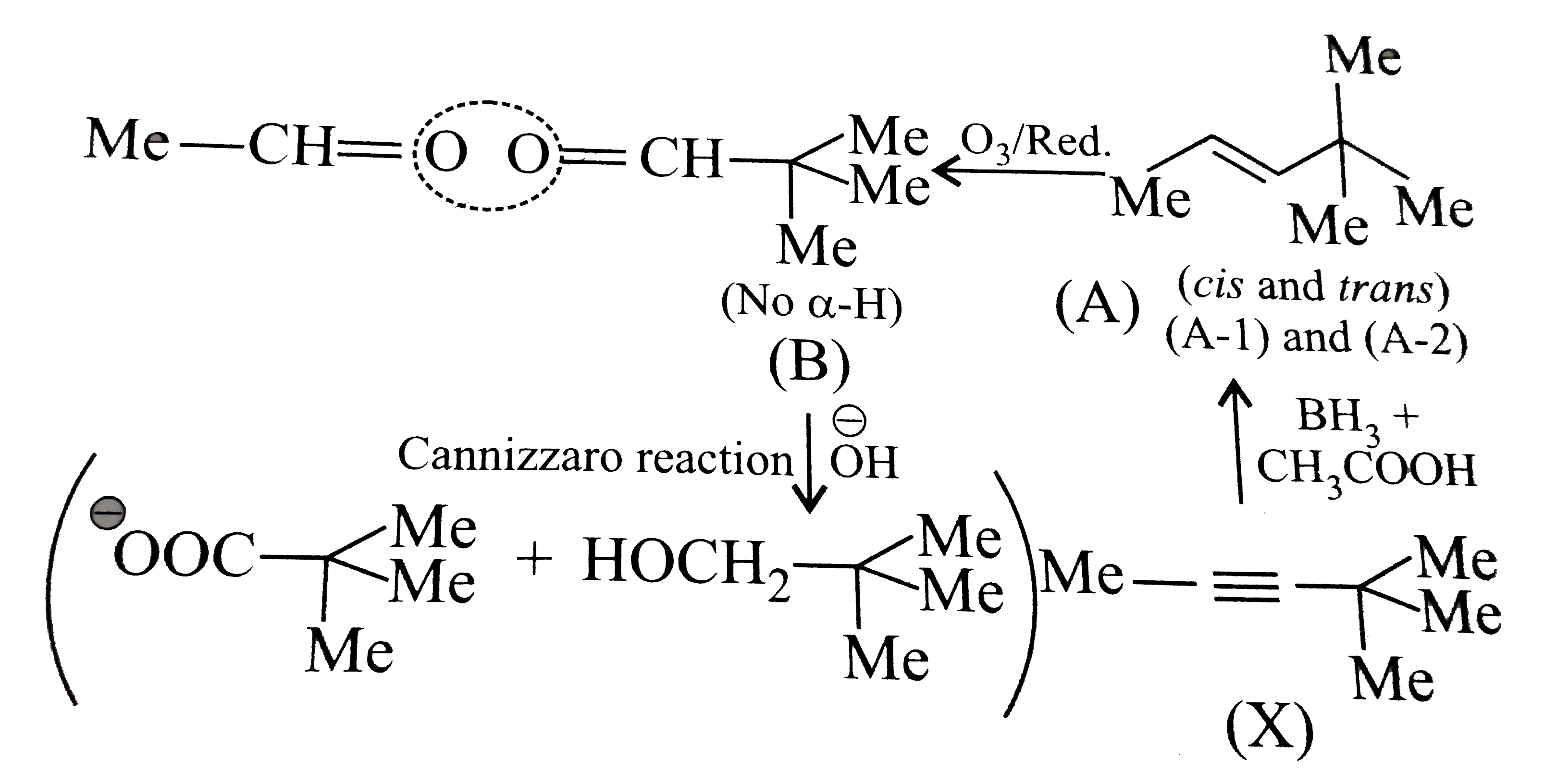
i. D.U. in (A) `= 2^(@)` [suggests one `(C-=C)` bond, since (A) undergoes reaction with `BH_(3)//CH_(3)COOH` to give `(C-=C)` bond which undergoes ozonolysis].
ii. One product of ozonolysis undergoes Cannizzaro reaction, which must be an aldehyde without `alpha`-H atom. Compound (B)must be `(Me_(3)C-CHO)` (five C atoms).
Proceed reverse:
Promotional Banner

Topper's Solved these Questions

  • ALIPHATIC AND AROMATIC ALDEHYDES AND KETONES

    CENGAGE CHEMISTRY ENGLISH|Exercise Exercises Concept Application|20 Videos
  • ALIPHATIC AND AROMATIC ALDEHYDES AND KETONES

    CENGAGE CHEMISTRY ENGLISH|Exercise Exercises Linked Comprehension|59 Videos
  • ALIPHATIC AND AROMATIC ALDEHYDES AND KETONES

    CENGAGE CHEMISTRY ENGLISH|Exercise Solved Examples|13 Videos
  • ALCOHOL,PHENOL AND ETHERS

    CENGAGE CHEMISTRY ENGLISH|Exercise Archives Analytical And Descriptive|15 Videos
  • APPENDIX INORGANIC VOLUME 2

    CENGAGE CHEMISTRY ENGLISH|Exercise Short Answer Type|179 Videos

Similar Questions

Explore conceptually related problems

Two different G.R. (A) and (B) give the product (X) on reaction with ( C) and (D) respectively. Give the structures of (A), (B), ( C) and (D) .

Two isomeric compounds, (A) and (B), have the same formula, C_(11)H_(13)OCI . Both are unsaturated, yield the same compound (C) on catalytic hydrogenation, and produce 4-chloro-3-ethoxybenzoic acid on vigorous oxidation. (A) exists in geometrical isomers, (D) and (E), but not (B). Give structures of (A) to (E) with proper reasoning.

An organic compound (A) (C_(6)H_(10)O) on reaction with CH_(3)MgBr followed by acid treatment gives compound (B). The compound (B) on ozonolysis gives compound (C ), which in the presence of a base gives 1-acetyl cyclopentene (D). The compound (B) on reaction with HBr gives compound (E ). Write the structures of (A), (B), (C ), (D), and (E ). Show how (D) is formed from (C ).

An organic compound (A) of molecular formula C_(5)H_(8) when treated with Na in liquid ammonia followed by reaction with -Propyl iodide yeidls (B) C_(8)H_(12) (A) gives a ketone C_(5)H_(10)O (e) when treated with dil H_(2)SO_(4) and HgSO_(4) (B) on oxidation with alkaline KMnO_(4) gives two isomeric acids (D) and (E) C_(4)H_(8)O_(2) . Give structures of compounds (A) to (E) with proper reasoning .

An organic compound C_(6)H_(12)(X) on reduction gives C_(6)H_(14)(Y) . X on ozonolysis gives two aldehydes C_(2)H_(4)O(I) and C_(4)H_(8)O(II) . Identify the compounds X, Y and aldehydes (I) and (II).

A hydrocarbon of formula C_(10)H_(16) absorbs only one mole of H_(2) upon hydrogenation. On ozonolysis, it yields 1 , 6 -Cyclodecanedione. What is the structure of the hydrocarbon ?

An alkyne C_(7)H_(12) when reacted with alkaline KMnO_(4) followed by acidification by HCl, yielded a mixture of CH_(3)-underset(CH_(3))underset(|)(CH)-COOH & CH_(3)CH_(2)COOH . The alkyne is -

A compound 'X' on ozonolysis followed by reduction gives an aldehyde, C_(2)H_(4)O and 2-butanone. Compound 'X' is:

An acidic compound (A) (C_4 H_8 O_3) loses its optical activity on strong heating yielding (B) (C_4 H_6 O_2) which reacts readly with KMnO_4 . (B) forms a dervative ( C) with SOCl_2 which on reaction with (CH_3)_2 NH gives (D) . The compound (A) on oxidation with dilute chromic acid gives an unstable compound (E) which decarboxylates readily to give (F) (C_3 H_6 O) . The compound (F) gives a hydrocarbon (G) on treatment with amalgamated Zn and HCl . Give the structures of (A) to (G) with proper reasoning.

CENGAGE CHEMISTRY ENGLISH-ALIPHATIC AND AROMATIC ALDEHYDES AND KETONES-Exercises Subjective
  1. p-Hydroxybenzaldehyde does not undergo Cannizzaro reaction. Explain.

    Text Solution

    |

  2. Complete the following reaction

    Text Solution

    |

  3. Convert HCHO to glycol in one step only.

    Text Solution

    |

  4. Convert and vice versa.

    Text Solution

    |

  5. Convert benzence to PhCHO in one step only.

    Text Solution

    |

  6. An aromatic kentone (X) has the molecular formula C(10)H(12)O(2). On v...

    Text Solution

    |

  7. A natural compound (A) (C(7)H(6)O) forms an oxime. When (A) is treated...

    Text Solution

    |

  8. An organic compound (A) (C(8)H(14)O) forms an oxime and gives a positi...

    Text Solution

    |

  9. Compound (A) (C(6)H(12)O(2)) on reduction with LiAlH(4) yielded two co...

    Text Solution

    |

  10. Hydrocarbon (X), C(7)H(12), on reaction with boron hydride followed by...

    Text Solution

    |

  11. An organic compound (A) (C(6)H(10)) on reaction with CH(3)MgBr followe...

    Text Solution

    |

  12. An organic compound (A) contaning C, H, and O (16.32%) does not decolo...

    Text Solution

    |

  13. A 0.535 gm mixture of ethanol and acetaldehyde when heated with Fehlin...

    Text Solution

    |

  14. An organic compound (A) contains 79.25% C, 5.66% H, and 15.09% O. It h...

    Text Solution

    |

  15. An organic compound (A) containing 60.12% (C ) and 13.3% H has vapour ...

    Text Solution

    |

  16. Two organic compounds (A) and (B) containing 62.01% C and 10.3% H reac...

    Text Solution

    |

  17. An organic compound (A) (C(5)H(7)OCl) reacts rapidly with ethanol to g...

    Text Solution

    |

  18. An organic compound (A) contains 87.27% C and 13.73% H. Its vapour den...

    Text Solution

    |

  19. An organic compound (A) C(4)H(9)Cl on reacting with aqueous KOH gives ...

    Text Solution

    |

  20. An alkyne with five carbon atoms per molecule when passed through dilu...

    Text Solution

    |

