Home
Class 12
PHYSICS
A car starts moving on a straight road. ...

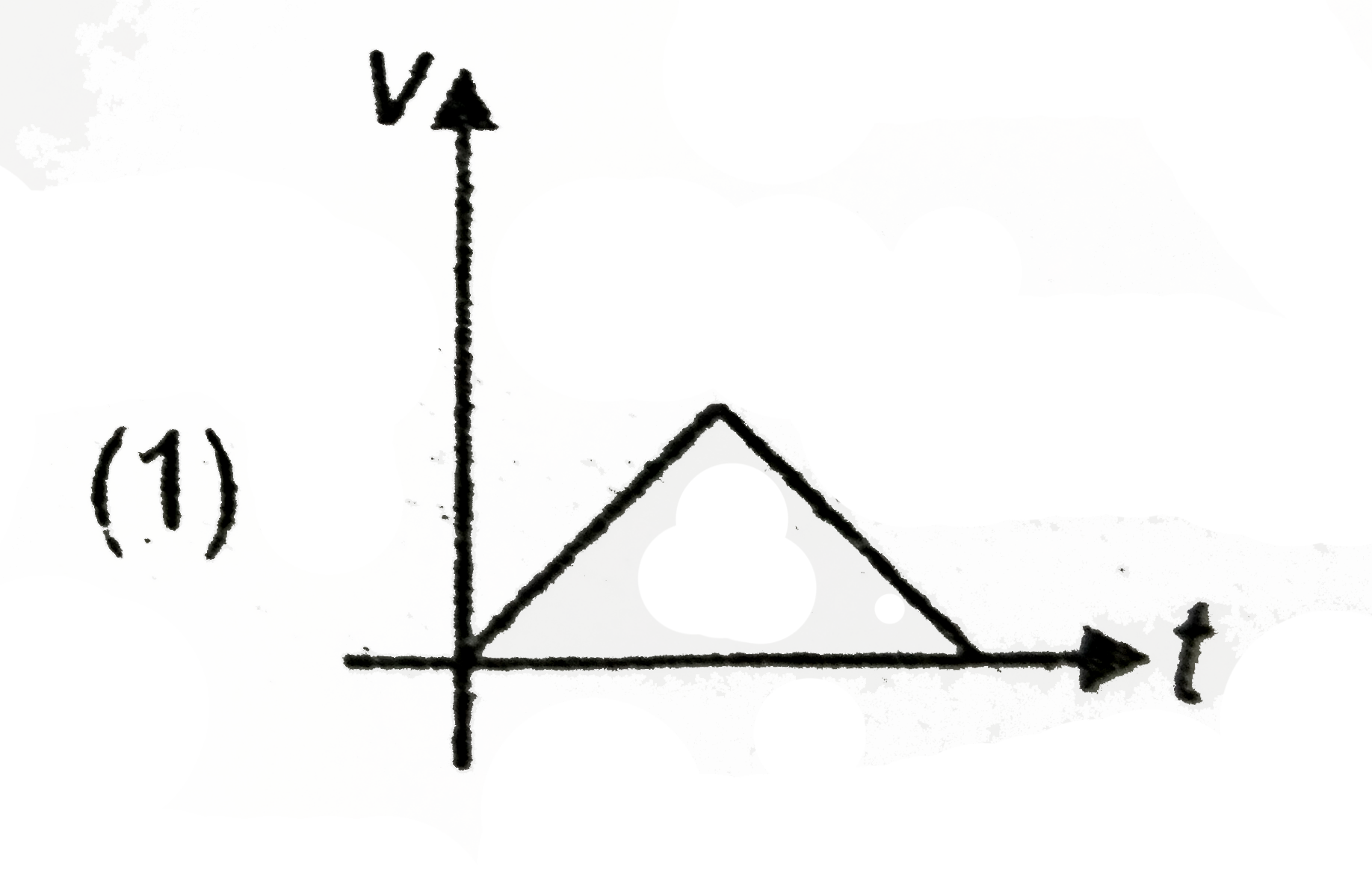
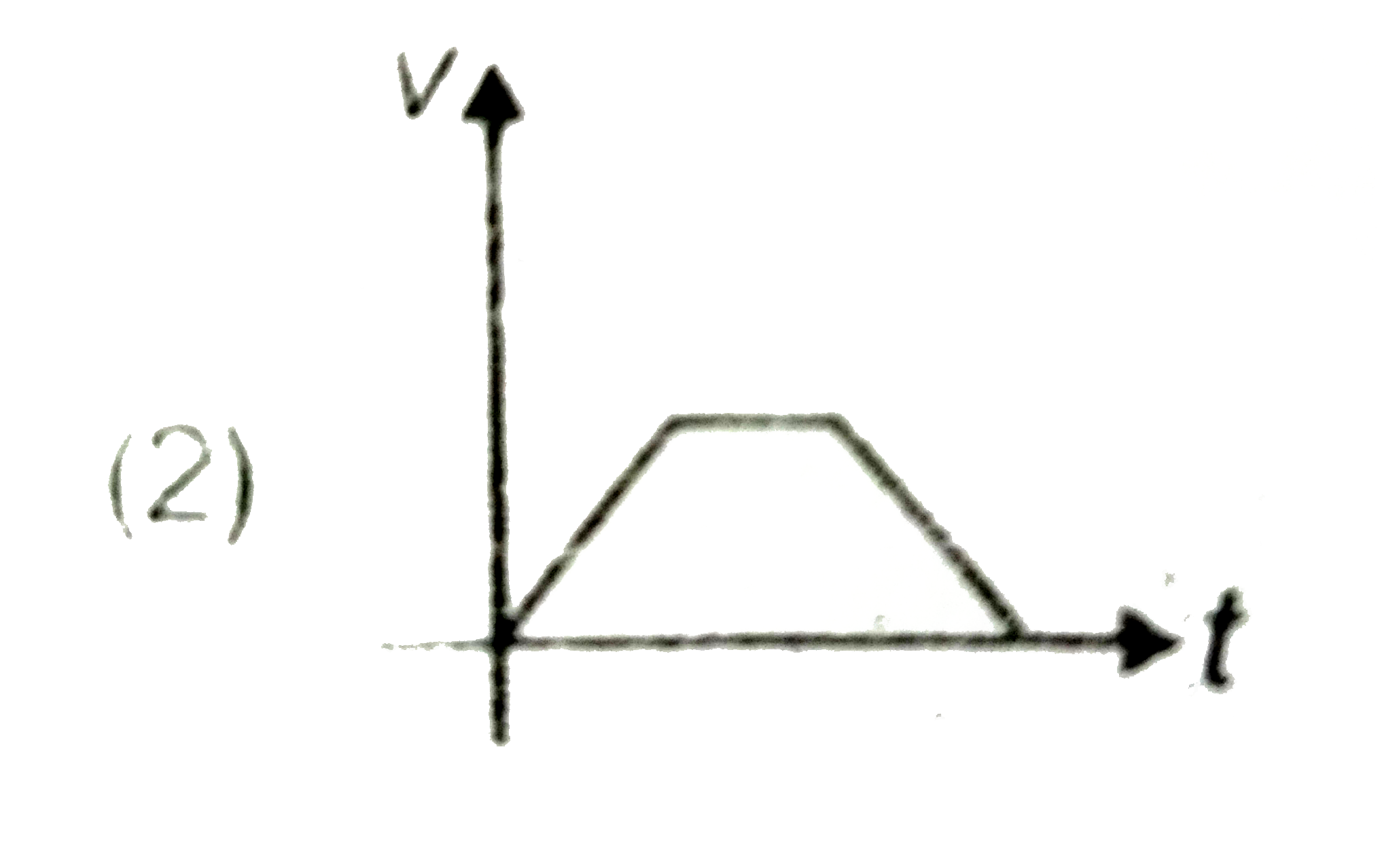
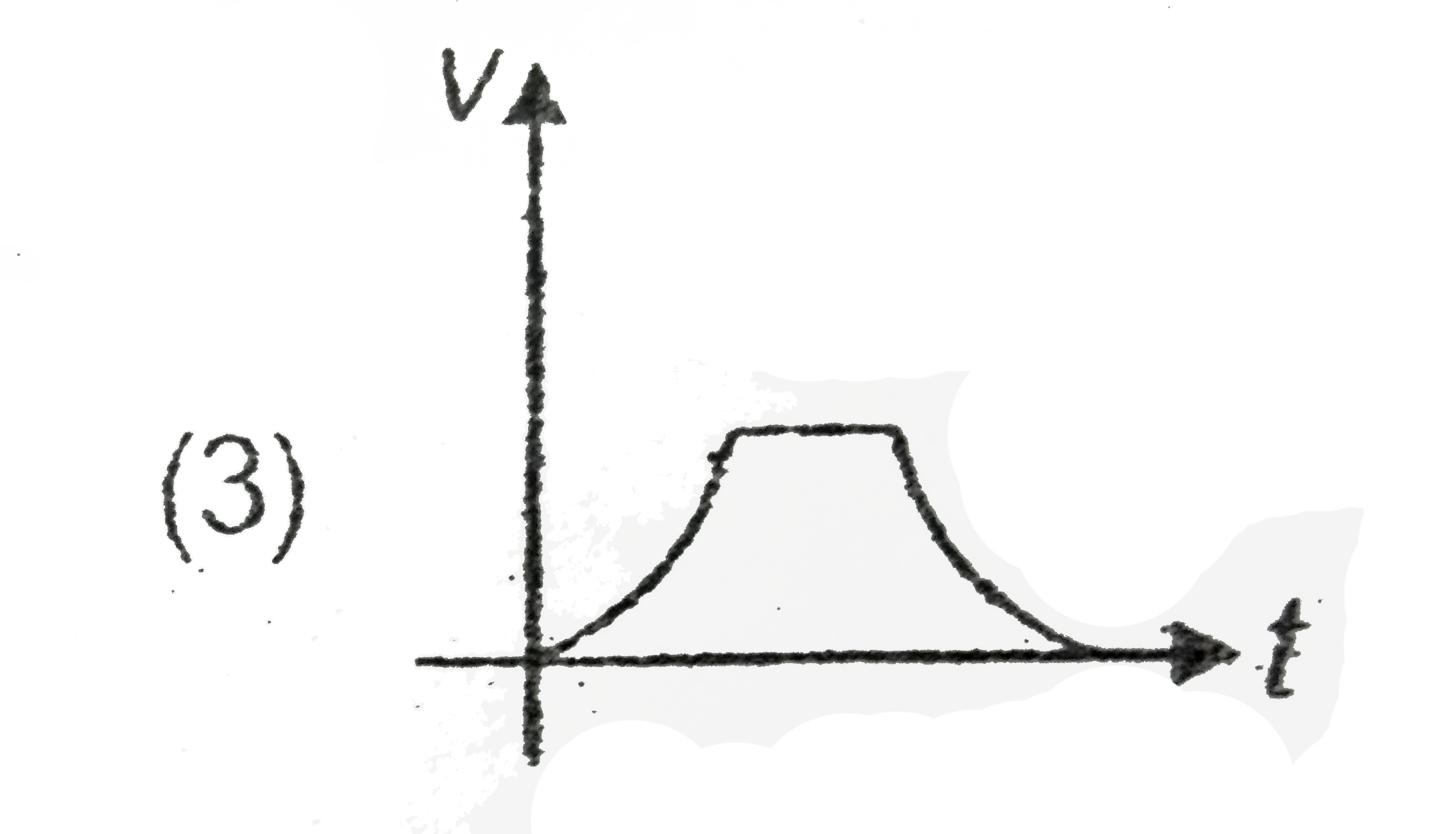
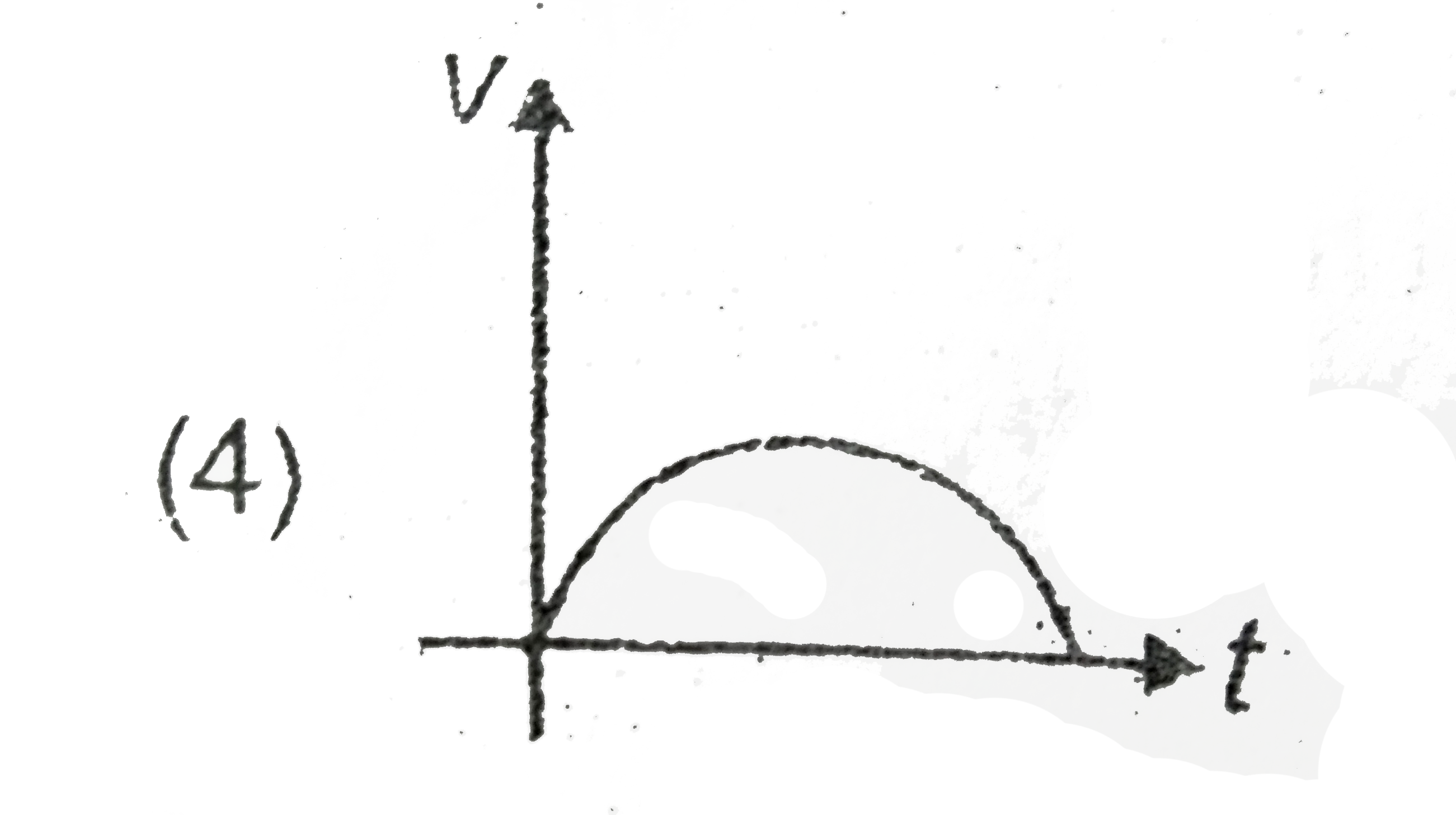
A car starts moving on a straight road. It makes the entire journey in three parts. The total time of journey is 25 s. For first part it accelerates at a constant rate `5m//s^(2)`. For second part it moves with a constant speed. For the third part it retards at constant rate `5m//s^(2)` to come to rest.
The correct velocity-time graph is

A

B

C

D

Text Solution

AI Generated Solution

The correct Answer is:

To solve the problem step by step, we need to analyze the motion of the car in three distinct parts: acceleration, constant speed, and deceleration. ### Step 1: Analyze the first part of the journey (Acceleration) - The car accelerates at a constant rate of \(5 \, \text{m/s}^2\). - Let the time taken for this part be \(t_1\). - The final velocity at the end of this part can be calculated using the formula: \[ v = u + at \] where \(u = 0\) (initial velocity), \(a = 5 \, \text{m/s}^2\), and \(t = t_1\). Thus, the final velocity after the first part is: \[ v_1 = 0 + 5t_1 = 5t_1 \] ### Step 2: Analyze the second part of the journey (Constant Speed) - In this part, the car moves with a constant speed \(v_1 = 5t_1\). - Let the time taken for this part be \(t_2\). - The distance covered during this part can be calculated as: \[ d_2 = v_1 \cdot t_2 = (5t_1) \cdot t_2 \] ### Step 3: Analyze the third part of the journey (Deceleration) - The car decelerates at a constant rate of \(5 \, \text{m/s}^2\) until it comes to rest. - Let the time taken for this part be \(t_3\). - The initial velocity for this part is \(v_1 = 5t_1\) and it comes to rest, so the final velocity is \(0\). - Using the formula: \[ v = u + at \] we have: \[ 0 = 5t_1 - 5t_3 \] Rearranging gives: \[ t_3 = t_1 \] ### Step 4: Total time of journey - The total time of the journey is given as \(25 \, \text{s}\): \[ t_1 + t_2 + t_3 = 25 \] Substituting \(t_3 = t_1\): \[ t_1 + t_2 + t_1 = 25 \implies 2t_1 + t_2 = 25 \] ### Step 5: Determine the relationship between the parts - From the equations, we have: \[ t_2 = 25 - 2t_1 \] - The car accelerates for \(t_1\), moves at constant speed for \(t_2\), and then decelerates for \(t_1\). ### Step 6: Sketch the velocity-time graph 1. **First Part (Acceleration)**: The velocity increases linearly from \(0\) to \(5t_1\) over the time \(t_1\). 2. **Second Part (Constant Speed)**: The velocity remains constant at \(5t_1\) for the duration \(t_2\). 3. **Third Part (Deceleration)**: The velocity decreases linearly from \(5t_1\) to \(0\) over the time \(t_1\). ### Conclusion The correct velocity-time graph will show: - A linear increase in velocity during the first part, - A horizontal line during the second part, - A linear decrease in velocity during the third part.
Promotional Banner

Topper's Solved these Questions

  • MOTION IN STRAIGHT LINE

    AAKASH INSTITUTE ENGLISH|Exercise Assignment (SECTION - E)|8 Videos
  • MOTION IN STRAIGHT LINE

    AAKASH INSTITUTE ENGLISH|Exercise Assignment (SECTION - F)|2 Videos
  • MOTION IN STRAIGHT LINE

    AAKASH INSTITUTE ENGLISH|Exercise Assignment (SECTION - C)|7 Videos
  • MOTION IN A STRAIGHT LINE

    AAKASH INSTITUTE ENGLISH|Exercise ASSIGNMENT (SECTION - D)|15 Videos
  • MOVING CHARGE AND MAGNESIUM

    AAKASH INSTITUTE ENGLISH|Exercise SECTION D|16 Videos

Similar Questions

Explore conceptually related problems

A car starts moving on a straight road. It makes the entire journey in three parts. The total time of journey is 25 s. For first part it accelerates at a constant rate 5m//s^(2) . For second part it moves with a constant speed. For the third part it retards at constant rate 5m//s^(2) to come to rest. If the average speed for entire journey is 20 m/s, time period of first part of journey is

A car starts moving on a straight road. It makes the entire journey in three parts. The total time of journey is 25 s. For first part it accelerates at a constant rate 5m//s^(2) . For second part it moves with a constant speed. For the third part it retards at constant rate 5m//s^(2) to come to rest. Let t_(1) be the time for first part, t_(2) be the time for 2nd part then correct relation is

A car accelerates from rest at a constant rate of 2 m s^(-2) for some time. The it retatds at a constant rate of 4 m s^(-2) and comes to rest. It remains in motion for 6 s .

A train accelerates from rest at a constant rate a for time t_(1) and then it retards at the constant rate b for time t_(2) then comes to rest. Find the ratio t_(1) / t_(2) .

A car acceleration from rest at a constant rate 2m//s^(2) for some time. Then, it retards at a constant rate of 4 m//s^(2) and comes to rest. If it remains motion for 3 second, then the maximum speed attained by the car is:-

A car , starting from rest, accelerates at the rate f through a distance S then continues at constant speed for time t and then decelerates at the rate (f)/(2) to come to rest . If the total distance traversed is 15 S , then

A car, starting from rest, accelerates at the rate f through a distance s, then continues at constant speed for time t and then decelerates at the rate f/ 2 to come to rest. If the total distance travelled is 15 s, then

A car, starting from rest, accelerates at the rate f through a distance s, then continues at constant speed for time t and then decelerates at the rate f/ 2 to come to rest. If the total distance travelled is 15 s, then

A train accelerates from rest at a constant rate alpha for some time and then it retards to rest at the constant rate beta . If the total distance covered by the train is s, then the velocity of the train is

A bus starting from rest, accelerates at the rate of f through a distance S, then continues at constant speed for time t and declerates at the rate f/2 to come to rest. If the total distance travelled is 15 S then S =

AAKASH INSTITUTE ENGLISH-MOTION IN STRAIGHT LINE-Assignment (SECTION - D)
  1. Graphs are very useful to represent a physical situation. Various quan...

    Text Solution

    |

  2. Graphs are very useful to represent a physical situation. Various quan...

    Text Solution

    |

  3. Graphs are very useful to represent a physical situation. Various quan...

    Text Solution

    |

  4. A car starts moving on a straight road. It makes the entire journey in...

    Text Solution

    |

  5. A car starts moving on a straight road. It makes the entire journey in...

    Text Solution

    |

  6. A car starts moving on a straight road. It makes the entire journey in...

    Text Solution

    |

  7. A rocket is fired upwards such that its engine takes 10 s to explods f...

    Text Solution

    |

  8. A rocket is fired upwards such that its engine takes 10 s to explods f...

    Text Solution

    |

  9. A rocket is fired upwards such that its engine takes 10 s to explods f...

    Text Solution

    |

  10. A car accelerates from rest at constant rate of 2ms^(-2) for some time...

    Text Solution

    |

  11. A car accelerates from rest at constant rate of 2ms^(-2) for some time...

    Text Solution

    |

  12. A car accelerates from rest at constant rate of 2ms^(-2) for some time...

    Text Solution

    |

  13. A car acceleration from rest at a constant rate 2m//s^(2) for some tim...

    Text Solution

    |

  14. A car accelerates from rest at constant rate of 2ms^(-2) for some time...

    Text Solution

    |

  15. A car accelerates from rest at constant rate of 2ms^(-2) for some time...

    Text Solution

    |

  16. A car accelerates from rest at constant rate of 2ms^(-2) for some time...

    Text Solution

    |

  17. The figure shows position time graph of two riders C and D. Based on t...

    Text Solution

    |

  18. The figure shows position time graph of two riders C and D. Based on t...

    Text Solution

    |

  19. The figure shows position time graph of two riders C and D. Based on t...

    Text Solution

    |

  20. The figure shows position time graph of two riders C and D. Based on t...

    Text Solution

    |
