Home
Class 12
PHYSICS
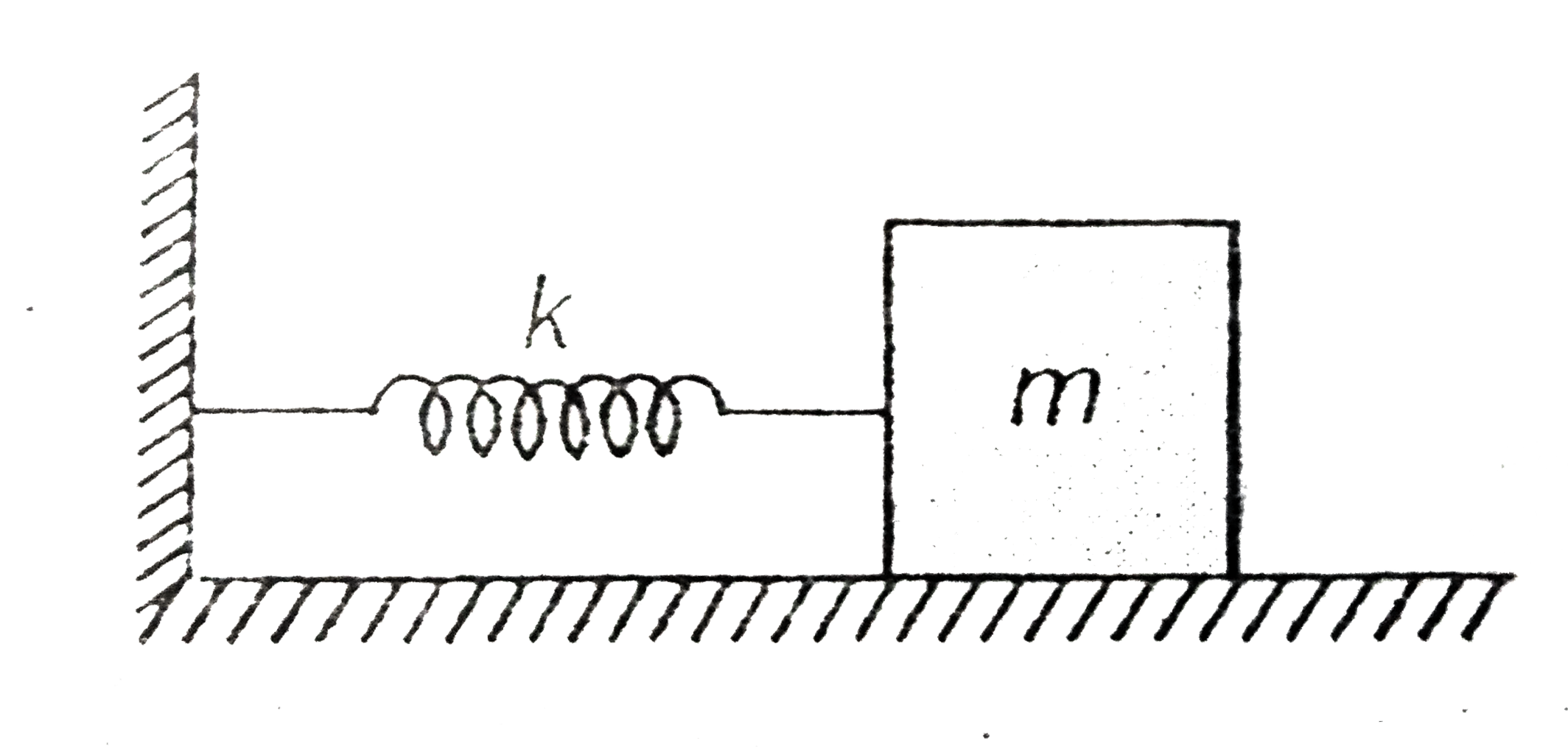
Figure shows a block of mass 'm' restin...

Figure shows a block of mass 'm' resting on a smooth horizontal surface. It is connected to a rigid wall by a massless spring of stiffness 'k'. The spring is in its natural length. A constant horizontal force F starts acting on the block towards right. Find (i) speed of the block as it moves throught a distance x, (ii) speed when the block is in equlibrium and (iii) maximum extension produced in the speing.

Text Solution

Verified by Experts
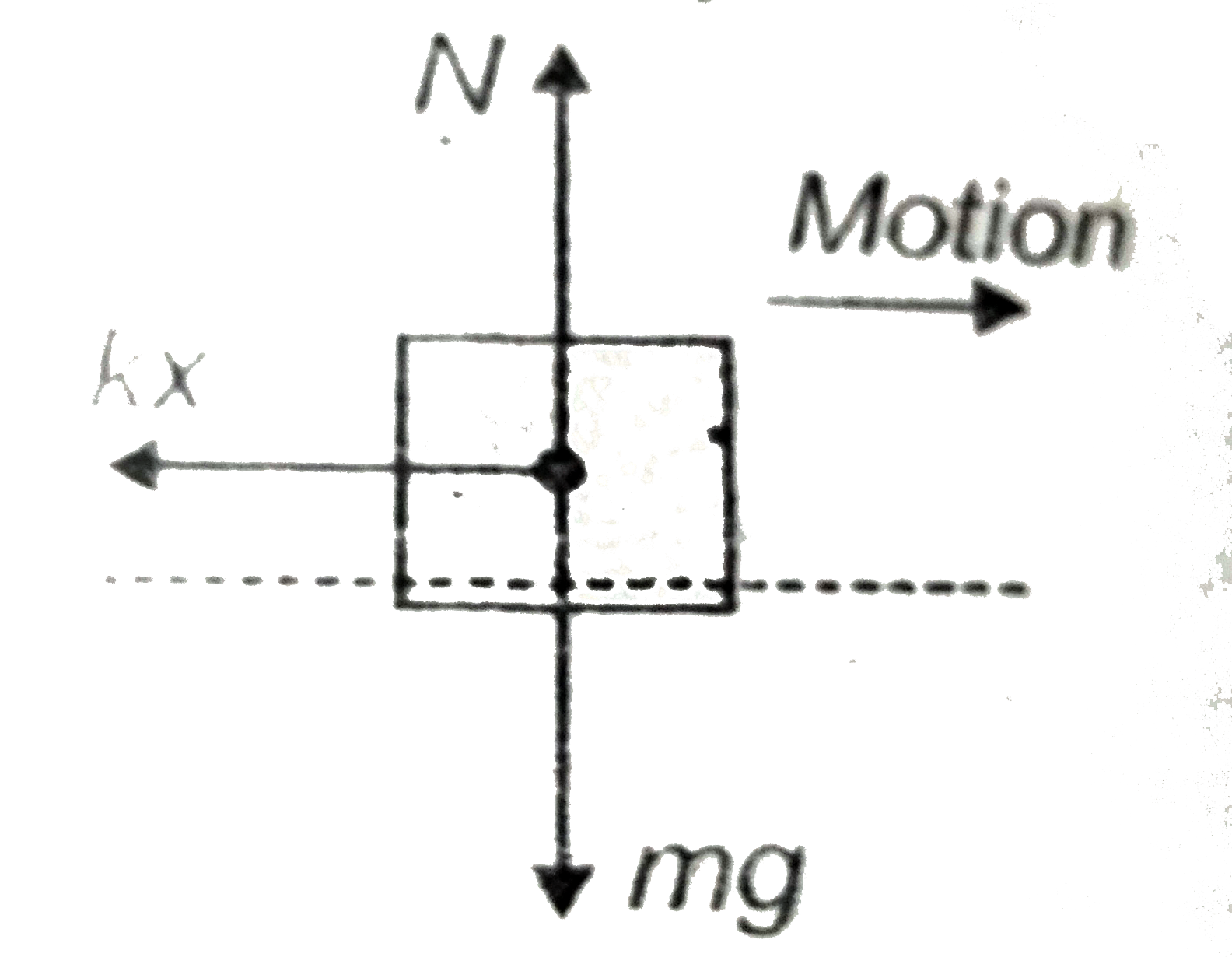
The various forces action on the block during its motion are (a) Weight, mg, downwards (b) Normal reaction N upwards (c ) Spring force, kx, leftward. The work done by the weight and normal reaction is zero
The work done by the speing force is `W_(sp)=-underset(0)overset(x)intkxdx`

negative sign appears as block moves towards right, whereas force act feftward.
(i) By work-energy principle, `W=Deltak`
`implies-underset(0)overset(x)intkxdx=1/2mv_(1)^(2)-1/2mv^(2)`
`implies(mv_(1)^(2)-mv^(2))/(2)=(-kx^(2))/(2)`
`thereforev_(1)=sqrt(v^(2)-k/mx^(2))`
(ii) The compression in the spring increases till the block moves towards teh wall. At the instant speed of the block reduces to zero, the compression is maximum. After that, compression will start decresing again.
So when `x=x_(max)v_(f)=0`
`implies0=sqrt(v^(2)-k/mx_(max)^(2))`
`or x_(max)=sqrt((mv^(2))/(k))`
Promotional Banner

Topper's Solved these Questions

  • WORK, ENERGY AND POWER

    AAKASH INSTITUTE ENGLISH|Exercise IILUSTRATION|2 Videos
  • WORK, ENERGY AND POWER

    AAKASH INSTITUTE ENGLISH|Exercise TRY YOURSELF|95 Videos
  • WAVES

    AAKASH INSTITUTE ENGLISH|Exercise ASSIGNMENT ( SECTION-D ( Assertion - Reason Type Questions ))|12 Videos

Similar Questions

Explore conceptually related problems

The figure showns a mass m on frictionless surface It is connected to righd wall by the mean of a massless spring of its constant K. Initially , The spring at its natural position.If a force of constant magnitude starts actiing on the block towareds right, then the speed of the block when the defromation in spring is x, will be

A block of mass m is connected to another .block of mass M by a massless spring of spring constant k. A constant force f starts action as shown in figure, then:

A block of mass m moving with velocity v_(0) on a smooth horizontal surface hits the spring of constant k as shown. The maximum compression in spring is

A block of mass m, lying on a smooth horizontal surface, is attached to a spring (of negligible mass) of spring constant k. The other end of the spring is fixed, as shown in the figure. The block is initally at rest in its equilibrium position. If now the block is pulled withe a constant force F, the maximum speed of the block is :

A block of mass m is connected to a spring of force constant k. Initially the block is at rest and the spring has natural length. A constant force F is applied hrizontally towards right. The maximum speed of the block will be (there is no friction between block and the surface)

A block of mass m is kept on a rough horizontal surface and is attached with a massless spring of force constant k. The minimum constant force applied on the other end of the spring of lift the block is

A bullet of mass m embeds itself in a block of mass M resting on a smooth horizontal surface, attached to a spring of force constant k. If the initial speed of the bullet is v_(0) along horizontal, find (a) the maximum compression of the spring and (b) the time for the bullet - block system to come to rest.

The block of mass m is released when the spring was in its natrual length. Spring constant is k. Find the maximum elongation of the spring.

A block of mass m, attacted to a string of spring constant k, oscillates on a smooth horizontal table. The other end of the spring is fixed to a wall. The block has a speed v when the spring is at its natural length. Before coming to an instantaneous rest. If the block moves a distance x from the mean position, then

Figure shown a block P of mass m resting on a smooth horizontal surface, attached to a spring of force constant k which is rigidly fixed on the wall on left side, shown in the figure . At a distance l to the right of the block there is a rigid wall. If block is pushed towards left so that spring is compressed by a distance 5l//3 and when released, if will starts its oscillations. If collision of block with the wall is considered to be perfectly elastic. Find the time period of oscillation of the block.

