Home
Class 12
PHYSICS
B and C are two identicalsphereskeptinco...

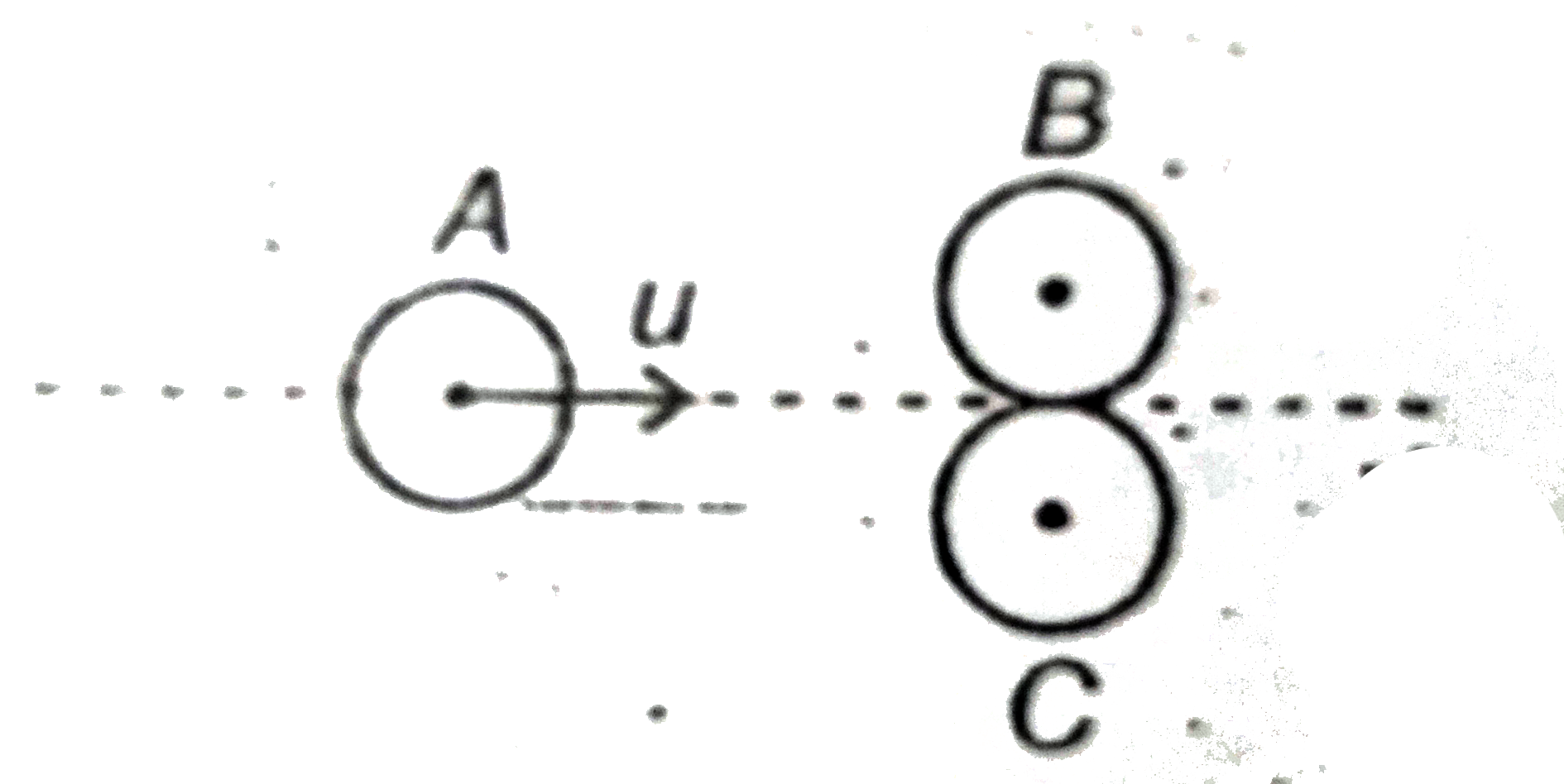
B and C are two identicalsphereskeptincontact with eachother on a horizontalfrictionaless floor.Another identicalspherea A moving with velocity u along the common tangent to B and C strikes B and C simultaneously.

Find their velocties after collision if
(a) Collision is elastic
(b) Collision is inelastic with coefficient of restitution e.

Text Solution

Verified by Experts
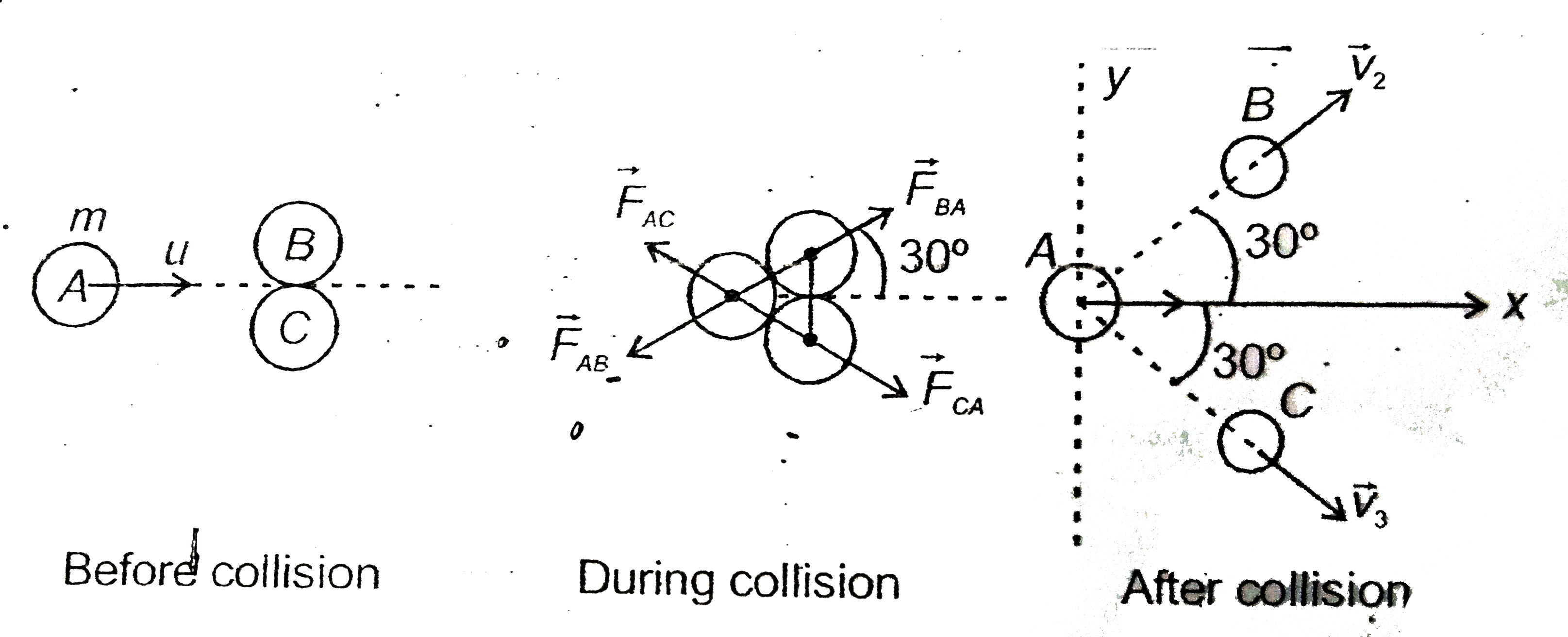

By conservation oflinear momentumalongy-axis,
`mv_(2)sin30^(@)-mv_(3)sin30^(@)=0`
`impliesv_(2)=v_(3)=v_(o)(say)" "…(1)`
By conservation of linear momentum along x-axis
`m u=mv_(1)+mv_(2)cos30^(@)+mv_(3)cos30^(@)`
`v=v_(1)+2v_(0)cos30^(@)`
`v=v_(1)+sqrt3v_(0)" "...(2)`
Coefficient of restitution,
`e=(v_("separation"))/(v_("approach"))`
`1=(v_(0)-v_(1)cos30^(@))/(u cos30^(@)). ` (for elastic collision)
`implies(sqrt3u)/(2)=v_(0)-(v_(1)sqrt3)/(2)`
`u=(2v_(0))/(sqrt3)-v_(1)" "...(3)`
Adding equation (1) and (2),
`2u=sqrt3v_(0)+(2v_(0))/(sqrt3)=(3v_(0)+2v_(0))/(sqrt3)`
`u=(5v_(0))/(2sqrt3)impliesv_(0)=(2sqrt3u)/(5)" "...(4)`
Putting value of `v_(0)` in equation (3),
`v_(1)=(2v_(0))/(sqrt3)-u=(2)/(sqrt3)(bar2sqrt(3u))/(5)-u`
`=(4u)/(5)-u`
`=-u/5" "...(5)`
(b) For inelastic collision
Total momentum of the system is conserved. We obrtain the same equations as in part (a) `implies "Equation"(1) v_(1)=v_(3)=v_(0)`
Equation `(2) u=v_(1)+sqrt3v_(0)`
Coefficient of restitution.
`e=(v_(0)-v_(1)cos30^(@))/(u cos30^(@))`
`implieseu(sqrt3)/(2)=v_(0)v_(1)(sqrt3)/(2)`
`impliesu=(2v_(0))/(esqrt3)-(v_(1))/(2)" "...(6)`
Dividing equation (2) by e,
`u/e=(v_(1))/(e)+(sqrt3v_(0))/(e)`
Equation (6): `u=(2v_(0))/(esqrt3)-(v_(1))/(e)`
Adding, `u((1)/(e)+1)=1/e[(5v_(0))/(sqrt3)]`
`impliesv_(0)=(sqrt3u)/(5)(1+e)" "...(7)`
Putting value of `v_(0)` in equation (6),
`v_(1)=((2v_(0))/(sqrt3)-eu)`
`=u/5(2-3e)" "...(8)`
Promotional Banner

Topper's Solved these Questions

  • WORK, ENERGY AND POWER

    AAKASH INSTITUTE ENGLISH|Exercise IILUSTRATION|2 Videos
  • WORK, ENERGY AND POWER

    AAKASH INSTITUTE ENGLISH|Exercise TRY YOURSELF|95 Videos
  • WAVES

    AAKASH INSTITUTE ENGLISH|Exercise ASSIGNMENT ( SECTION-D ( Assertion - Reason Type Questions ))|12 Videos

Similar Questions

Explore conceptually related problems

An object of mass m moving with speed u collides one dimentionally with another identical object at rest. Find their velocities after collision, if coefficient of restitution of collision is e.

An object of mass m moving with speed u collides one dimentionally with another identical object at rest. Find their velocities after collision, if coefficient of restitution of collision is e.

A body of mass a moving with a velocity b strikes a body of mass c and gets embedded into it. The velocity of the systems after collision is

Two particles of masses m and 2m moving in opposite directions collide elastically with velocity 2v and v , respectiely. Find their velocities after collision.

Two balls of masses m and 2m moving in opposite directions collide head on elastically with velocities v and 2v . Find their velocities after collision.

Two balls of masses m and 2m moving in opposite directions collide head on elastically with velocities v and 2v . Find their velocities after collision.

Two identical balls A and B moving with velocities + 0.5 m/s and -0.3 .m/s respectively collide head-on elastically. The velocities of the ball A and B after collision will be respectively

Two indentical balls A and B moving with velocities u_(A) and u_(B) In the same direction collide. Coefficient of restitution is e. (a) Deduce expression for velocities of the balls after the collision. (b) If collision is perfectly elastic, what do you observe?

A particle of mass 2kg moving with a velocity 5hatim//s collides head-on with another particle of mass 3kg moving with a velocity -2hatim//s . After the collision the first particle has speed of 1.6m//s in negative x-direction, Find (a) velocity of the centre of mass after the collision, (b) velocity of the second particle after the collision. (c) coefficient of restitution.

A particle of mass 2kg moving with a velocity 5hatim//s collides head-on with another particle of mass 3kg moving with a velocity -2hatim//s . After the collision the first particle has speed of 1.6m//s in negative x-direction, Find (a) velocity of the centre of mass after the collision, (b) velocity of the second particle after the collision. (c) coefficient of restitution.

