Home
Class 12
PHYSICS
The potential energy for a conservative ...

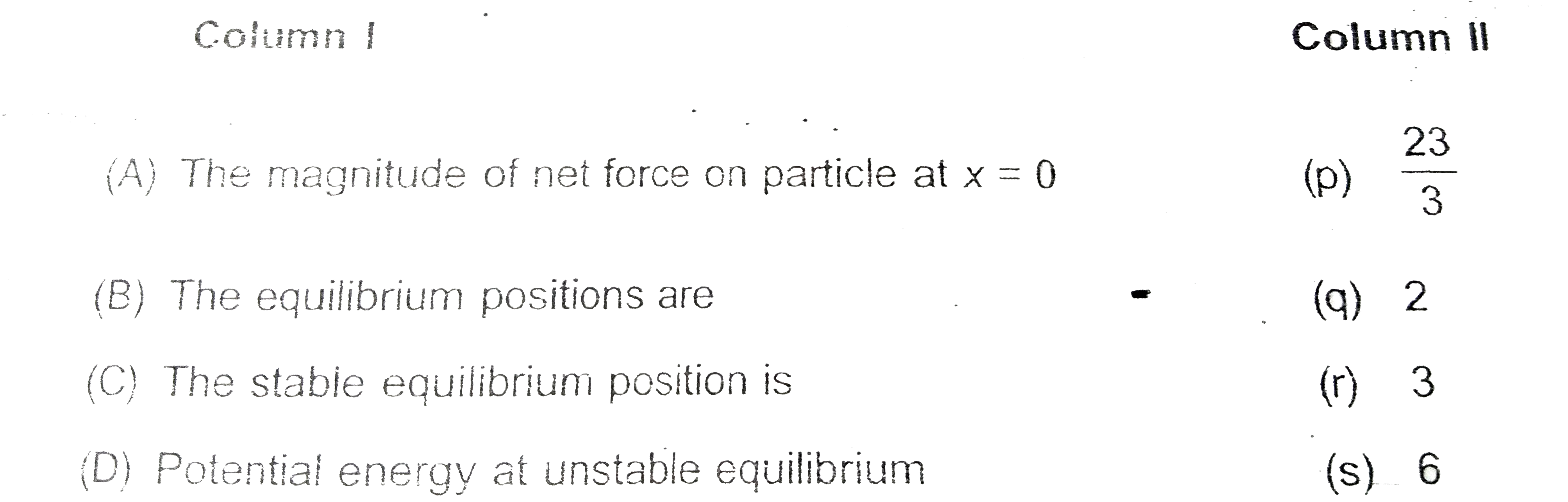
The potential energy for a conservative system is given by `U=(x^(3))/(3)-(5x^(2))/(2)+6x+3.` Match all the entries in Column l to all the entries in Column II.

Text Solution

Verified by Experts

The correct Answer is:

`A(s);B(q)(r);C(r);D(p)`
Promotional Banner

Topper's Solved these Questions

  • WORK, ENERGY AND POWER

    AAKASH INSTITUTE ENGLISH|Exercise SECTION-G (INTEGER ANSWER TYPE QUESTIONS)|6 Videos
  • WORK, ENERGY AND POWER

    AAKASH INSTITUTE ENGLISH|Exercise SECTION-H (MULTIPLE TRUE FALSE TYPE QUESTIONS)|10 Videos
  • WORK, ENERGY AND POWER

    AAKASH INSTITUTE ENGLISH|Exercise SECTION-E (ASSERTION-REASON TYPE QUESTIONS)|9 Videos
  • WAVES

    AAKASH INSTITUTE ENGLISH|Exercise ASSIGNMENT ( SECTION-D ( Assertion - Reason Type Questions ))|12 Videos

Similar Questions

Explore conceptually related problems

Match all the entries in column-I to all the entries in column-II

Match the entries in column II with the statements given in column I.

The potential energy of a particle under a conservative force is given by U ( x) = ( x^(2) -3x) J. The equilibrium position of the particle is at

A particle of mass m_(1) experiences a perfectlly elastic collision with a stationary particle of mass m_(2) . Match the entries in column I to all the entries in column II .

Potential energy of a particle at position x is given by U=x^(2)-5x . Which of the following is equilibrium position of the particle?

Potential energy function along x- axis in a certain force field is given as U(x)=(x^(4))/(4)-2x^(2)+(11)/(2)x^(2)-6x For the given force field :- (i)the points of equilibrium are x=1 , x=2 and x=3 (ii) the point x=2 is a point of unstable equilibrium. (iii) the points x=1 and x=3 are points of stable equilibrium. (iv) there exists no point of neutral equilibrium. The correct option is :-

Regarding the spectrum of hydrogen, match the entries in column-I with all the entries in column-II. Match the following :

ColumnI lists physical quantities for a uniform current carrying conductor . These quantities depend on quantities given in column II. Match entries in column I to all the quantities in column II on which it depends. {:(,"Column I",,"Column II"),((A),"Resistivity",(p),"Length of conductor"),((B),"Current through the conductor for a given potential difference across the condcutor",(q),"Electric field in conductor"),(( C),"Current density in condcutor for a given potential difference across the conductor ",(r ),"Temperature of conductor"),((D),"Thermal power generated per unit volume for given value of potential difference across the conductor",(s),"Nature of conductor"),(,,(t ),"Area of condcutor"):}

In Column-I, some physical quantities are given and in column-II, dimensions of the physical quantities are given . Match the entries in column-I to each entry in Column-II.

The potential energy (U) of a body of unit mass moving in a one-dimension force field is given by U=(x^(2)-4x+3) . All units are in S.L
