Home
Class 12
MATHS
m n squares of the equal size are arrang...

`m n` squares of the equal size are arranged to form a rectangle of dmensin `mb yn ,w h e r ema n dn` are natural number. Two square will be called neighbours if they have exactly one common side. A number is written in each square such that the number written in any square is the arithmetic men of the numbers written in its neighboring squares. Show that this is possible only if all the numbers used are equal.

Text Solution

Verified by Experts
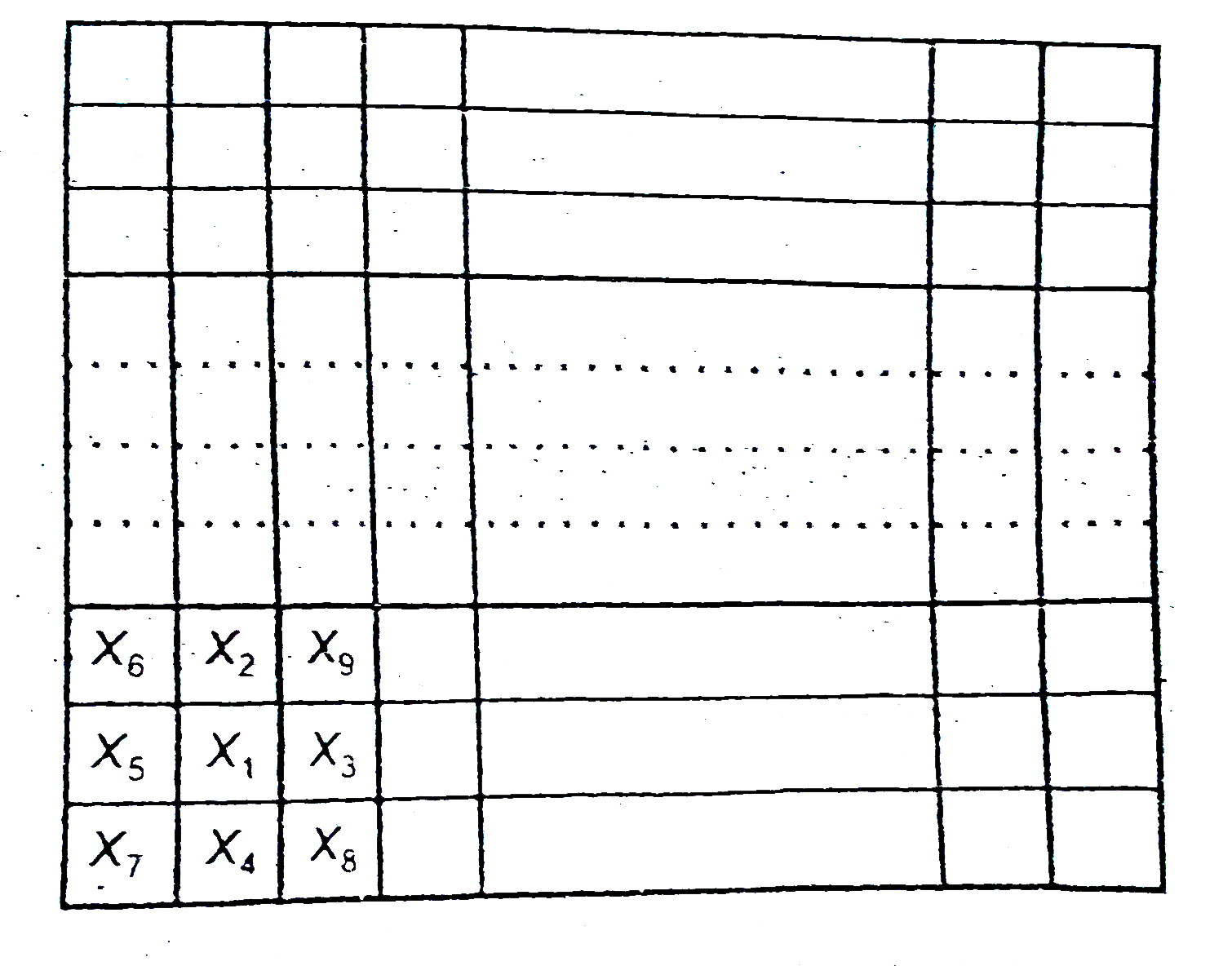
Let mn squares of equal size are arranged to form a rectangle of dimensions m and n shown in the figure. The neighbiur of `x_(1)` are `x_(2),x_(3),x_(4),x_(5)` .
Similarly neighbours of `x_(5)` are `x_(6) , x_(1)` and `x_(7)` and that of `x_(7)` are `x_(5) , x_(4)` .
From the guven condition ,
`x_(1)=(x_(2)+x_(3)+x_(4)+x_(5))/(4)`
`implies 4x_(2)=x_(2)+x_(3)+x_(4)+x_(5)`
Also `X_(5)=(x_(1)+x_(6)+x_(7))/(3)`
`implies 3x_(5)=x_(1)+x_(6)+x_(7) and x_(7)=(x_(4)+x_(5))/(2)`
`implies 2x_(7)=x_(4)+x_(5)`

`therefore 4x_(1)=x_(2)+x_(3)+x_(4)+(x_(1)+x_(6)+x_(7))/(3)`
`implies 12x_(1)+3x_(2)=3x_(3)+3x_(4)=x_(1)=x_(6)+x_(7)`
`=3x_(2)+3x_(3)+3x_(4)+x_(1)+x_(6)+ (x_(4)+x_(5))/(2)`
`implies 24x_(1)=6x_(2)+6x_(3)+7x_(4)+2x_(1)+2x_(6)+x_(5)`
`implies 22x_(1)=6x_(2)+6x_(3)+7x_(4)+x_(5)+2x_(6)`
Where `x_(1),x_(2),x_(3),x_(4),x_(5),x_(6)` are all natural numbers and `x_(1)` is linearly expressed as the sum of `x_(2),x_(3),x_(4),x_(5) and x_(6)` where the sum of coefficients is equal to the coefficient of `x_(1)`.
i.e., 22=6+6+7+1+2
Which will happen only when
`x_(1)=x_(2)=x_(3)=x_(4)=x_(5)=x_(6)`
`implies ` all the numbers used are equal .
Promotional Banner

Topper's Solved these Questions

  • PERMUTATIONS AND COMBINATIONS

    AAKASH INSTITUTE ENGLISH|Exercise Try Yourself|65 Videos
  • PERMUTATIONS AND COMBINATIONS

    AAKASH INSTITUTE ENGLISH|Exercise Assignment Section A Objective type questions (One option is correct )|51 Videos
  • MATRICES

    AAKASH INSTITUTE ENGLISH|Exercise Assignment (Section - J) Aakash Challengers Questions|3 Videos
  • PRINCIPLE OF MATHEMATICAL

    AAKASH INSTITUTE ENGLISH|Exercise Section-D:(Assertion-Reason Type Questions)|11 Videos

Similar Questions

Explore conceptually related problems

mn squares of equal size are arranged to form a rectangle of dimension m by n, where m and n are natural numbers. Two square will be called neighbors if they have exactly one common side. A number is written in each square such that the number written in any square is the arithmetic mean of the numbers written in its neighboring squares. Show that this is possible only if all the numbers used are equal.

The arithmetic mean of the squares of first n natural numbers is

Find the squares of the number127

The arithmetic mean of two numbers is 18(3)/(4) and the positive square root of their product is 15. The larger of the two numbers is

The sum of a number and its positive square root is 6/25.Find the number.

Find the number of ways of selecting pair of black squares in chessboard such that they have exactly one common corner

Find the smallest square number that is divisible by each of the numbers 4, 9 and 10.

Find the smallest square number that is divisible by each of the numbers 8, 15 and 20.

Find the square roots of the numbers by expressing each number as the product of primes : 25

Find the square roots of the numbers by expressing each number as the product of primes : 169

