Home
Class 12
MATHS
Consider three solutions of 3 strong ele...

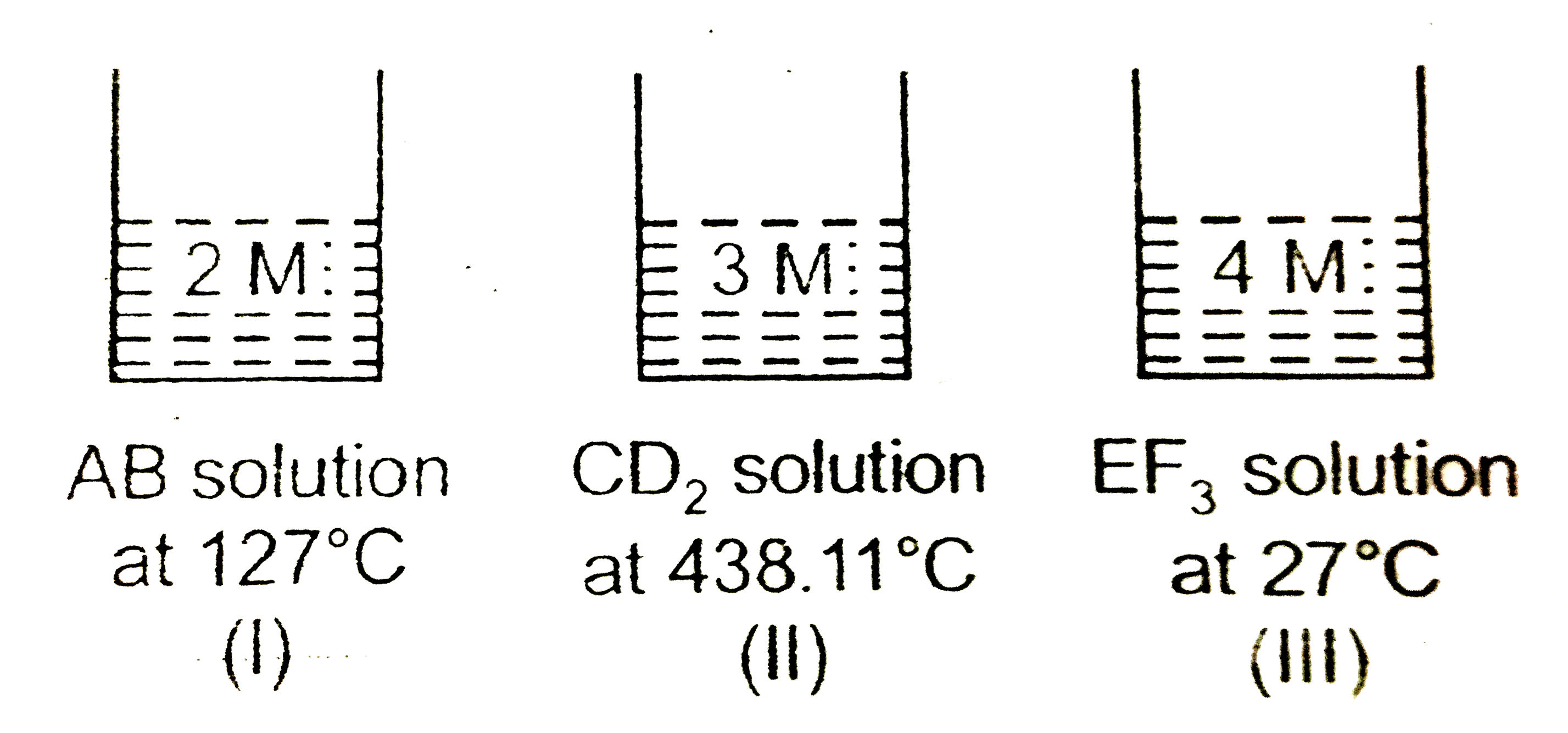
Consider three solutions of 3 strong electrolytes.AB, `CD_(2)` and `EF_(3)`

The osmotic pressure ratio of I,II, and III is

Text Solution

Verified by Experts

`""^(n+1)C_(4)`
Promotional Banner

Topper's Solved these Questions

  • PERMUTATIONS AND COMBINATIONS

    AAKASH INSTITUTE ENGLISH|Exercise Assignment Section-I (Subjective Type Questions)|11 Videos
  • MATRICES

    AAKASH INSTITUTE ENGLISH|Exercise Assignment (Section - J) Aakash Challengers Questions|3 Videos
  • PRINCIPLE OF MATHEMATICAL

    AAKASH INSTITUTE ENGLISH|Exercise Section-D:(Assertion-Reason Type Questions)|11 Videos

Similar Questions

Explore conceptually related problems

Degree of dissociation of three binary electrolytes AB, CD and EF are 60%.20% and 100% in the solution having same mole fraction of water.Ratio of lowering in vapour pressure of their solution is

The osmotic pressures of equimolar solutions of urea , BaCl_(2) and AlCl_(3) will be in the order :

The vapour pressure of a solution of a non-volatile electrolyte B in a solvent A is 95% of the vapour pressure of the solvent at the same temperature. If the molecular weight of the solvent is 0.3 times, the molecular weight of solute, the weight ratio of the solvent and solute are:

200 cm^(3) of an aqueous solution of a protein contains 1.26 g of the protein. The osmotic pressure of such a solution at 300 K is found to be 2.57 xx10^(-3) bar. Calculate the molar mass of the protein.

consider 0.1 M solutions of two solutes X and Y. The behaves as a univalent electrolyte while the solute Y dimerises in solution. Which of the following statement are correct regarding these solutions? (1) The boiling point of the solution of X will be higher than that of Y (2) The osmotic pressure of the solution of Y will be lower than that of X (3) The freezing point of the solition of X will be lower than that of Y (4) The relative lowering of vapour pressure of both the solutions will be the same (a)1, 2 and 3 (b)2, 3 and 4 (c)1, 2 and 4 (d)1, 3 and 4

At 10^(@)C , the osmotic pressure of urea solution is 500 mm .The solution is diluted and the temperature is raised to 25^(@)C .when the osmotic pressure is found to be 105.3 mm . Determine the extent of dilution.

The osmotic pressure of a solution of NaCl is 0.10 atm and that of a glucose solution is 0.20 atm. The osmotic pressure of a solution formed by mixing 1 L of the sodium chloride solution with 2L of the glucose solution is x xx 10^(-3) atm. x is _________.(nearest integer)

The osmotic pressure of a solution is 1.3 atm . The density of solution is 1.3 g cm^(-3) . Calculate the osmotic pressure rise. ( 1 atm =76 cm Hg , d_(Hg)=13.6 g cm^(-3) )

Solute A is a ternary electrolyte and solute B is non-elctrolyte . If 0.1 M solution of solute B produces an osmotic pressure of 2P ,then 0.05M solution of A at the same temperature will produce on osmotic pressure equal to

The empirical formula of a non-electrolyte is CH_(2)O . A solution containing 3 g L^(-1) of the compound exerts the same osmotic pressure as that of 0.05 M glucose solution. The molecules formula of the compound is :
