Home
Class 12
PHYSICS
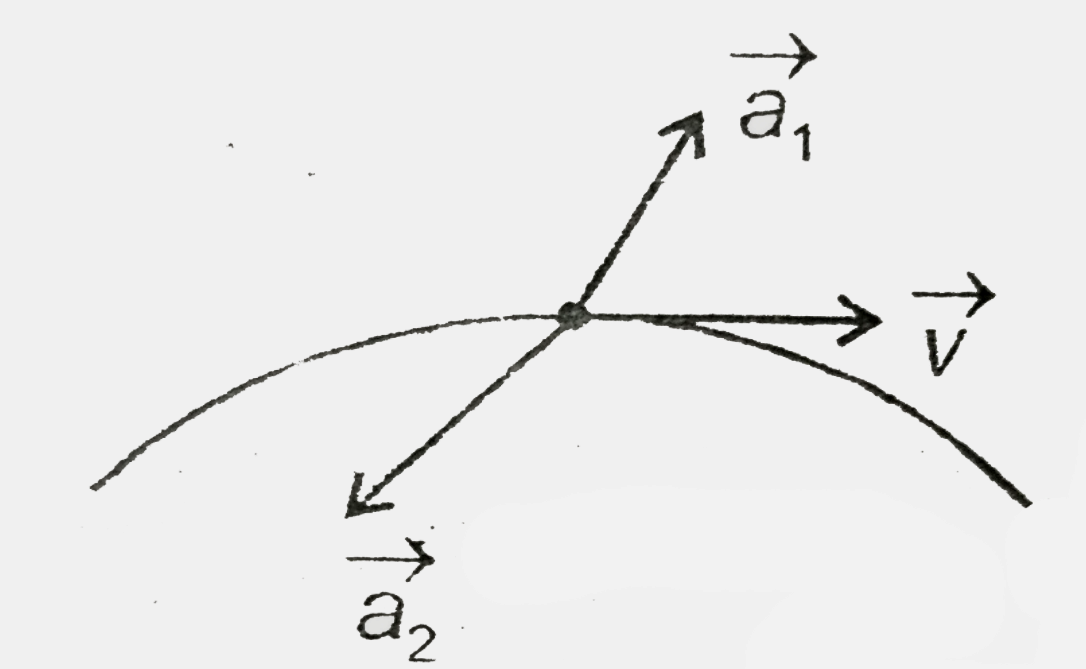
A body moves in a curved path as show : ...

A body moves in a curved path as show :

Statement -1 : Its acceleration vector cannot be `veca_(1)` but it may be ` veca_(2)` .
Statement -2 . The normal acceleratin is awlays directed towards the centre of curvature.

A

Statement -1 is Ture, statement -2 is Ture, Statement -2 is a correct explanation for statement -1 .

B

Statement -1 is True, statement -2 is True, statement - 2 is NOT a correct explanation for statement -4

C

Statement -1 is True, Statement -2 si False

D

Statement -1 is False ,Statement -2 is True.

Text Solution

Verified by Experts

The correct Answer is:

A
Promotional Banner

Topper's Solved these Questions

  • MOTION IN A PLANE

    AAKASH INSTITUTE ENGLISH|Exercise Assignement section -F (Matrix-Match)|2 Videos
  • MOTION IN A PLANE

    AAKASH INSTITUTE ENGLISH|Exercise Assignement section -G (Integer)|4 Videos
  • MOTION IN A PLANE

    AAKASH INSTITUTE ENGLISH|Exercise Assignement section -D (Linked Comprehension)|12 Videos
  • MOCK_TEST_17

    AAKASH INSTITUTE ENGLISH|Exercise Example|15 Videos
  • MOTION IN A STRAIGHT LINE

    AAKASH INSTITUTE ENGLISH|Exercise ASSIGNMENT (SECTION - D)|15 Videos

Similar Questions

Explore conceptually related problems

Statement 1 : If |veca | = 3, |vecb| = 4 and |veca + vecb| = 5 , then |veca - vecb|=5 . Statement 2 : The length of the diagonals of a rectangle is the same.

Statement-I : When the direction of motion of a particle moving in a circular path is reversed the direction of radial acceleration still remains the same (at the given point). Statement-II : Particle revolves on circular path in any direction such as clockwise or anticlockwise the direction of radius accelerationis always towards the centre of the circular path.

Statement-1 : The centre of mass of a body may lie where there is no mass. Statement-2 : The centre of mass has nothing to do with the mass.

In the following questions a statement of assertion (A) is followed by a statement of reason ( R). A: When a body moves on a curved path with increasing speed then angle between instantaneous velocity and acceleration is acute angle. R: When the speed is increasing its tangential acceleration is in the direction of instaneous velocity .

Statement-1 Path of a charged particle in a uniform and steady magnetic field cannot be parabolic Statement-2 Magnetic field cannot accelerate a charged particle

STATEMENT - 1 : A positive acceleration of a body can be associated with a slowing down of the body. and STATEMENT - 2 : Acceleration is a vector quantity.

Statement-1: Two identical conincal pipes shown in figure have a drop of water. The water drop tens to move towards tapered end. Statement-2: Excess pressure is directed towards centre of curvature and inversely proportional to radius of curvature. Net excess pressure is therefore, directed towards tapered end. So the water drop tends to move towards tapered end.

If a particle is moving on a circular path with constant speed, then the angle between the direction of acceleration and its position vector w.r.t. centre of circle will be

Two blocks A and B are being accelerated by forces shown in figure with accelerations veca_(1) and veca_(2) respectively. The value of |veca_(1)-veca_(2)|

Statement 1 : If |veca + vecb| = |veca - vecb| , then veca and vecb are perpendicular to each other. Statement 2 : If the diagonals of a parallelogram are equal in magnitude, then the parallelogram is a rectangle.
