Home
Class 12
MATHS
For an ideal gas, an illustration of thr...

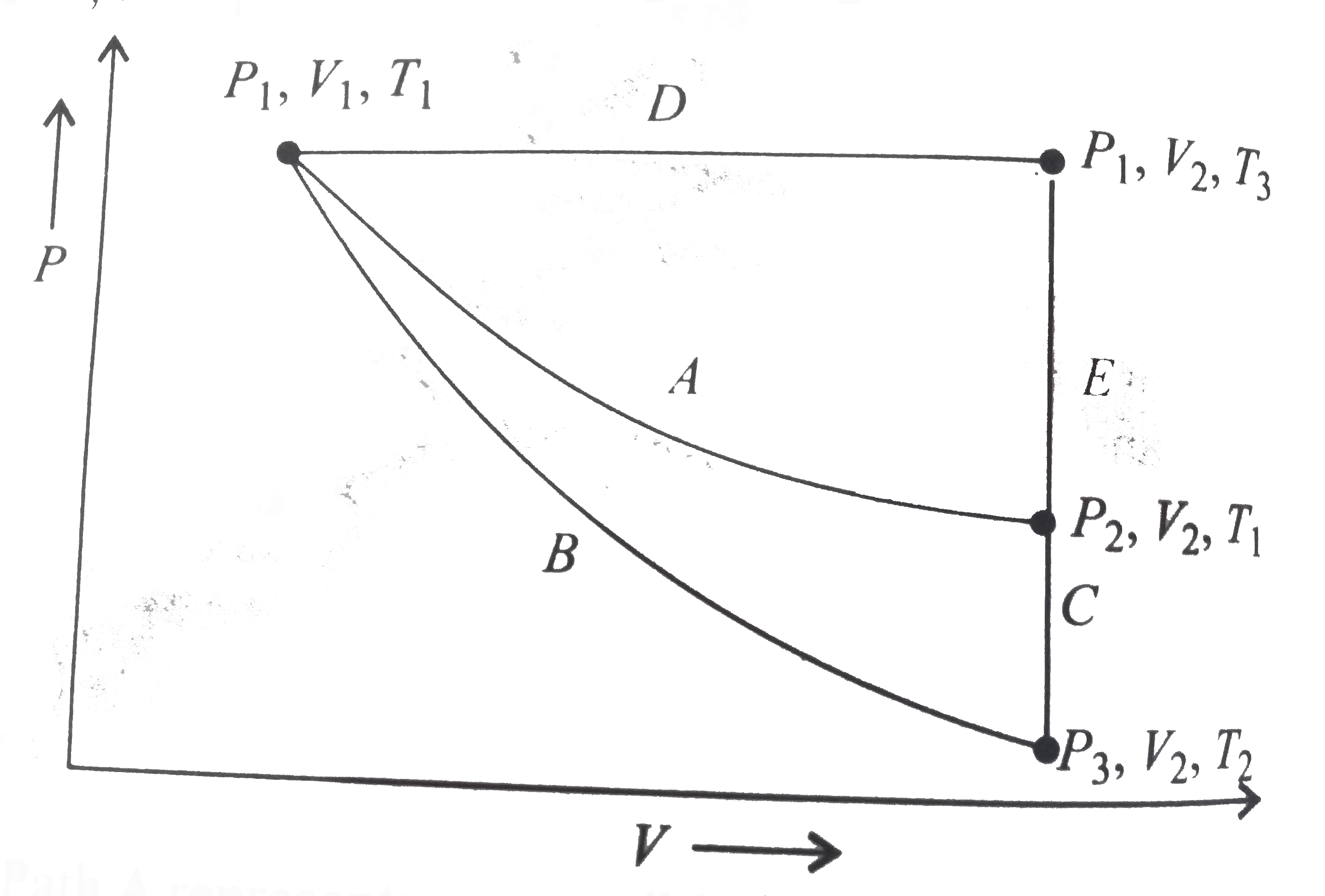
For an ideal gas, an illustration of three different paths `A,(B+C)` and `(D+E)` from an initial state `P_(1), V_(1), T_(1)` to a final state `P_(2), V_(2),T_(1)` is shown in the given figure.

Path `A`represents a reversible isothermal expansion form `P_(1),V_(1)` to `P_(2),V_(2)`, Path `(B+C)` represents a reversible adiabatic expansion `(B)` from `P_(1),V_(1),T_(1)to P_(3),V_(2),T_(2)` followed by reversible heating the gas at constant volume `(C)`from `P_(3),V_(2),T_(2)` to `P_(2),V_(2),T_(1)`. Path `(D+E)` represents a reversible expansion at constant pressure `P_(1)(D)` from `P_(1),V_(1),T_(1)` to `P_(1),V_(2),T_(3)` followed by a reversible cooling at constant volume `V_(2)(E)` from `P_(1),V_(2),T_(3) to P_(2),V_(2),T_(1)`.
What is `q_(rev)`, for path `A`?

A

`-7920x^(-4)`

B

`7920x^(4)`

C

`7920x^(-4)`

D

`-7920x^(4)`

Text Solution

Verified by Experts

The correct Answer is:

3
Promotional Banner

Topper's Solved these Questions

  • BINOMIAL THEOREM

    AAKASH INSTITUTE ENGLISH|Exercise Assignment (section-B)|34 Videos
  • BINOMIAL THEOREM

    AAKASH INSTITUTE ENGLISH|Exercise Assignment (section-C) Objective type question (More than one correct answer)|15 Videos
  • BINOMIAL THEOREM

    AAKASH INSTITUTE ENGLISH|Exercise Try Yourself|20 Videos
  • APPLICATION OF INTEGRALS

    AAKASH INSTITUTE ENGLISH|Exercise Assignment Section - I Aakash Challengers Questions|2 Videos
  • COMPLEX NUMBERS AND QUADRATIC EQUATIONS

    AAKASH INSTITUTE ENGLISH|Exercise section-J (Aakash Challengers Qestions)|13 Videos

Similar Questions

Explore conceptually related problems

For an ideal gas, an illustratio of three different paths A(B+C) and (D+E) from an initial state P_(1), V_(1), T_(1) to a final state P_(2), V_(2),T_(1) is shown in the given figure. Path A represents a reversible isothermal expansion form P_(1),V_(1) to P_(2),V_(2) , Path (B+C) represents a reversible adiabatic expansion (B) from P_(1),V_(1),T_(1)to P_(3),V_(2),T_(2) followed by reversible heating the gas at constant volume (C) from P_(3),V_(2),T_(2) to P_(2),V_(2),T_(1) . Path (D+E) represents a reversible expansion at constant pressure P_(1)(D) from P_(1),V_(1),T_(1) to P_(1),V_(2),T_(3) followed by a reversible cooling at constant volume V_(2)(E) from P_(1),V_(2),T_(3) to P_(2),V_(2),T_(1) . What is DeltaS for path (D +E) ?

For an ideal gas, an illustratio of three different paths A(B+C) and (D+E) from an initial state P_(1), V_(1), T_(1) to a final state P_(2), V_(2),T_(1) is shown in the given figure. Path A represents a reversible isothermal expansion form P_(1),V_(1) to P_(2),V_(2) , Path (B+C) represents a reversible adiabatic expansion (B) from P_(1),V_(1),T_(1)to P_(3),V_(2),T_(2) followed by reversible heating the gas at constant volume (C) from P_(3),V_(2),T_(2) to P_(2),V_(2),T_(1) . Path (D+E) represents a reversible expansion at constant pressure P_(1)(D) from P_(1),V_(1),T_(1) to P_(1),V_(2),T_(3) followed by a reversible cooling at constant volume V_(2)(E) from P_(1),V_(2),T_(3) to P_(2),V_(2),T_(1) . What is DeltaS for path A ?

A gas with (c_(p))/(c_(V))=gamma goes from an intial state (p_(1), V_(1), T_(1)) to a final state (p_(2), V_(2), T_(2)) through an adiabatic process. The work done by the gas is

A system changes from the state (P_(1),V_(1)) to (P_(2),V_(2)) as shown in the diagram. The work done by the system is

One mole of hydrogen, assumed to be ideal, is adiabatically expanded from its initial state (P_(1), V_(1), T_(1)) to the final state (P_(2), V_(2), T_(2)) . The decrease in the internal energy of the gas during this process will be given by

An ideal gas is expand from (p_(1),V_(1),T_(1)) to (p_(2),V_(2),T_(2)) under different conditions. The correct statement(s) among the following is (are):

The relationship between P_(C), V_(C) and T_(C) is

Assertion: When ideal gas expand from P_(1), V_(1), T_(1), to P_(2), V_(2), T_(2) two steps, and work done is high in which number of steps are high Reason: Work is path function

For an ideal gas V - T curves at constant pressure P_(1) & P_(2) are shown in figure, from the figure

An ideal gas expands adiabatically from an initial temperature T_(1) to a final temperature T_(2) . Prove that the work done by the gas is C_(V) (T_(1) - T_(2)) .

AAKASH INSTITUTE ENGLISH-BINOMIAL THEOREM-Assignment (section-A)
  1. The term containing a^(3)b^(4) in the expansion of (a-2b)^(7) is

    Text Solution

    |

  2. The coefficient of the term independent of x in the expansion of (x-3/...

    Text Solution

    |

  3. For an ideal gas, an illustration of three different paths A,(B+C) and...

    Text Solution

    |

  4. If p a n d q are positive, then prove that the coefficients of x^pa n ...

    Text Solution

    |

  5. The number of terms in expansion of {(a+4b)^(3)(a-4b)^(3)}^(2) is

    Text Solution

    |

  6. If r^(th) term in the expansion of (x^(2)+1/x)^(12) is independent of ...

    Text Solution

    |

  7. Find the number of nonzero terms in the expansion of (1+3sqrt(2)x)^9+(...

    Text Solution

    |

  8. In the expansion of (2+1/(3x))^(n), the cofficient of x^(-7) and x^(-...

    Text Solution

    |

  9. In in the expansion of (1+px)^(q), q belongs to N, the coefficients of...

    Text Solution

    |

  10. The expansion of (x^(alpha)+1/x^(beta))^(n) has constant term, if

    Text Solution

    |

  11. The number of rational terms in the expansion of ((25)^(1/3) + 1/(25)^...

    Text Solution

    |

  12. The number of zeros at the end of (101)^(11)-1 is

    Text Solution

    |

  13. In the expantion of (1+kx)^(4) the cofficient of x^(3) is 32, then th...

    Text Solution

    |

  14. In the expansion of (3+x/2)^(n) the coefficients of x^(7) and x^(8) ar...

    Text Solution

    |

  15. sqrt(5){(sqrt(5)+1)^(50)-(sqrt(5)-1)^(50)}

    Text Solution

    |

  16. In expansion of (x+a)^(5), T(2):T(3)=1:3, then x:a is equal to

    Text Solution

    |

  17. If the coefficient of x^(7)in [ax^(2) + (1/bx)]^(11) equals the coeffi...

    Text Solution

    |

  18. The middle term in the expansioin of (1+x)^(2n) is

    Text Solution

    |

  19. Cofficient of x^(12) in the expansion of (1+x^(2))^50(x+1/x)^(-10)

    Text Solution

    |

  20. The number of terms in expansion of (x^(2)+18x+81)^(15) is

    Text Solution

    |
