Text Solution
Verified by Experts




Topper's Solved these Questions
LAWS OF MOTION
AAKASH INSTITUTE ENGLISH|Exercise ASSIGNMENT ( SECTION -A)|50 VideosLAWS OF MOTION
AAKASH INSTITUTE ENGLISH|Exercise ASSIGNMENT ( SECTION -B) objective type questions (one option is correct)|59 VideosLAWS OF MOTION
AAKASH INSTITUTE ENGLISH|Exercise Illustration|7 VideosKINETIC THEORY
AAKASH INSTITUTE ENGLISH|Exercise EXERCISE (ASSIGNMENT) SECTION - D Assertion - Reason Type Questions|10 VideosMAGNETISM AND MATTER
AAKASH INSTITUTE ENGLISH|Exercise ASSIGNMENT (SECTION D)|26 Videos
Similar Questions
Explore conceptually related problems
AAKASH INSTITUTE ENGLISH-LAWS OF MOTION-TRY YOURSELF
- A girl of mass 25 kg running with a speed of 1*5 m/s jumps on a skateb...
Text Solution
|
- Find the tension in the strings AC and BC shown in figure.
Text Solution
|
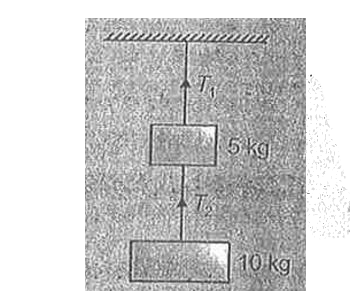
- Find T(1) and T(2) in the given figure.
Text Solution
|
- Draw the free body diagram of following system :
Text Solution
|
- Figure shows a three blocks are connected by strings. Its free body di...
Text Solution
|
- Draw the free body diagram of following also find the tension in each ...
Text Solution
|
- Two masses m(1) and m(2) ( m(2) gt m(1)) are hanging vertically over f...
Text Solution
|
- Two blocks of masses 2 kg and 4 kg tied to a string passing over a fri...
Text Solution
|
- In the given figure, what will be acceleration of block of mass 7 kg?
Text Solution
|
- What will be the tension T(1) and T(2) in the given figure?
Text Solution
|
- Three blocks, P, Q and R of masses 5 kg, 4 kg and 3 kg respectively ar...
Text Solution
|
- A student is cleansing a black board by moving a light duster up and d...
Text Solution
|
- A stone of weight W is thrown straight up from the ground with an inti...
Text Solution
|
- Determine the maximum acceleration of the truck in which a box lying o...
Text Solution
|
- Why is it difficult to climb up a greasy pole ?
Text Solution
|
- STATEMENT -1 : Friction always opposes motion . STATEMENT - 2 : Less...
Text Solution
|
- A ball rolled on ice with a velocity of 14 ms^(-1) comes to rest after...
Text Solution
|
- An aircraft executes a horizontal loop at a speed of 540 km/h with its...
Text Solution
|
- A curved road of diameter 1*8 km is banked so that no friction is requ...
Text Solution
|
- Which of the following bodies have more inertia? (i) A metal ball an...
Text Solution
|