Home
Class 12
PHYSICS
Three identical rods have been joined at...

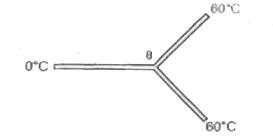
Three identical rods have been joined at a junction to make it a Y shape structure .If two free ends are maintained at `60"^(@)C` and the thired end is at `0"^(@)C` then what is the juction temperature `theta`?

Text Solution

Verified by Experts
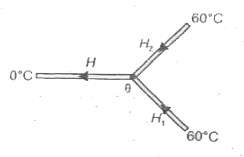
Rods are in steady state
So, `H=H_1+H_2`
`implies(KA(theta-0))/(L)=(KA(60-0))/(L)+kA((60-theta))/(L)`
`impliestheta=60-theta+60-0`
`implies` 30=120
`implies0=40"^(@)C`
Promotional Banner

Topper's Solved these Questions

  • THERMAL PROPERTIES OF MATTER

    AAKASH INSTITUTE ENGLISH|Exercise Try Youself|16 Videos
  • THERMAL PROPERTIES OF MATTER

    AAKASH INSTITUTE ENGLISH|Exercise Assignment (Section-A) Objective Type questions (one option is correct)|50 Videos
  • TEST2

    AAKASH INSTITUTE ENGLISH|Exercise EXERCISE|2 Videos
  • THERMODYNAMICS

    AAKASH INSTITUTE ENGLISH|Exercise ASSIGNMENT (SECTION -D) (Assertion - Reason Type Questions)|10 Videos

Similar Questions

Explore conceptually related problems

Three identical rods have been joined at a junction to make it a Y shape structure. If two free ends are maintained at 45^(@)C and the end is at 0^(@)C , then what is the junction temperature T?

A rod AB is 1m long. The temperature of its one end A is maintained at 100^(@) C and other end B at 10^(@) C, the temperature at a distance of 60 cm from point B is

Two rods of same dimensions, but made of different materials are joined end to end to end with their free end being maintained at 100^(@)C and 0^(@)C respectively. The temperature of the junction is 70^(@)C . Then the temperature of the junction if the rods are inerchanged will be equal to T^(@)C Find T :

Three rods of material x and three of material y are connected as shown in figure. All the rods are identical in length and cross sectional area. If the end A is maintained at 60^(@)C and the junction E at 10^(@)C , calculate the temperature of the junction B. The thermal conductivity of x is 800Wm^(-1)C^(-1) and that of y is 400Wm^(-1)C^(-1) .

Three rods of material x and three of material y are connected as shown in figure. All the rods are identical in length and cross sectional area. If the end A is maintained at 60^(@)C and the junction E at 10^(@)C , calculate the temperature of the junction B . The thermal conductivity of x is 800Wm^(-1).^(@)C^(-1) and that of y is 400Wm^(-1).^(@)C^(-1) .

Three rods of material X and three rods of material Y are connected as shown in the figure. All the rods are of identical length and cross-sectional area. If the end A is maintained at 60^@C and the junction E at 10^@C . Calculate the temperature of the junction B, C and D. The thermal conductivity of X is 0.92cal//sec-cm^@C and that of Y is 0.46cal//sec-cm-^@C .

Figure shows an aluminium rod joined to a copper rod. Each of the rods has a length of 20cm and area of cross section 0.20cm^(2) . The junction is maintained at a constant temperature 40^(@)C and the two ends are maintained at 80^(@)C . Calculate the amount of heat taken out from the cold junction in one minute after the steady state is reached. The conductivities are K_(Al)=200Wm^(-1)C^(-1) . and K_(Cu)=400Wm^(-1)C^(-1) .

Figure shows a copper rod joined to a steel rod. The rods have equal length and and the equal cross sectional area. The free end of the copper rod is kept at 0^(@)C and that of the steel rod is kept at 100^(@)C . Find the temperature at the junction of the rods. conductivity of copper =390Wm^(-1)C^(-1) and that of steel =46Wm^(-1)C^(-1) .

Figure shows a copper rod joined to a steel rod. The rods have equal length and and the equal cross sectional area. The free end of the copper rod is kept at 0^(@)C and that of the steel rod is kept at 100^(@)C . Find the temperature at the junction of the rods. conductivity of copper =390WM^(-1).^(@)C^(-1) and that of steel =46Wm^(-1).^(@)C^(-1) .

Two rods of similar area of cross section and length are joined as shown in the figure. The ratio of their thermal conductivity is 2:3. The free ends are maintained at 100^(@)C and 0^(@)C respectivley. THE temperature at junction in steady state is

