Home
Class 12
PHYSICS
Two particles A and B have the same mass...

Two particles A and B have the same mass m. A is moving along X-axis with a speed of `5 ms^(-1)` and B is at rest. After undergoing a perfectly elastic collision with B, particle A gets scattered through an angle of `60^(@).` What is the direction of B, and the speeds of A and B, after the collision ?

Text Solution

Verified by Experts
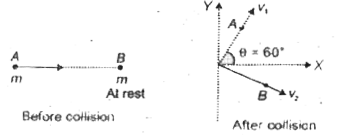

A & B have same mass and the collision is perfectly elastic
`therefore" "theta +phi=90^(@)`
`phi=90^(@)-60^(@)=30^(@)" ….(i)"`
Using law of conservation of linear momentum
(a) For X - components
`u=5=v_(1)cos 60^(@)+v_(2)cos30^(@)`
`5=(v_(1))/(2)+v_(2)(sqrt3)/(2)`
`10=v_(1)+v_(2)sqrt3" ...(ii)"`
(b) For Y - components
`0=v_(1)sin60^(@)-v_(2)sin30^(@)`
`v_(1)(sqrt3)/(2)=(v_(2))/(2)`
`v_(1)sqrt3=v_(2)" ....(iii)"`
From equations (ii) & (iii),
`10=v_(1)+3v_(1)" "rArr" "v_(1)=2.5ms^(-1)`
`v_(2)=v_(1)sqrt3=2.5xx1.732" "rArr" "v_(2)=4.33ms^(-1)`
Promotional Banner

Topper's Solved these Questions

  • WORK, ENERGY AND POWER

    AAKASH INSTITUTE ENGLISH|Exercise IILUSTRATION|2 Videos
  • WORK, ENERGY AND POWER

    AAKASH INSTITUTE ENGLISH|Exercise TRY YOURSELF|95 Videos
  • WAVES

    AAKASH INSTITUTE ENGLISH|Exercise ASSIGNMENT ( SECTION-D ( Assertion - Reason Type Questions ))|12 Videos

Similar Questions

Explore conceptually related problems

A sphere P of mass m and velocity v_i undergoes an oblique and perfectly elastic collision with an identical sphere Q initially at rest. The angle theta between the velocities of the spheres after the collision shall be

Particle A makes a perfectly elastic collision with anther particle B at rest. They fly apart in opposite direction with equal speeds. If the masses are m_(A)&m_(B) respectively, then

Particle A makes a perfectly elastic collision with anther particle B at rest. They fly apart in opposite direction with equal speeds. If the masses are m_(A)&m_(B) respectively, then

Two particles A and B of mass 3kg and 2kg moving with speed 10m//s and 5m//s as shown in figure. Find the maximum momentum that particles A can have after collision with B .

Two particles A and B of mass 3kg and 2kg moving with speed 10m//s and 5m//s as shown in figure. Find the maximum momentum that particle B can have after collision with A

A ball moving with a speed of 9m//s strikes an identical ball at rest, such that after the collision, the direction of each ball makes an angle of 30^(@) with the original line of motion. Find the speeds of the two balls after collision.

A moving particle of mass m makes a head-on perfectly inelastic collision with a particle of mas 2m which is initially at rest. Find the fractional loss in energy of the colliding partic le after collision.

Two identical balls moving in opposite directions with speed 20 m/s and 25 m/s undergo head on perfectly inelastic collision. The speed of combined mass after collision is

On a friction surface a block a mass M moving at speed v collides elastic with another block of same mass M which is initially at rest . After collision the first block moves at an angle theta to its initial direction and has a speed (v)/(3) . The second block's speed after the collision is

When two spheres of equal masses undergo glancing elastic collision with one of them at rest after collision they will move

