Home
Class 12
CHEMISTRY
Which of the following is most reactive...

Which of the following is most reactive towards electrophillic aromatic substitution for halogen ?

A

B

C

D

Text Solution

AI Generated Solution

The correct Answer is:

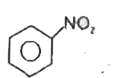
To determine which compound is most reactive towards electrophilic aromatic substitution for halogen, we need to analyze the substituents on the aromatic rings in the given options. The reactivity towards electrophilic aromatic substitution is influenced by whether the substituents are electron-donating or electron-withdrawing. ### Step-by-Step Solution: 1. **Identify the Nature of Substituents**: - For electrophilic aromatic substitution, we need to identify whether the substituents on the aromatic ring are electron-donating groups (EDGs) or electron-withdrawing groups (EWGs). - EDGs increase the electron density of the aromatic ring, making it more reactive towards electrophiles, while EWGs decrease the electron density, making it less reactive. 2. **Analyze Each Option**: - **Option A: Toluene (C6H5-CH3)**: The methyl group (–CH3) is an electron-donating group through hyperconjugation and inductive effect (+I). This increases the electron density on the benzene ring, making it more reactive. - **Option B: Nitrobenzene (C6H5-NO2)**: The nitro group (–NO2) is a strong electron-withdrawing group (-I and -R). This decreases the electron density on the benzene ring, making it less reactive. - **Option C: Ethylbenzene (C6H5-C2H5)**: The ethyl group (–C2H5) is also an electron-donating group (+I and +H), similar to toluene, but it has fewer alpha hydrogens compared to toluene. - **Option D: Chlorobenzene (C6H5-Cl)**: The chlorine atom (–Cl) has both -I (inductive effect) and +R (resonance effect) properties, but the -I effect is stronger, making it an electron-withdrawing group overall. 3. **Compare the Electron Density**: - Toluene has the highest electron density due to the presence of three alpha hydrogens contributing to hyperconjugation. - Ethylbenzene has two alpha hydrogens, which means it has less hyperconjugation compared to toluene. - Nitrobenzene and chlorobenzene are less reactive due to their electron-withdrawing groups. 4. **Conclusion**: - Among the options, toluene (Option A) is the most reactive towards electrophilic aromatic substitution because it has the highest electron density due to the electron-donating effect of the methyl group. ### Final Answer: **Option A: Toluene (C6H5-CH3)** is the most reactive towards electrophilic aromatic substitution for halogen.
Promotional Banner

Topper's Solved these Questions

  • HALOALKANES AND HALOARENES

    AAKASH INSTITUTE ENGLISH|Exercise ASSIGNMENT SECTON - A|45 Videos
  • HALOALKANES AND HALOARENES

    AAKASH INSTITUTE ENGLISH|Exercise ASSIGNMENT SECTION - B|25 Videos
  • HALOALKANES AND HALOARENES

    AAKASH INSTITUTE ENGLISH|Exercise Try Yourself|40 Videos
  • GENERAL PRINCIPLES AND PROCESSES OF ISOLATION OF ELEMENTS

    AAKASH INSTITUTE ENGLISH|Exercise Try Yourself|33 Videos
  • HYDROCARBONS

    AAKASH INSTITUTE ENGLISH|Exercise Assignment(Section - C) (Previous Years Questions)|60 Videos

Similar Questions

Explore conceptually related problems

Which one of the following is most reactive towards electrophilic attack?

Which one of the following is most reactive towards electrophillic reagent?

Which of the following compounds is most reactive in electrophilic aromatic substitution?

Which of the following is the most reactive towards electrophilic substitution?

Which one of the following is most reactive towards water?

Which of the following is the most reactive towards nucleophilic substitution reaction?

Which of the following is most reactive towards aqueous NaOH?

Which of the following is most reactive towards nucleophilic substritution reaction?

How many of the following are activated towards electrophilic aromatic substitution reactions?

AAKASH INSTITUTE ENGLISH-HALOALKANES AND HALOARENES -EXERCISE
  1. Which of the following will react most readily with HI ?

    Text Solution

    |

  2. The isomer of C(6)H(14) which will give maximum number of monochlorode...

    Text Solution

    |

  3. Which of the following is most reactive towards electrophillic aromat...

    Text Solution

    |

  4. Amongst the C-X bond the correct bond energy order is

    Text Solution

    |

  5. Which of the following has highest boilling point ?

    Text Solution

    |

  6. Out of the following compounds which one will have zero dipole moment ...

    Text Solution

    |

  7. Treatment of ammonia with excess of ethyl chloride will yield

    Text Solution

    |

  8. Identity Z in the following sequence

    Text Solution

    |

  9. Most reactive halide towards S(N^(1)) reactions is

    Text Solution

    |

  10. Which of the following is the most reactive towards nucleophilic subst...

    Text Solution

    |

  11. NBS is a specific reagent for

    Text Solution

    |

  12. For the reaction C(2)H(5) OH + HX to C2 H(5) X + H(2)O , the order of ...

    Text Solution

    |

  13. Which of the following is not true for S(N^(1)) reaction ?

    Text Solution

    |

  14. 2-Chloro-2-methylpropane on reaction with alc. KOH gives X as the prod...

    Text Solution

    |

  15. Which of the following does not form Grignard reagent on reaction with...

    Text Solution

    |

  16. 1-phenyl-2-chloropropane on treating with alc. KOH gives mainly

    Text Solution

    |

  17. An alkyl halide on reaction with sodium in the presence of ether gives...

    Text Solution

    |

  18. Ethyl bromide reacts with lead sodium alloy to form:

    Text Solution

    |

  19. Allybromide on dehydrobromination gives

    Text Solution

    |

  20. Identify the major product

    Text Solution

    |
