Home
Class 12
CHEMISTRY
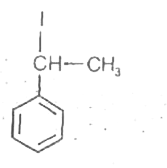
Which of the following does not give yel...

Which of the following does not give yellow precipitate with `"AgNO"_(3)` ?

A

`(CH_(3))_(3) C - CH_(2)` - l

B

`CH_(2) = CH - CH_(2)` - l

C

`CH_(2) = underset(I)underset(|)(C ) - CH_(3)`

D

Text Solution

AI Generated Solution

The correct Answer is:

To determine which of the following compounds does not give a yellow precipitate with AgNO₃, we need to analyze the behavior of different types of haloalkanes when they react with silver nitrate. The yellow precipitate is primarily due to the formation of silver iodide (AgI). ### Step-by-Step Solution: 1. **Understanding the Reaction**: The general reaction of haloalkanes (specifically iodides) with silver nitrate can be represented as: \[ R-I + AgNO_3 \rightarrow R-ONO_2 + AgI \downarrow \] Here, \(AgI\) is the yellow precipitate formed. 2. **Identifying the Types of Haloalkanes**: We need to consider the types of haloalkanes given in the options. Alkyl iodides generally react to form yellow precipitate, while certain structures like vinyl iodides and phenyl iodides do not. 3. **Analyzing Each Option**: - **Option 1: CH₃(CH₂)₃I (Alkyl Iodide)**: This is a primary alkyl iodide. It will react with AgNO₃ to form a yellow precipitate of AgI. Thus, this option does give a yellow precipitate. - **Option 2: CH₂=CH-CH₂I (Allyl Iodide)**: This is an allyl iodide. It will also react with AgNO₃ to give a yellow precipitate of AgI. Thus, this option also gives a yellow precipitate. - **Option 3: CH₂=CH-CH₂Cl (Vinyl Iodide)**: This compound has a strong C-I bond due to the conjugative effect. It does not readily react with AgNO₃ to form AgI, hence it does not give a yellow precipitate. This is the correct answer. - **Option 4: CHI (Benzyl Iodide)**: This is a benzyl iodide. It will react with AgNO₃ to form a yellow precipitate of AgI. Thus, this option also gives a yellow precipitate. 4. **Conclusion**: The compound that does not give a yellow precipitate with AgNO₃ is **Option 3: CH₂=CH-CH₂Cl (Vinyl Iodide)**. ### Final Answer: **Option 3: CH₂=CH-CH₂Cl (Vinyl Iodide)** does not give a yellow precipitate with AgNO₃.
Promotional Banner

Topper's Solved these Questions

  • HALOALKANES AND HALOARENES

    AAKASH INSTITUTE ENGLISH|Exercise ASSIGNMENT SECTION - C|39 Videos
  • HALOALKANES AND HALOARENES

    AAKASH INSTITUTE ENGLISH|Exercise ASSIGNMENT SECTION -D|15 Videos
  • HALOALKANES AND HALOARENES

    AAKASH INSTITUTE ENGLISH|Exercise ASSIGNMENT SECTON - A|45 Videos
  • GENERAL PRINCIPLES AND PROCESSES OF ISOLATION OF ELEMENTS

    AAKASH INSTITUTE ENGLISH|Exercise Try Yourself|33 Videos
  • HYDROCARBONS

    AAKASH INSTITUTE ENGLISH|Exercise Assignment(Section - C) (Previous Years Questions)|60 Videos

Similar Questions

Explore conceptually related problems

Which of the following does not give a precipitate with alcoholic AgNO_(3) ?

Which of the following gives yellow precipitate with NaOI ?

Which of the following ketone will not give yellow precipitate with NaOH//I_(2) ?

Which one of the following is likely to give a precipitate with AgNO_(3) solution ?

Which one of the following is likely to give a precipitate with AgNO_(3) solution ?

Which of the following cation does not give precipitate with H_(2)S in neutral medium?

Which of the following compounds will produce a precipitate with AgNO_(3) ?

Which of the following salt does not give any ppt with AgNO_(3) sol. :

Which one of the following gives white precipitate with AgNO_(3) ?

Which of the following compound will give curdy precipiate with AgNO_(3) solution:

AAKASH INSTITUTE ENGLISH-HALOALKANES AND HALOARENES -ASSIGNMENT SECTION - B
  1. Which one of the following is a free-radical substitution reaction :

    Text Solution

    |

  2. Which of the following compounds undergoes mucleophilic substitution r...

    Text Solution

    |

  3. Assertion: Replacement fo -Cl group by -OH in chlorobenzene is easier ...

    Text Solution

    |

  4. Chloropicrin is obtained by the reaction of

    Text Solution

    |

  5. The reaction of toluene with CI(2) in presence of FeCI(3) gives X and ...

    Text Solution

    |

  6. What is B ?

    Text Solution

    |

  7. Ethylidene chloride on treatement with aq. KOH gives

    Text Solution

    |

  8. The correct order of reactivity of the following compounds towards aqu...

    Text Solution

    |

  9. Which among the following is the correct order of melting point ?

    Text Solution

    |

  10. For which of the following G, above reaction will be the fastest ?

    Text Solution

    |

  11. Which of the following is least reactive towards nucleophilic substitu...

    Text Solution

    |

  12. Among the following The correct order of reactivity towards ArS...

    Text Solution

    |

  13. Which of the following does not give yellow precipitate with "AgNO"(3)...

    Text Solution

    |

  14. What is C ?

    Text Solution

    |

  15. The product (C ) is

    Text Solution

    |

  16. In the given reaction The product will be

    Text Solution

    |

  17. udner identical conditions, solvolysis of which of the following subst...

    Text Solution

    |

  18. The correct order of reactivity towards S(N)1 reaction is

    Text Solution

    |

  19. When cis-but-2-ene is treated with Br(2) in "CCl"(4) medium the produc...

    Text Solution

    |

  20. CH3-Cl+NaI overset("Acetone")iff CH3-I+NACl Above equilibrium is mor...

    Text Solution

    |
