Home
Class 12
PHYSICS
You are given two concentric charged con...

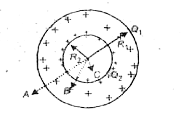
You are given two concentric charged conducting spheres of radii `R_(1) and R_(2)` such that `R_(1) gt R_(2) , ` having charges `Q_(1) and Q_(2)` respectively and uniformly distributed over its surface. Calculate E and V at three points A, B , C whose distances from the centre are `r_(A), r_(B) and r_(c)` respectively as shown in figure.

Text Solution

Verified by Experts

At point A , the point A is outside both the spheres so for the purpose of calculation of E and V we have to consider both `Q_(1) and Q_(2)` to be concentrated at the centre.
So, E ` ((Q_(1) + Q_(2)))/(4 pi epsilon_(0).r_(A)^(2)) and V = ((Q_(1) + Q_(2)))/(4 pi epsilon_(0).r_(A))`
At point B : For electric field calculation note that the point B is inside the outer sphere so there will be no contribution of `Q_(1)` in the electric field at B. But for `Q_(2)` charges, the point B is outside so we have t assume `Q_(2)` to be at the centre and distance of B will be taken to be `r_(B)`
So, `e at B = (Q_(2))/(4 pi epsilon_(0)r_(B)^(2))`
Now, for potential, remember that a single charge will never give zero contribution to potential at finite pionts.
So `Q_(1)` as well as `Q_(2)` will contribute to potential at B. Noe talk about the contribution of `Q_(1)` at point B you can see that the point B is inside the large sphere of `Q_(1) `so `Q_(1)` will offer its surface potential `(Q_(1))/(4 pi epsilon_(0)R_(1)` at all its inside points. but what about the potential contribution of `Q_(2)` at point B! for `Q_(2)` the point B is outside the sphere so, we'll assume as if `Q_(2)` is concentrated at the centre and the distance taken will be `r_(B)`. so the contribution of `Q_(2)` in potential will be `(Q_(2))/(4 pi epsilon_(0)r_(B))`
Hence the total potential at B = `(Q_(1))/(4 pi epsilon_(0)R_(1)) + (Q_(2))/(4 pi epsilon_(0)r_(B))`
At point C :
For electric field note that to both `Q_(1) and Q_(2)` . the point c is inside. So, the net contribution in the electric field will be zero, i.e E at C = zero. infact, at all the point inside the smaller sphere, the electric field will be zero,
whate about potential at C! For both the spheres the point C is inside so both `Q_(1) and Q_(2)` will offer
their respective surface potential. since surface potential of `Q_(1)` is `(Q_(1))/(4 pi epsilon_(0)R_(1))` and that of `Q_(2)` is `(Q_(2))/(4 pi epsilon_(0)R_(2))` , hence the potential at C will be `(Q_(1))/(4 pi epsilon_(0)R_(1)) + (Q_(2))/(4 pi epsilon_(0)R_(2))`
In fact at all the points inside the inner sphere the potential will be constant and will be equal to the potential at C.
Promotional Banner

Topper's Solved these Questions

  • ELECTROSTATIC POTENTIAL AND CAPACITANCE

    AAKASH INSTITUTE ENGLISH|Exercise EXERCISE|20 Videos
  • ELECTROSTATIC POTENTIAL AND CAPACITANCE

    AAKASH INSTITUTE ENGLISH|Exercise ASSIGNMENT SECTION - A|44 Videos
  • ELECTROSTATIC POTENTIAL AND CAPACITANCE

    AAKASH INSTITUTE ENGLISH|Exercise SECTION-J Aakash Challengers Questions|5 Videos
  • ELECTROMAGNETIC WAVES

    AAKASH INSTITUTE ENGLISH|Exercise ASSIGNMENT SECTION - D Assertion-Reason Type Questions|25 Videos
  • GRAVITATION

    AAKASH INSTITUTE ENGLISH|Exercise ASSIGNMENT SECTION - D (ASSERTION-REASON TYPE QUESTIONS)|15 Videos

Similar Questions

Explore conceptually related problems

The insulated spheres of radii R_(1) and R_(2) having charges Q_(1) and Q_(2) respectively are connected to each other. There is

The insulated spheres of radii R_(1) and R_(2) having charges Q_(1) and Q_(2) respectively are connected to each other. There is

The capacitance of two concentric spherical shells of radii R_(1) and R_(2) (R_(2) gt R_(1)) is

Two concentric spherical shells of radius R_(1) and R_(2) (R_(2) gt R_(1)) are having uniformly distributed charges Q_(1) and Q_(2) respectively. Find out total energy of the system.

Two concentric, thin metallic spheres of radii R_(1) and R_(2) (R_(1) gt R_(2)) charges Q_(1) and Q_(2) respectively Then the potential at radius r between R_(1) and R_(2) will be (k = 1//4pi in)

Figure shows two concentric conducting shells of radii r_(1) and r_(2) carrying uniformly distributed charges q_(1) and q_(2) , respectively. Find an expression for the potential of each shell. .

Find force acting between two shells of radius R_(1) and R_(2) which have uniformly distributed charges Q_(1) and Q_(2) respectively and distance between their centres is r.

A charge Q has been divided on two concentirc conducting spheres of radii R_(1) and R_(2) (R_(1) gt R_(2)) such that the surface charge densities on both the sphere is same. Find the potential at their common center.

Two non-conduction hollow uniformly charged spheres of radil R_(1) and R_(2) with charge Q_(1) and Q_(2) respectively are places at a distance r. Find out total energy of the system.

Two concentric conducting shells of radii R and 2R are having charges Q and -2Q respectively.In a region r

AAKASH INSTITUTE ENGLISH-ELECTROSTATIC POTENTIAL AND CAPACITANCE -EXAMPLE
  1. An uncharged metal sphere suspended by a silk thread is placed in a u...

    Text Solution

    |

  2. A charge is placed on an insulated conductor in the form of a perfect ...

    Text Solution

    |

  3. You are given two concentric charged conducting spheres of radii R(1) ...

    Text Solution

    |

  4. A charge Q has been divided on two concentirc conducting spheres of ra...

    Text Solution

    |

  5. Charge on the outer sphere is q, and the inner sphere is grounded. The...

    Text Solution

    |

  6. A sphere of 4 cm radius is suspended with in a hollow sphere of 6 cm r...

    Text Solution

    |

  7. Consider Two metallic charged sphere whose radii are 20 cm and 10 cm r...

    Text Solution

    |

  8. A capacitor of 0.75 muF is charged to a voltage of 16 V. What is the m...

    Text Solution

    |

  9. A parallel plate capacitor is constructed with plates of area 0.0280 m...

    Text Solution

    |

  10. The plates of a parallel plate capacitance 1.0 F are separated by a di...

    Text Solution

    |

  11. The capacitance of earth, treating it as a spherical conductor of radi...

    Text Solution

    |

  12. A parallel -plate capacitor is connected to a battery that maintains a...

    Text Solution

    |

  13. In the arrangement shown find the equivalent capacitance between A an...

    Text Solution

    |

  14. (i) Find the equivalent capacitance of the combination shown in the fi...

    Text Solution

    |

  15. Find the equivalent capacitance of the combination between A and B in ...

    Text Solution

    |

  16. The arrangement shows a part of complete circuit. The potentials at po...

    Text Solution

    |

  17. For the following arrangement, find the equivalent capacitance between...

    Text Solution

    |

  18. Find the equivalent capacitance of each of the two combinations betwee...

    Text Solution

    |

  19. (a) Find the equivalent capacitance of the combination between A and ...

    Text Solution

    |

  20. Figure shows a combination of twelve capacitors, each pf capacitance C...

    Text Solution

    |
