Home
Class 12
CHEMISTRY
In the reaction with HCl, an alkene reac...

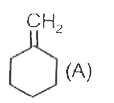
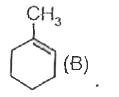
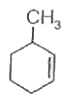
In the reaction with HCl, an alkene reacts in accordance with Markownikoff's rule to give a product 1-chloro-1-methylcyclohexane. The possible alkene is:

A

B

C

(A) and (B)

D

Text Solution

AI Generated Solution

The correct Answer is:

To solve the problem, we need to identify the alkene that reacts with HCl to produce 1-chloro-1-methylcyclohexane according to Markovnikov's rule. Let's break down the steps: ### Step 1: Understand Markovnikov's Rule Markovnikov's rule states that when HX (where X is a halogen) is added to an alkene, the hydrogen atom (H) will attach to the carbon with the greater number of hydrogen atoms, while the halogen (X) will attach to the carbon with fewer hydrogen atoms. This leads to the formation of the more stable carbocation intermediate. ### Step 2: Analyze the Product The product we are looking for is 1-chloro-1-methylcyclohexane. This indicates that: - The chlorine atom is attached to the first carbon of the cyclohexane ring. - A methyl group is also attached to the same carbon (C1). ### Step 3: Identify Possible Alkenes We need to consider alkenes that could lead to this product upon reaction with HCl. The alkene should have a double bond that allows for the formation of a stable carbocation. ### Step 4: Evaluate Each Option 1. **Option A**: Check the structure of the alkene. When HCl reacts, H will add to the carbon with more hydrogens, leading to a stable carbocation. The chlorine will then attach to the carbon with fewer hydrogens. 2. **Option B**: Similar to option A, analyze the structure. Determine where H will add and where the carbocation will form. If it leads to the desired product, it is a valid option. 3. **Option C**: Check if the structure can lead to the formation of the desired product. Consider the stability of the carbocation formed and whether the chlorine will attach to the correct carbon. 4. **Option D**: If applicable, analyze this option as well. ### Step 5: Conclusion After evaluating the options, we find that both option A and option B lead to the formation of 1-chloro-1-methylcyclohexane. Therefore, the possible alkene(s) that can react with HCl to yield the desired product are found in these options. ### Final Answer The possible alkene is **Option A and Option B**. ---
Promotional Banner

Topper's Solved these Questions

  • HYDROCARBONS

    AAKASH INSTITUTE ENGLISH|Exercise Assignment(Section - B) (Obejctive type question)|5 Videos
  • HALOALKANES AND HALOARENES

    AAKASH INSTITUTE ENGLISH|Exercise ASSIGNMENT SECTION -D|15 Videos
  • HYDROGEN

    AAKASH INSTITUTE ENGLISH|Exercise ASSIGNMENT (SECTION - D) (Assertion-Reason Type question)|15 Videos

Similar Questions

Explore conceptually related problems

In the reaction with HCl , an alkene reacts in accordance with the Markovnikov's rule to give a product 1-chloro,1-methylcyclohexane. The possible alkene is

Which of the following alkenes will give anti-markownikoff's product as major product.

Which of the following alkenes will give anti-markownikoff's product as major product.

which alkene does not follow Anti-Markownikoff's addition rule

The reaction of vinyl chloride with hydrogen iodide to give 1-chloro-1-iodoethane is an example of anti-Markownikoff's rule.

Consider the following reaction. (1R,3S)-cis-Bromo-3-methylcyclohexane The product formed in the reaction is

In the presence of peroxide addition of HBr to propene takes place according to anti Markownikoff's rule but peroxide effect is not seen in the case of HCl and HI. Explain.

Name of the alkene which will yield 1-chloro-1-methylcyclohexane by its reaction with HCl. Write the reaction involved.

Which alkene upon reductive ozonolysis will give acetone as the product?

AAKASH INSTITUTE ENGLISH-HYDROCARBONS-Assignment(Section - C) (Previous Years Questions)
  1. In the reactions HC-=CHoverset((1)NaNH(2) // liq. NH(3))underset((2)CH...

    Text Solution

    |

  2. Consider the nitration of benzene using mixed conc. H(2)SO(4) and HNO(...

    Text Solution

    |

  3. In the reaction with HCl, an alkene reacts in accordance with Markowni...

    Text Solution

    |

  4. The reaction of C(6) H(5) CH=CHCH(3) with HBr produces :

    Text Solution

    |

  5. Which of the following organic compounds has same hybridisation as its...

    Text Solution

    |

  6. Which of the following reagents will be able to distinguish between 1-...

    Text Solution

    |

  7. Liquid hydrocarbon is converted to a mixture of gaseous hydrocarbons b...

    Text Solution

    |

  8. The reaction of toluene with CI(2) in presence of FeCI(3) gives X and ...

    Text Solution

    |

  9. In the following the most stable conformation of n-butane is

    Text Solution

    |

  10. Benzene reacts with CH(3)Cl in the presence of anhydrous AlCl(3) to ...

    Text Solution

    |

  11. Nitrobenzene can be prepared from benzene by using a mixture of conc....

    Text Solution

    |

  12. How many stereoisomers does this molecule have ? CH(3)CH=CHCH(2)CHBr...

    Text Solution

    |

  13. The order decreasing reactivity towards an electrophilic reagent, for ...

    Text Solution

    |

  14. Predict the product C obtained in the following reaction of butyne-1: ...

    Text Solution

    |

  15. Which one of the following alkenes will react faster with H(2) under ...

    Text Solution

    |

  16. Which is maximum stable ?

    Text Solution

    |

  17. Geometrical isomers differ in:

    Text Solution

    |

  18. The correct order of reactivity towards the electrophilic substitiutio...

    Text Solution

    |

  19. The reactive species in the nitration of benzene is

    Text Solution

    |

  20. CH(3)-underset(CH(3))underset(|)(C)H-CH=CH(2)+HBr rarr (product) which...

    Text Solution

    |
