Home
Class 11
BIOLOGY
Starch, Cellulose, Glycogen, Chitin are ...

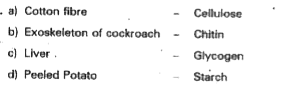
Starch, Cellulose, Glycogen, Chitin are polysaccharides found among the following. Choose the one appropriate and write against each.
a) Cotton fibre - b) Exoskeleton of cockroach _ c) Liver _ d) Peeled potato –

Text Solution

Verified by Experts
Promotional Banner

Topper's Solved these Questions

  • BIMOLECULES

    VIKRAM PUBLICATION ( ANDHRA PUBLICATION)|Exercise SHORT ANSWER TYPE QUESTIONS |11 Videos
  • BIMOLECULES

    VIKRAM PUBLICATION ( ANDHRA PUBLICATION)|Exercise IMPORTANT QUESTIONS|4 Videos
  • ANIMAL DIVERSITY - II (CHORDATES)

    VIKRAM PUBLICATION ( ANDHRA PUBLICATION)|Exercise IMPORTANT QUESTIONS |23 Videos
  • BIOLOGICAL CLASSIFICATION

    VIKRAM PUBLICATION ( ANDHRA PUBLICATION)|Exercise IMPORTANT QUESTIONS|7 Videos

Similar Questions

Explore conceptually related problems

Select an appropriate chemical bond among ester bond, glycosidic bond, peptide bond and hydrogen bond and write against each of the following. a) Polysaccharide_ b) Protein__ c) Fat_ d) Water_

Medicines are either man made (i.e., synthetic) or obtained from living organisms like plants, bacteria, animals etc. and hence the latter are called 'natural products. Sometimes natural products are chemically altered by man to reduce toxicity or side effects. Write against each of the following whether they were initially obtained as a natural product or as a synthetic chemical. a) Penicillin_ b) Sulfonamide_ c) Vitamin C __. d) Growth Hormone ___

Carry out the following osmosis experiment: Take four peeled potato halves and scoop each one out to make potato cups. One of these potato cups should be made from a boiled potato. Put each potato cup in a trough containing water. Now, Keep cup A empty. Put one teaspoon sugar in cup B. Put one teaspoon salt in cup C. Put one teaspoon sugar in the boiled potato cup D. Keep these for two hours. Then observe the four potato cups and answer the following: Explain why water does not gather in the hollowed out portions of A and D.

Carry out the following osmosis experiment: Take four peeled potato halves and scoop each one out to make potato cups. One of these potato cups should be made from a boiled potato. Put each potato cup in a trough containing water. Now, Keep cup A empty. Put one teaspoon sugar in cup B. Put one teaspoon salt in cup C. Put one teaspoon sugar in the boiled potato cup D. Keep these for two hours. Then observe the four potato cups and answer the following: Explain why water gathers in the hollowed portion of B and C.

Carry out the following osmosis experiment: Take four peeled potato halves and scoop each one out to make potato cups. One of these potato cups should be made from a boiled potato. Put each potato cup in a trough containing water. Now, Keep cup A empty. Put one teaspoon sugar in cup B. Put one teaspoon salt in cup C. Put one teaspoon sugar in the boiled potato cup D. Keep these for two hours. Then observe the four potato cups and answer the following: Why is potato A necessary for this experiment?

Match the following terms in Column-I with their descriptions by writing the appropriate letters from Column-II. Column-I A) A molecule used to carry foreign B) A rapid way to amplify DNA C) A way to separate DNA fragments D) Molecular scissors E) A gene sequence from more than one origin Column - II I) Restriction enzymes genes into bacteria II) Recombinant DNA in the laboratory III) PCR based on their size IV) Vector V) Gel electrophoresis

