Home
Class 12
BIOLOGY
Even though a very few cells in a C(4) ...

Even though a very few cells in a `C_(4)` plant carry out the biosynthetic – Calvin pathway, yet they are highly productive. Can you discuss why?

Text Solution

Verified by Experts
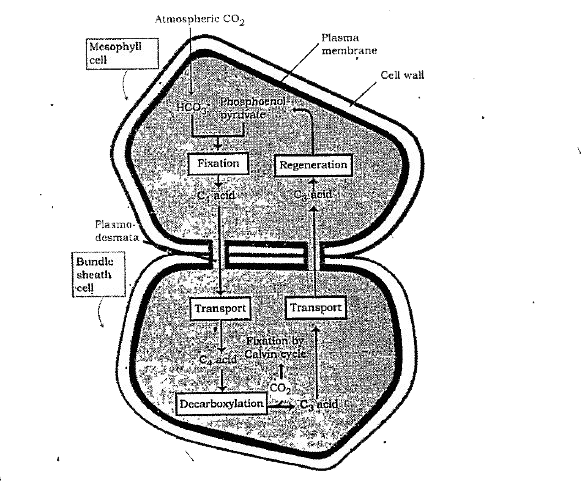
H.P. Kortschak and C.E Hartt found that in sugarcane the first products of photosynthesis were acids containing 4 - c atoms, rather than the 3c - acid. The same has been found true for many tropical plants. Ex : Maize, Elensine, Sorghum, Amaranthus & Euphorbia etc. These plants are called `C_(4)` plants. Hatch and Slack explained the manner of `CO_(2)` fixation and reduction in such plants.
The leaves of `C_(4)` plants show Kranz anatomy, means `wreath. there vascular bundles are surrounded by two rings of cells. (i) Bundle sheath cells (ii) Mesophyll cells.
1. In `C_(4)` - pathway, the primary acceptor of `CO_(2)` is phosphoenol pyruvic acid (PEP) and which is converted into oxaloacetate in the presence of enzyme PEP carboxylase.
2. The oxaloacetate is converted into malate or aspartate depending upon the species.
3. The malate formed in mesophyll cells is transferred to the neighbour bundle sheath cells via plasmodesmata between these cells.
4. In the bundle sheath cell the malate is now decarboxylated producing pyruvate and `CO_(2)` by action of NADP specific malic enzyme.
5. In the bundle sheath cells the `CO_(2)` arising from the decarboxylation of malate is now fixed again in exactly the same calvin pathway of `C_(3)` plants.
6. Sucrose & starch are ultemately formed from 3 PGA in bundle sheath cells.
7. The pyruvate formed by decarboxylation of malate in the bundle sheath is transported bock to the mesophyll cells where it is converted into phosphoenol pyruvate by the action of enzyme pyruvate phosphate dikinase.
Promotional Banner

Topper's Solved these Questions

  • PHOTOSYNTHESIS IN HIGHER PLANTS

    VIKRAM PUBLICATION ( ANDHRA PUBLICATION)|Exercise LONG ANSWER QUESTIONS |2 Videos
  • PHOTOSYNTHESIS IN HIGHER PLANTS

    VIKRAM PUBLICATION ( ANDHRA PUBLICATION)|Exercise IMPORTANT QUESTIONS |6 Videos
  • PHOTOSYNTHESIS IN HIGHER PLANTS

    VIKRAM PUBLICATION ( ANDHRA PUBLICATION)|Exercise EXERCISES |18 Videos
  • ORGANIC EVOLUTION

    VIKRAM PUBLICATION ( ANDHRA PUBLICATION)|Exercise SHORT ANSWER QUESTIONS |7 Videos
  • PLANT GROWTH AND DEVELOPMENT

    VIKRAM PUBLICATION ( ANDHRA PUBLICATION)|Exercise EXERCISES |13 Videos

Similar Questions

Explore conceptually related problems

By looking at a plant externally can you tell whether a plant is C_(3) or C_(4) ? Why and how?

Olefins can be halogenated in the allylic position by number of reagents of which N-bromo succinimide (NBS) is the most common. When this reagent is used the reaction is known as WohlZiegler bromination. Other N-bromoamides have also been used. To a much lesser extent allylic chlorination has been carried out with N-chloro-succinimide. N-Chloro-N-cyclohexyl benzene sulphonamide or t-hypochlorite when the allylic radical intermediate is unsymmetrical allylic rearrangement takes place so that the mixture of both possible products is obtained. CH_3 - CH_2 -CH = CH_2underset(hv)overset(NBS)(to) CH_3 - CH = CH - CH_2 - Br + CH_3 - undersetoverset(|)(Br)(C ) - CH = CH_2 NBS is also a highly regioselective brominating agent at other positions, including positions a to a carbonyl group.

Olefins can be halogenated in the allylic position by number of reagents of which N-bromo succinimide (NBS) is the most common. When this reagent is used the reaction is known as WohlZiegler bromination. Other N-bromoamides have also been used. To a much lesser extent allylic chlorination has been carried out with N-chloro-succinimide. N-Chloro-N-cyclohexyl benzene sulphonamide or t-hypochlorite when the allylic radical intermediate is unsymmetrical allylic rearrangement takes place so that the mixture of both possible products is obtained. CH_3 - CH_2 -CH = CH_2underset(hv)overset(NBS)(to) CH_3 - CH = CH - CH_2 - Br + CH_3 - undersetoverset(|)(Br)(C ) - CH = CH_2 NBS is also a highly regioselective brominating agent at other positions, including positions a to a carbonyl group.

Olefins can be halogenated in the allylic position by number of reagents of which N-bromo succinimide (NBS) is the most common. When this reagent is used the reaction is known as WohlZiegler bromination. Other N-bromoamides have also been used. To a much lesser extent allylic chlorination has been carried out with N-chloro-succinimide. N-Chloro-N-cyclohexyl benzene sulphonamide or t-hypochlorite when the allylic radical intermediate is unsymmetrical allylic rearrangement takes place so that the mixture of both possible products is obtained. CH_3 - CH_2 -CH = CH_2underset(hv)overset(NBS)(to) CH_3 - CH = CH - CH_2 - Br + CH_3 - undersetoverset(|)(Br)(C ) - CH = CH_2 NBS is also a highly regioselective brominating agent at other positions, including positions a to a carbonyl group. Which of the following is allylic chlorinating agent ?

RUB is CO is an enzyme that acts as both as a carboxylase and oxygenase. Why do you think RUB is CO carries out more carboxylation in C_(4) plants ?

